
America's 10 Geysers That Are Best-Kept Secrets From Tourists
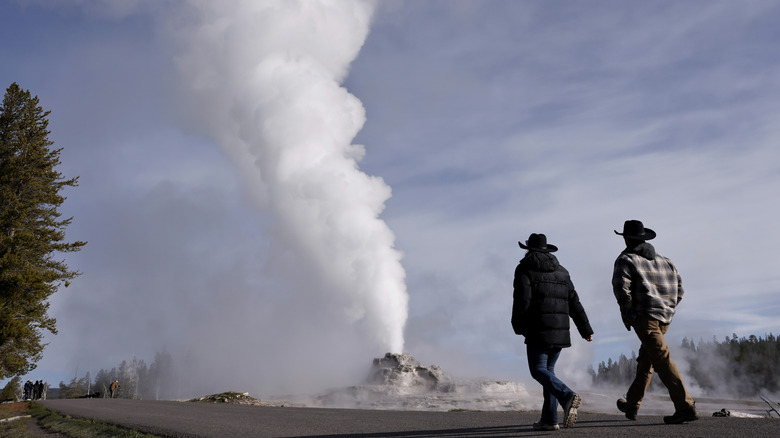
Yellowstone National Park is America's most famous and most active geothermal landscape. With stunning natural beauty, it is known to the world for many a marquee attraction, some with their predictable bursts, others with jaw-dropping overlooks, crowds, and the incessant documenting of it all. The park boasts more than 500 geysers — over half of all active geysers on Earth — but beyond its "faithful" spectacles lies another side of Yellowstone, one that's sometimes marked by remote trails, little-known spouters, and geothermal wonders that few visitors encounter.
While some of these may demand day-long hikes or overnight camping, others are easily missed, despite being surprisingly accessible, sitting not too far from their starry neighbors. Moreover, these bubbling and spouting wonders don't end at Yellowstone's border. In the American West, there are geysers that bubble and erupt far from the country's geothermal hotspots, not always finding a place on visitors' itineraries.
For this list, we stuck to natural geysers only, though there are a handful of man-made geysers — such as Oregon's Old Perpetual or Nevada's Fly Geyser — scattered across the country. To find them, we looked beyond official park literature; we sifted through "geyser gazer" threads on Reddit and Facebook and browsed Tripadvisor, specialist blogs, and other travel coverage. Beyond obscurity, we also looked for geysers with distinct eruption patterns, stunning settings, or intriguing backstories, ensuring that each of these geysers justifies the journey. And yes, most of them are in Yellowstone National Park, but there are others outside the park that are worth the trip.
Shoshone Geyser Basin, Yellowstone National Park
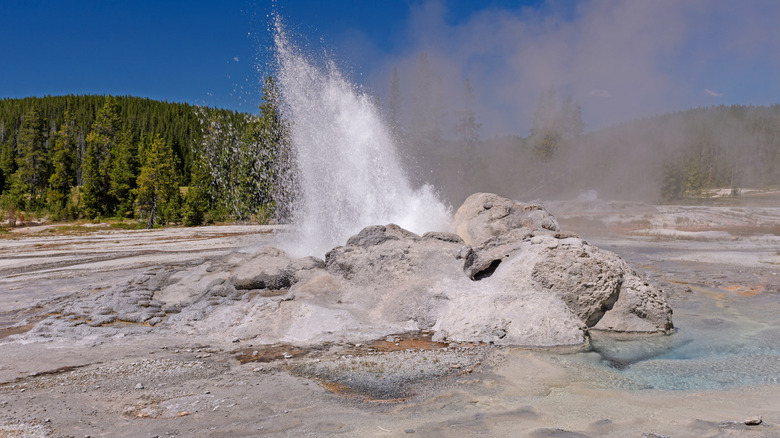
Hidden in the wilderness of Yellowstone Backcountry are some of the world's most spectacular geothermal features, and the Shoshone Geyser is its crown jewel. Sitting on the edge of Shoshone Lake, in this part of Yellowstone National Park, there are no boardwalks, vehicles, or crowds. For the few who actually take on the 8.5-mile one-way hike to the largest backcountry geyser basin in the park, or canoe or kayak their way across Lewis or Shoshone Lake, it's well worth the trip. According to National Park Service estimates, there are over 80 geysers packed into an area of 1,600 by 800 feet, making this one of the world's most concentrated geyser fields. However, its remote, off-the-grid location means Shoshone sees far fewer visitors than its stature would warrant. A nearly 20-mile hike in a day is beyond doable for most people, leaving overnight camping as a more practical option — one that not many go for — explaining why it remains a best-kept secret.
The potent geyser basin here makes it imperative to stick to the trail, especially in the absence of safety rails or boardwalks to demarcate boundaries. Shoshone's star attraction is the Minute Man, named after its water jet eruptions that occur every few minutes across a span of two to four hours, before falling silent for roughly seven hours, only to repeat the cycle again. Robert Pahre, a professor at the University of Illinois, says in his blog that it "would be a crowd pleaser if there were any crowds here." Union Geyser, the basin's other claim to fame, has long periods of dormancy, having last spouted in 1977, but it remains Shoshone's potentially tallest spouter, with recorded heights over 100 feet.
Solitary Geyser, Yellowstone National Park
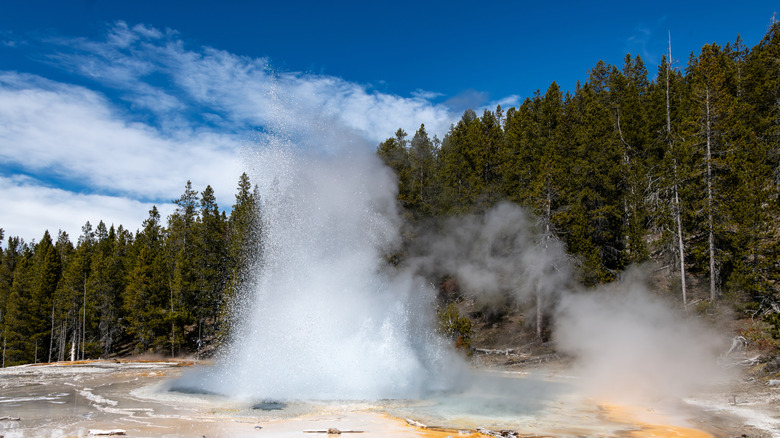
With an eruption cycle of four to eight minutes, Solitary Geyser is among the most frequently erupting geysers in Yellowstone. Adventurers deem it a worthy off-the-beaten-path find, one that lives up to its name, sitting a short hike away from the Old Faithful area. A clear blue pool ringed by a cream-colored sinter remains one of the lesser-known features of the Upper Geyser Basin, easy to miss unless one is there at the precise moment it bubbles up.
This geyser also has an unusual past; it wasn't always a geyser. It started off as a thermal feature that used to fill up a hot-water swimming pool, built for visitors in the Upper Geyser Basin, back in the late 19th century. In 1914, bathhouse operator Henry J. Brothers got permission to pipe its hot water for nearly half a mile to the bathhouse, and the diversion lowered the spring's water table enough to set off eruptions that haven't stopped since. The pool itself closed decades later, and the pipeline along with it, but Solitary never reverted to its old dormant state; it just kept going on its own, with an eruption cycle of five to 10 minutes, shooting an average of around three feet.
Its accidental origin story is part of what makes this one worth the detour. A geyser essentially created by a swimming pool, still erupting steadily a century after the pool disappeared, hiding on a quiet loop trail, minutes from one of the most photographed spots in the park.
Artemisia Geyser, Yellowstone National Park
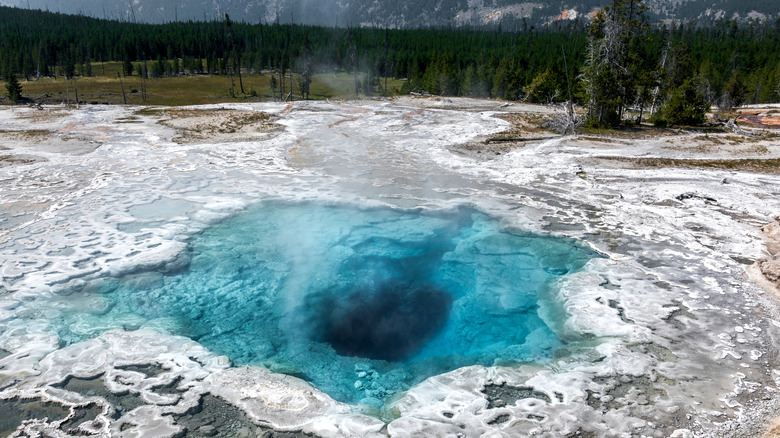
Yellowstone's Artemisia Geyser derives its name from the color of the mineral crust surrounding the pool, which resembles the dull green of the desert sagebrush. The crust builds outwards in shelf-like ledges, circling the main basin with its strikingly blue surface. It's also among the largest pools in the park, though footfalls don't seem to justify this distinction. Artemisia isn't known for a skyward column of water jet; instead, it's more of a rolling boil, wherein the entire surface of the electric blue pool heaves and churns, rather than shooting water up in the air. This phenomenon hinges on an unusually loose schedule, somewhere between 19 and 40 hours apart, making the sighting more of an accident than an intentional plan.
Getting there means leaving the main boardwalk loop for a dedicated side trail, dotted with several other Upper Geyser Basin geothermal features, en route to the most photographed Morning Glory Pool — Yellowstone's famous hot spring — before finally branching onto the Artemisia Trail itself. The trail from Morning Glory Pool to Biscuit Basin, passing Artemisia Geyser along the way, offers ample room for tranquility in the backdrop of striking views of meadows and ridges. The discreet location keeps the area almost devoid of human presence, with Artemisia being called the "real star" of this corner of the park by one Tripadvisor adventurer.
Norris Geyser Basin, Yellowstone National Park
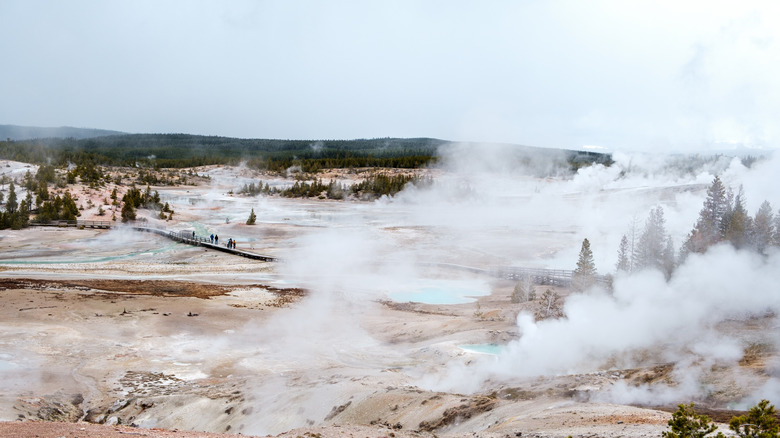
Those looking to hit the hottest and oldest thermal area of Yellowstone can end their search at the Norris Geyser Basin. This very volatile spot sits at the meeting point of two major faults that make it one of the park's most seismically active zones, one with its own loyal fan base. There's nearly no spot in the area that dips below boiling-point temperature, and most of the water here is acidic, including the formation of the exceptionally rare acid geysers, such as the Echinus Geyser, whose pH levels match that of vinegar. Scientists once drilled a hole here and hit 459 degrees Fahrenheit, just over 1,000 feet down, making it the highest subsurface temperature ever recorded in any Yellowstone thermal area.
The basin splits into two: Porcelain Basin and Back Basin. Porcelain Basin is stark and treeless, its white silica ground hissing and popping with vents like Whirligig Geyser, whose waters spill into runoff channels, streaked orange and green from minerals and algae. A lake called Crackling Lake, named after the sound of gas bubbles breaking at the surface, is also a point of interest here. In sharp contrast, Back Basin is a forested expanse, home to the Steamboat Geyser, the world's tallest geyser, clocking in at heights of over 300 feet.
The Norris Geyser Basin remains intriguing to geyser-heads because of its instability. Underneath its surface lies one of the most dynamic water chemistries known to man, with new hot springs and geysers sprouting and spouting every year, while others fall dormant. These are sometimes triggered by earthquakes that are too small to feel, yet strong enough to keep altering the geology, making it a head-scratcher for scientists still searching for a complete explanation.
Monument Geyser Basin, Yellowstone National Park
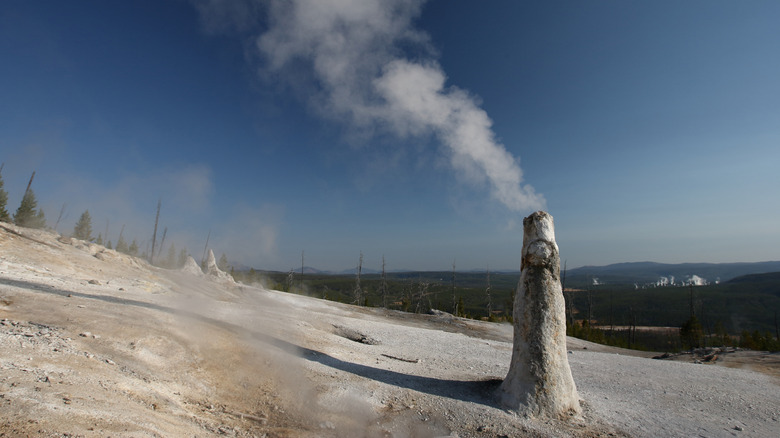
The Monument Geyser Basin makes you work for it. While the 2-mile round-trip hike feels short on paper, its 800-foot elevation can be a stretch for the lungs, which is why most Yellowstone visitors don't attempt it. However, the breathless trek has its rewards. At the end of the climb is a basin unlike any other in the park. The centerpiece of this basin is Monument Geyser itself, an 8-foot sinter cone nicknamed "Thermos Bottle Geyser" by a park ranger in the 1920s. It once shot water up to 15 feet in the air, but by the 1930s the eruptions had faded; today, it mostly hisses and steams as its own mineral buildup slowly seals it shut.
The basin is dotted with small hot springs and steam vents, along with boiling pools, mud pots, frying pans, and sulfur deposits. But what truly sets it apart are its roughly half a dozen sinter formations, several rising into unusual chimney- or spire-like structures. Standing up to 10 feet tall, these narrow formations give Monument Geyser Basin its name. Geologically, this basin is a rarity. According to the USGS, this is a vapor-dominated, acid-steam hydrothermal system, distinct from the water-driven geysers that define most of Yellowstone's famous basins.
With no boardwalks, boundaries, or crowds, this basin offers a glimpse of Yellowstone in its most natural state. As a visitor on Tripadvisor observed, it's a remarkable example of "99% of Yellowstone seen by only 1% of its visitors." It's not hard to see why. Far from the park's dramatic spectacles, this landscape feels quieter and stranger, best remembered for its eerie stone chimney-like structures, steadily emitting steam as hot as 700 degrees Fahrenheit, lending the basin an otherworldly stillness.
Lone Star Geyser, Yellowstone National Park
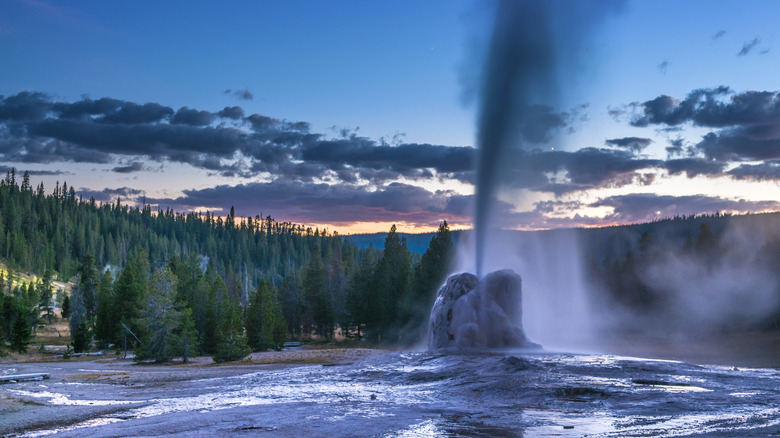
About 3.5 miles south of Old Faithful, along an old service road beside the Firehole River, sits the Lone Star Geyser. The Firehole River runs alongside the road before plunging into the gorge at the spectacular Kepler Cascades. The picturesque trail is also known for allowing visitors to avoid the crowds in Yellowstone National Park. A cone-type geyser, Lone Star is deemed one of the park's most consistently active and yet routinely overlooked geothermal features. Built from the remnants of silica sinter deposited over centuries into its distinctive 12-foot mound, it erupts on a strikingly steady three-to-four-hour interval, a pattern that hasn't wavered since at least the 1880s.
Each cycle builds gradually, with small preliminary bursts of water and steam appearing and growing before the main event, which reaches close to 50 feet and lasts roughly 30 minutes. This makes it even more consistent than Old Faithful's few minutes, even if not as tall as close to 180 feet. A logbook near the geyser lets hikers track past eruption times to estimate the next one, a small ritual of shared record-keeping unique to this spot. However, for those arriving in the early hours of the day, the schedule offers little help, so it's recommended to keep time in hand to linger around.
Lone Star Geyser can be reached by a round-trip walk or bike ride on a very flat 4.8-mile route. The final few hundred feet after the asphalt ends must be covered on foot. As one nears the geyser, they'll hear the small fumaroles hissing, releasing wisps of steam and hot gases. In between eruptions, the trees nearby provide shaded spots to sit and wait.
Lion Geyser, Yellowstone National Park
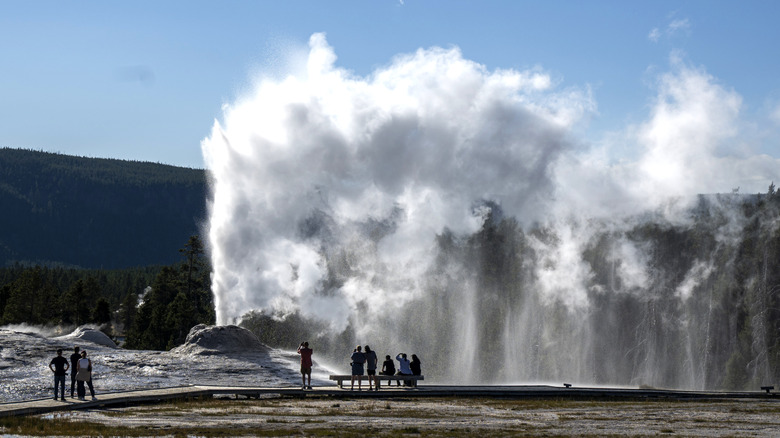
Officially known as the Lion Geyser Complex, Lion Geyser is a cluster of seven hydrothermal features in Yellowstone's Upper Geyser Basin, near Old Faithful. It comprises four geysers and three hot springs, which have all erupted at some point in history. Lion Geyser itself, the largest of the group – which also features Little Cub, Lioness, and Big Cub geysers – sits on the biggest cone and produces a distinctive series of bursts within a single eruption cycle, regularly reaching as high as 50 feet, spread over every few minutes rather than one clean spike. In a single series of eruptions, the geyser may erupt once or nine times, or even more; however, three to five eruptions are most common before the system pauses for a break.
The "Lion" name reportedly comes from the deep, rumbling roar the geyser lets out as steam escapes post-eruption. A visitor on Tripadvisor describes this aftermath as carrying "an indeed Lionesque roar." Another visitor recounted catching it mid-eruption while walking the boardwalk on a visit to the Upper Geyser Basin, calling it payoff worth the wait, likening it to "standing inside a volcano".
The rest of the complex also has its own story. Little Cub Geyser, on the mound's southern side, was once the most frequent performer, but its rhythm has grown erratic since 2004, now erupting anywhere from once an hour to once every two days. Lioness and Big Cub sit at the center, rarely erupting, but reaching heights of up to 50 feet when they do.
Imperial Geyser, Yellowstone National Park
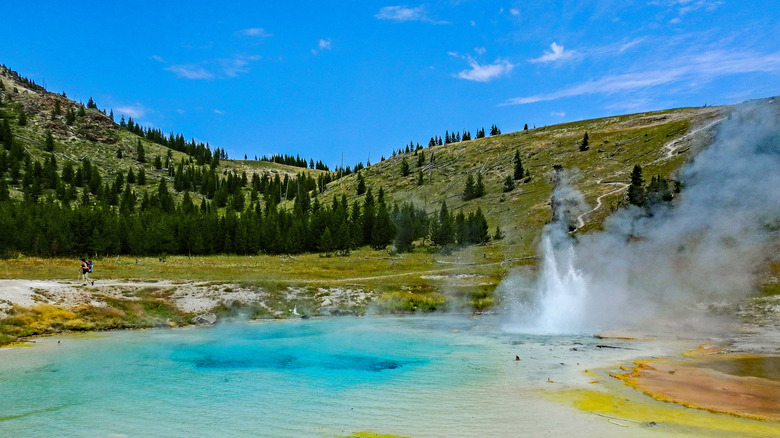
The Imperial Geyser sits along the same trail as the Fairy Falls, leading to the Grand Prismatic Spring, the largest hot spring in Yellowstone, and a prime hotspot. Its first recorded eruption can be traced back to 1927, lasting up to several hours the year after, at times jetting out twice the water volume of an Old Faithful eruption. While the geyser suddenly went quiet in 1929, a new vent opened in 1966 on the edge of the geyser pool, which continues to be active in the present day. Cycling between dormancy and activity, the Imperial Geyser is known to erupt every 10 seconds, spouting water several yards high.
Reaching this geyser means continuing on the crowd-puller trail until the crowds thin out. A hiker on Reddit who continued past the Fairy Falls trail on a busy June weekend reported having the Imperial Geyser to themselves for well over an hour. Geophysicist Michael Poland described the walk as "quintessentially Yellowstone." It passes through meadows, rhyolite cliffs, plateaus, forests, and glacial hills; Poland pointed out that this geyser is deemed "one of the most spectacular" geysers in Yellowstone. Adventurers going the extra mile are rewarded by the soothing sounds of cascading waterfalls amid the lush greenery, lending the hike a calming rhythm before it opens up to the bubbling surface of the Imperial Geyser. Given its backcountry location, Imperial Geyser has no boardwalks or barriers, so visitors need to watch their footing around the mud pots and fumaroles that are strewn all over.
Geyser Spring Trail, Colorado
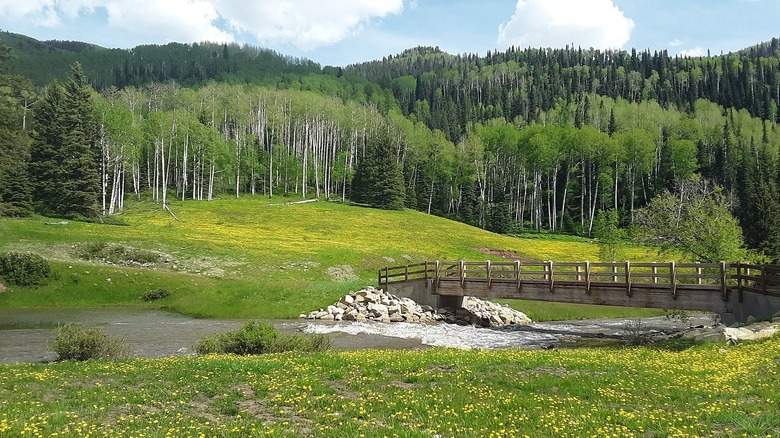
A geyser in Colorado isn't something people would commonly expect. However, the San Juan National Forest in Colorado hides a trail deep within its pine and aspen cover that leads to the state's only natural geyser. This distinction matters, since it excludes hot springs and other geothermal features that dot Colorado's landscape, but not a natural geyser.
The sight itself is not a dramatic spectacle, at least not the kind typical of many geysers. Rather than a towering column, the bright aqua blue pool here is a picture of a pot coming to a boil, likened to a "witch's cauldron" by some adventurers. There's also a heavy odor of rotten eggs from the hydrogen sulfide gas the geyser emits. The rumbling activity occurs every 30 to 40 minutes and is known to last for approximately 15 minutes, when the water spills over into the creek. Due to the presence of toxic gases over and around its surface, the pool is off limits for visitors.
What adds to the drama here, as gathered from visitors, is the suddenness of this mystery bubbling pool with funny smells, ensconced deep within a quiet forest where it's the last thing one would expect to see. The lesser-known mountain trail is an easy 2.6-mile round trip, about an hour's drive from Dolores, a quiet town in southwestern Colorado. It traces the banks of a stream before slanting uphill into the lush aspens and pines, its remote location adding to the intrigue of what lies ahead. The unassuming nature of it all makes it a standout. Without any visitor centers, souvenir shops, or crowds, it only heightens the chances of having the place largely to oneself.
Old Faithful, California
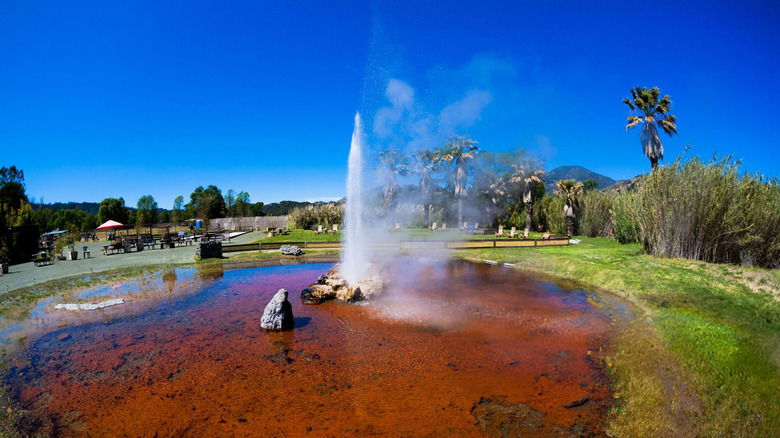
Yellowstone isn't the only home to America's "Old Faithful". Just north of Calistoga, in Napa Valley, California, is the state's very own Old Faithful, and its story began with a mistake. In the late 19th century, a settler drilling a well on his property struck a steam vent instead of water and accidentally opened a geyser, almost losing his own life in the process. The land was later purchased by Olga Kolbeck, known in geological circles as the "Geyser Lady." Not only did she turn it into the tourist attraction that it is today, setting up a museum, a visitor center, picnic grounds, and even a small zoo, but she was also the first to notice the changes in the geyser's activity before major earthquakes in the region. Eventually, this intrigued seismologists who study the geyser as a natural warning system for earthquakes. It has been observed that its eruptions become less frequent in the lead-up to some earthquakes, making it a potential seismic indicator.
The accidental discovery of California's own rare geyser has stood the test of time. The Golden State's Old Faithful has erupted on a steady cycle since 1881, sending water roughly 60 feet into the air every half hour or so, with each burst lasting two to four minutes. This eruption cycle leaves ample room for visitors who can linger around exploring the surroundings, without having to wait too long for the "show". In fact, this one is touted as the more "faithful" one when compared to its Yellowstone counterpart, which erupts every hour.