
8 Once-Thriving Hotels In Canada That Are Now Eerily Abandoned
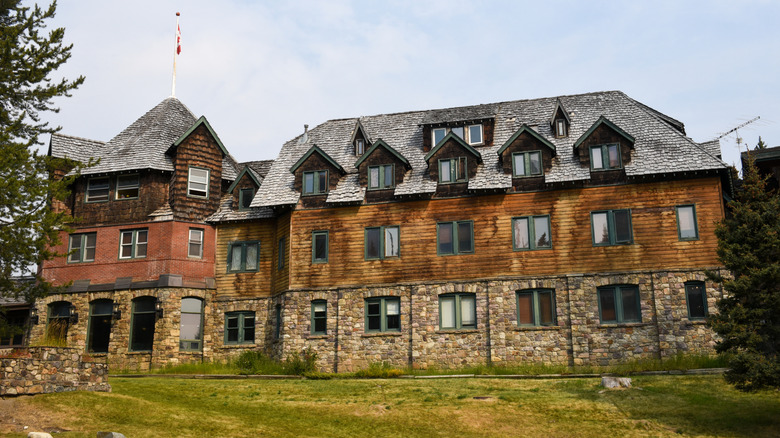
Hotels are literally built to be filled with people, a fact that makes abandoned ones feel all the more unsettling. Decaying guest rooms, creepily silent ballrooms, and derelict grounds where people once gathered serve as an eerie reminder that these places were once vibrant and bustling. Because of the stories they hold, abandoned hotels worldwide — much like America's scary abandoned amusement parks and the world's creepiest ghost towns — tend to capture the imagination. They're especially popular among urban explorers and supernatural enthusiasts. In this article, we'll take a virtual tour, of sorts, of eight once-thriving hotels in Canada that are now eerily abandoned.
Some properties included here were previously popular vacation resorts for generations of families, while others were designed to attract railroad travelers, and still others were constructed during 19th-century gold booms. While you can technically visit all of the hotels on this list, be aware that you should follow posted guidelines. Some buildings may only be viewable from a bit of a distance. Furthermore, abandoned buildings can have structural problems or belong to a private citizen, so get permission from the proper authorities if you plan to enter.
To compile this piece, we used historical data from a wide range of sources, including various YouTube urban explorer channels, Facebook groups dedicated to historic hotels, and blogs like Onboard Tangaroa, Talking Walls Photography, Military Bruce, Riddim Ryder, and The Tyee. We also consulted news sites like The Globe and Mail and official Canadian government resources, such as Parks Canada.
Martin Inn (Ocean Falls, British Columbia)
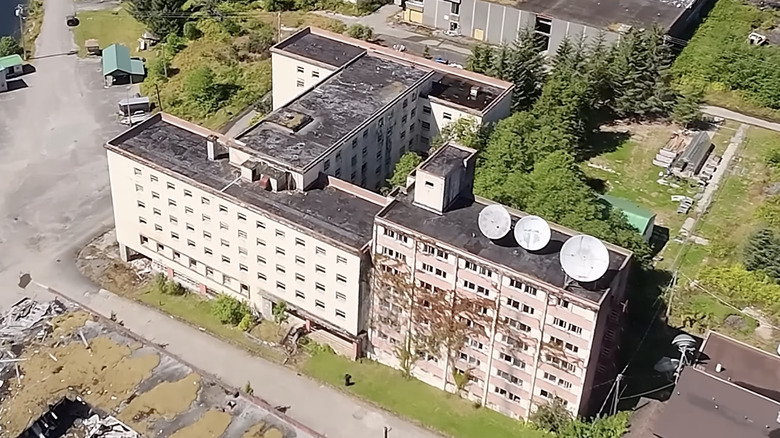
In British Columbia, Canada, a province that is also home to a breathtaking waterfall taller than Niagara, lies Martin Inn. If you want to visit the remnants of this former hotel in Ocean Falls, though, you'll have to do some planning to get there. Accessible only via boat or plane, Ocean Falls is a remote community that developed around a paper mill. While the town never had more than 4,000 residents, it offered a wide array of amenities, including a school, a swimming pool facility, a dance hall, a baseball team, and arts and cultural organizations.
It also had Martin Inn, which was among British Columbia's biggest hotels when it was completed in 1947. It was so popular among visitors that, in a 1953 project, an additional 105 rooms were added. However, by the mid-1980s, Martin Inn was largely abandoned after the paper mill shut down production and people moved away. Today, the once-bustling property is a popular stop for urban explorers and others who are fascinated by abandoned places and anthropological studies.
It seems fairly straightforward to enter this abandoned property, though one should take caution as with all crumbling buildings. The Onboard Tangaroa blog noted, "it's been heavily ransacked, but it's still possible to walk through and imagine the grandeur it once held." Photos shared on the blog show rooms with peeling paint and wallpaper, collapsed ceilings, plant life growing into once-beautiful bathrooms through cracks in the tiles, and even bicycles that look like someone simply walked away and never returned to finish their ride.
Wigamog Inn (Haliburton, Ontario)
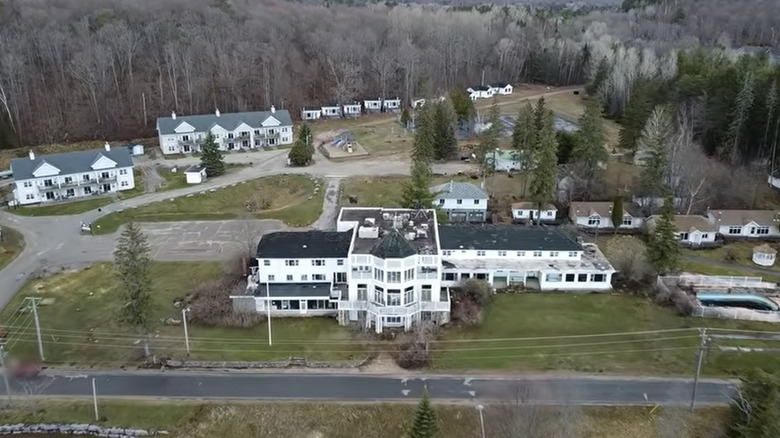
Before Ontario's Wigamog Inn became a destination for urban explorers, it was a popular resort that some families visited for generations. Even before that, though, it was a boarding house operated by Robert and Anne Gould. Beginning in 1903, the couple began charging a reported $3 per week for lodging at their Lake Kashagawigamog residence. Later owners converted the property into a hotel. By the 1930s, Wigamog Inn was a place where lakegoers enjoyed the good life.
It continued thriving well into the mid-century, and in the 1960s, it expanded with a conference center. The lakefront hotel closed its doors permanently in 2011. A 2025 fire left the upper levels of the one-time hotel in ruins, giving it an even more ghostly appearance. And it already had a haunting look. Just before the fire claimed portions of Wigamog Inn, the Haliburton Echo wrote of decaying art on peeling walls, furniture left behind, and even half-played board games waiting for guests who will never come back.
Even further back in 2018, videographer Freaktography spent the night at Wigamog. He described "pieces of the ceiling all over the treadmill and equipment" in the gym, as well as drained pools, and a chilling overall appearance. Although this is a popular spot for urban explorers who seem to have no trouble gaining entry, bear in mind that the site is privately owned, so entering without permission constitutes trespassing.
Hotel Kaleden (Kaleden, British Columbia)
Located in the Okanagan Valley, the small town of Kaleden had a major impact on the region's agriculture industry in the early 20th century, thanks to its famous apricot orchards. In 1910, just one year after Kaleden was officially named, construction began on Hotel Kaleden. The property officially opened the following year — though some accounts suggest guests didn't begin staying until 1912 — offering an impressive level of luxury for the era and location.
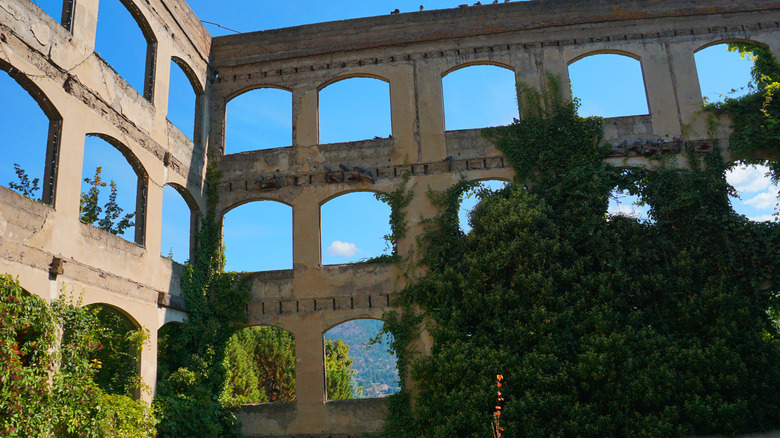
The hotel had indoor plumbing and electricity, a true novelty at the time. There were also two on-site restaurants. Unfortunately, Hotel Kaleden's operational life was cut quite short. When World War I broke out in 1914, the hotel closed, never to reopen. During the Great Depression era, anything of value, including flooring and fixtures, was removed from Hotel Kaleden. Today, the ghostly concrete shell of this once-grand structure is a historical site that serves as the centerpiece of the Kaleden Hotel Park.
Due to the fact that a park was literally constructed around this abandoned hotel, it is extremely easy for would-be adventurers to visit. You can simply walk right up to the ruins, take photos, look through the empty windowpanes, and enjoy imagining the grandeur that once was. The Kaleden Community Association urges anyone who cares about historic preservation to get involved with saving the remnants of Hotel Kaleden for future generations to experience.
Le Château de l'Aéroport (Mirabel, Quebec)
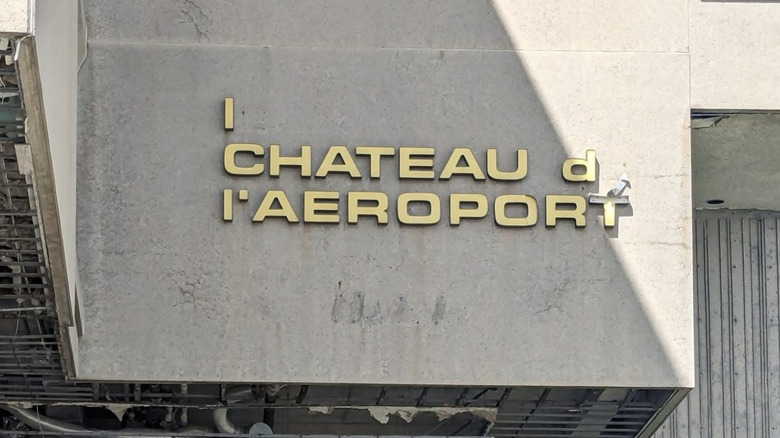
In 1977, two years after Montréal–Mirabel International Airport had its grand opening, Le Château de l'Aéroport opened. It proved to be the type of airport hotel that made guests want an overnight layover. The "airport castle" was a tropical paradise in Canada, with palm trees and other foliage in a large atrium, an indoor pool, and themed dining. Former employee Jo-Anne Sauvé-Taylor told La Presse, "It was THE HOTEL ... The vacation started before we even boarded the plane." Unfortunately, the Montréal–Mirabel Airport was a disastrous project. Plans for it to become a major hub were scrapped, and many of its routes were transferred to another airport before Montréal–Mirabel finally stopped most commercial passenger travel.
As passenger travel through the airport declined, Le Château de l'Aéroport struggled to stay afloat, permanently closing its doors in 2002. While Montréal–Mirabel Airport is still open, the hotel has fallen largely to ruin, though it still has relics of its fun-loving past. A sign with a palm tree motif still stands outside, and some bright blue accent paint remains near the foundation. One of the creepiest aspects of the hotel is the curtains falling off of guest room windows, almost as if people left in the midst of a normal day and simply never returned.
Today, urban explorers can stand outside the property's fencing to take photos, and some rooms are still illuminated, but the public is not permitted to enter. Over the years, plans to repurpose this hotel site have been proposed, but none of them have come to fruition. It currently remains closed and deteriorating, an overgrown relic of the glamour of 1970s travel.
The Empress Hotel (Stewart, British Columbia)
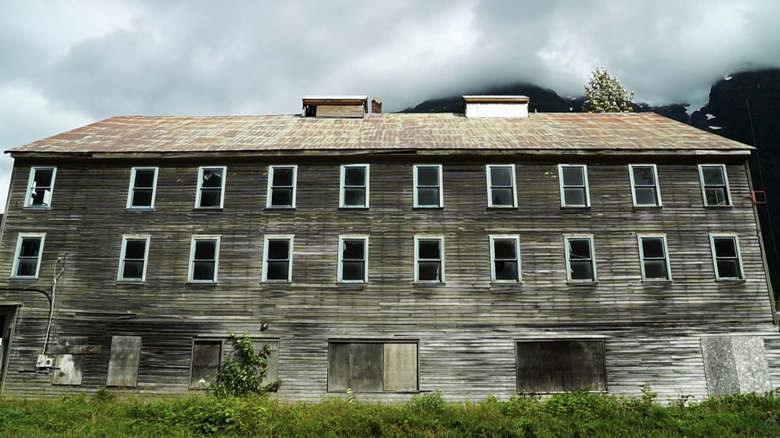
Not to be confused with Victoria, British Columbia's four-figure-a-night Fairmont Empress, the Empress Hotel in Stewart is a long-abandoned establishment. Construction of this historic hotel was ordered by German financier Alvo von Alvensleben in the early 1900s, with the goal of attracting railroad workers and passengers traveling on a proposed transcontinental line. The Empress Hotel opened to great fanfare in 1910. Sadly for the townspeople in Stewart, however, despite great optimism, the railway project was never completed, and the Canadian North Eastern Rail stopped operations in 1915.
Only about 14 miles of track for the project were laid, and the Empress Hotel only operated in its original form for two years. Against all odds, though, the building became a major part of Stewart's community culture for many years after the hotel's demise. Local businessman John Meneghello, a colorful character according to lore, converted the structure into the North Star Hall, which hosted dances, holiday celebrations, and more. An exact closing date of North Star Hall is not publicly available, but the former Empress Hotel now lies abandoned in downtown Stewart.
The building is still standing, although it's in rough condition. Today, the building has eerie-looking faded siding, dark windows, and empty rooms that have led some Facebookers to call it the "Ghost Hotel." Travelers are welcome to take photographs of the property's facade, and guided tours of the town can be arranged by speaking to the staff at the nearby Stewart Museum. The Museum has regular hours between May and September, though you can contact them to arrange off-season tours.
Minaki Lodge (Minaki, Ontario)
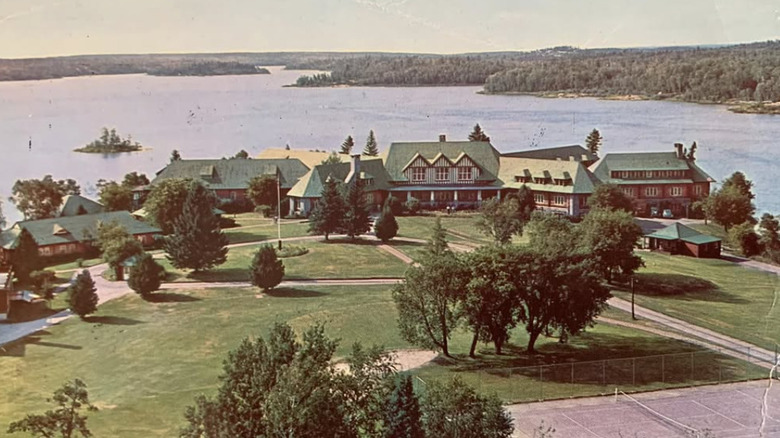
Minaki Lodge opened as a hotel for passengers along the Grand Trunk Pacific Railway route in 1914, and was purchased by Canadian National Railway (CNR) five years later. The team at CNR wanted to renovate the existing lodge into an upscale property that would appeal to wealthy vacationers. They got their wish in an unexpected way. Minaki Lodge was severely damaged by fire in 1925, and by 1927 had been rebuilt with a luxurious Northwoods aesthetic that endured for many years.
It was considered a premier Canadian hotel for decades. The Christian Science Monitor even referred to it as "the Ritz of the North" in 1985. Over time, Minaki Lodge had multiple owners, including, at one point, the government of Ontario, which ultimately sold it to Four Seasons in 1987. The property's last owner before its closure attempted to rehabilitate it, but was ultimately unsuccessful. The once-great lodge closed for good in September 2003. Tragically, just one month later, a horrific fire leveled the main lodge, leaving behind ramshackle stone chimneys, pieces of the foundation, and other charred ruins.
The property remains abandoned today. If you're going to visit, it is best to take photos from a distance as the site is privately owned. Unpopular redevelopment plans were proposed for the Minaki Lodge site over the years, but nothing has come to fruition at the time of publication. The heritage railway station in Minaki is another great place to visit if you are interested in this outpost's once-thriving past.
Highland Inn (Algonquin Provincial Park, Ontario)
Around the turn of the 20th century, many tourists visited Ontario's Algonquin Provincial Park by train. The Grand Trunk Railway decided to capitalize on this popularity by opening the Highland Inn in 1908. The first iteration of the hotel was so well-received that it underwent a major expansion in 1913, giving affluent visitors a dance hall, new parlors and sitting areas, a billiards room, tennis courts, and other amenities. The Great Depression significantly impacted tourism and capitalism in North America, forcing many commercial enterprises to close. Unfortunately, Highland Inn was not immune to this decline.
After reopening in 1938, the property changed hands several times before it was purchased by the Ontario government in 1956. Rather than continue to operate the Highland Inn, officials opted for a controlled burn of the property. Today, although there is not much left of the original structure, history enthusiasts can still see ghostly bits and pieces of this hotel that once drew well-heeled travelers from all over to the Canadian wilderness.
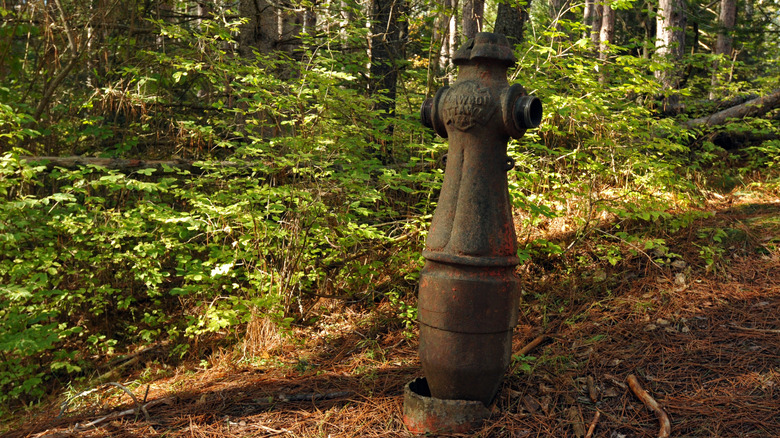
In an excerpt from his book, "Destination Algonquin Park: Tracks to Cache Lake And The Highland Inn" (via the Legislative Assembly of Ontario website), Donald Beauprie shared that there remains, "a long, low, retaining wall, a concrete sidewalk and steps leading to nowhere, and a short isolated section of rusting railway track." There is also a rusted fire hydrant, seen in the feature image of this section. Modern explorers are welcome to legally enter this area, walk up and down the stairs, and imagine the early guests who once frequented this site. Informational signage throughout the Cache Lake Historic Site offers today's visitors a glimpse at the fashionable resort that once thrived here.
Harbour Island Resort (Manitoulin Island, Ontario)
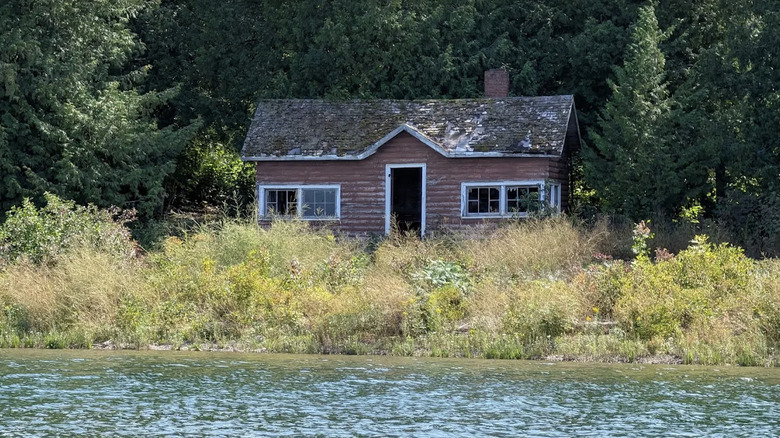
Although it has the same name as Travis Kelce and Taylor Swift's Bahamas getaway, Ontario's Harbour Island Resort no longer attracts a celebrity crowd. At one time, though, lore suggests that it welcomed the likes of actors John Wayne and Marilyn Monroe, singer Gene Autry, heavyweight boxer Gene Tunney, and Canadian Prime Minister Lester B. Pearson. Like Martin Inn at the beginning of this article, there is no land access to Harbour Island. Instead, people have to come via water or air.
The land where Harbour Island Resort was built was purchased in 1942, and its cabins and lodge were constructed the next year. The accommodations were used by businesses for corporate retreats for the first few years until it became a traditional hotel in 1946. Then, the property was sold again and functioned as a members-only location throughout the 1950s and 1960s, when it developed its celebrity reputation. It began to lose its luster in the 1970s and was abandoned by the 1990s. These days, despite an intended restoration by a descendant of the original owner, the once-glamorous resort lies in ruins.
Harbour Island was listed again in 2021, and no further updates have been made. In photos from that period, the cabins were beginning to crumble, roofs had caved in, and the whole property gave the eerie appearance of a vacation interrupted midway through. The Old Mill Heritage Center's Community Stories section notes, "the docks are gone, the buildings are collapsing and the grounds are completely covered by poison ivy." Since Harbour Island is visible from the water, you can take photos of some of the remaining structures from a boat. To ask about accessing the island itself, you can try reaching out on the island's website, which is owned by the last known owner (the original owner's descendant). The website has a contact page, although it's not clear if the site is kept up to date.