
9 Egyptian Pyramid Rules American Tourists Break Within The First 10 Minutes
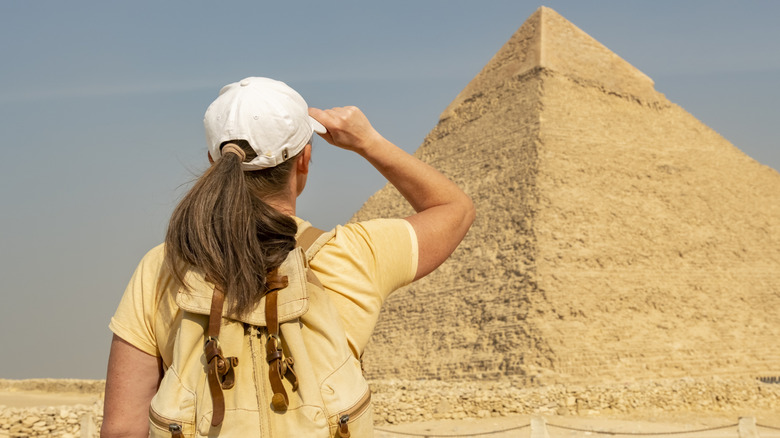
There are many places to visit in Egypt beyond the famous pyramids, but there's just something about those soaring stone structures that sets them apart as one of the most intriguing destinations in the world. The origins of many major structures, out of the 100-plus surviving pyramids in Egypt, go back over 4,000 years, making them some of the most ancient architectural marvels one can still visit in person. It's not hard to see why the Egyptian pyramids draw a footfall in the millions every year, or why one of those masterpieces — the Great Pyramid of Giza — ranks among the Seven Wonders of the Ancient World (and is the only one still standing).
Not all those visiting know what to expect, though, and it is easy for people visiting the pyramids to make a few mistakes the first time around. Something as seemingly simple as the attire someone wears to the pyramids can be a point of contention. Or assuming that buying a ticket gives one unrestricted access to run amok and explore whichever parts of the pyramid complex they please. Certain spoken and unspoken rules do exist in and around the Egyptian pyramids to help people navigate social codes, conservation efforts, visitor safety, and the general cultural landscape that makes this experience so unique.
Here are some rules tourists break at the pyramids in Egypt and how to avoid making these mistakes to make the most of your visit to this historic location.
Not scaling the pyramid walls
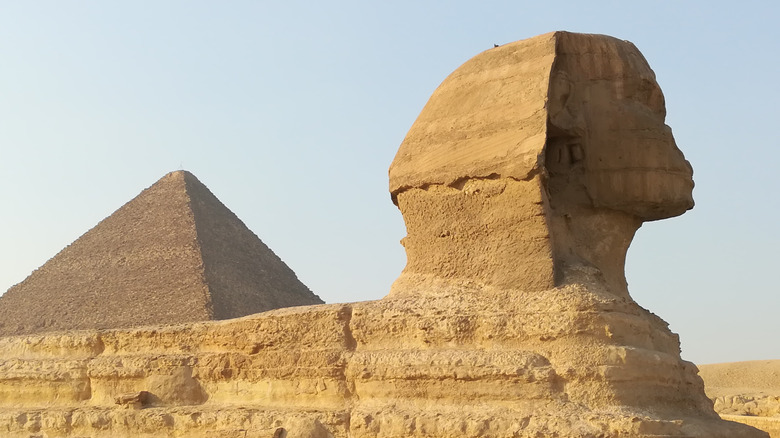
No matter how appealing the idea might sound, scaling the pyramids in Egypt is not permitted. It's a misadventure many have attempted in the past, even to fatal ends. And while others have been luckier — like an American student who climbed the Great Pyramid of Giza back in the 2000s and was only briefly detained by authorities — it's an activity that is best avoided, not just for your own safety but also for the safety of the pyramids.
Alongside the fact that Egyptian pyramids rise to dangerous heights — with the Great Pyramid standing at about 450 feet — their structural fragility is also a major issue. Many of these ancient artifacts are approximately 4,500 years old (or even older) and, aside from weathering away through natural processes, also face constant risk of abrasion from human contact. In fact, a paper in Scientific Reports showed that the pyramids are prone to degradation even without touch, through emissions of breath and sweat.
Egyptian authorities have reiterated bans on climbing the ancient structures since the 20th century, but in 2019, the law was tightened further around what the higher-ups called a "negative deed," Ahram Online reported. The parliament criminalized the act of scaling Egyptian antiquities without a license, with offenders facing imprisonment or a fine of up to almost $2,000. So no matter how much of an urge to climb to get a bird's-eye view of Egypt kicks in, don't give in!
Understanding what tickets offer (and don't offer)
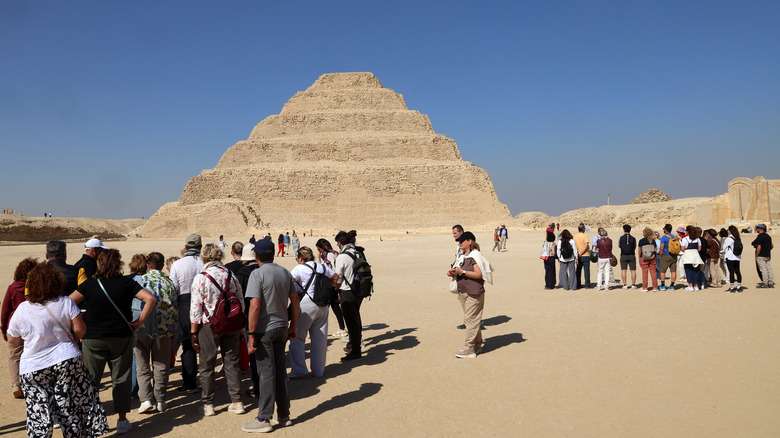
A mistake many tourists make upon arriving at the pyramids in Egypt is believing that a single ticket will give you access to the whole complex. In reality, the ticketing system at these historic sites is far more layered, and your areas of access inside are pre-decided with your ticket. Therefore, it's important to understand the breakdown of prices and how routes inside are structured in a bid to get to the spots you actually want to see. In Saqqara, for instance, a general ticket that includes the Step Pyramid of Djoser exteriors (entry separate), the Imhotep Museum, and some other pyramids costs EGP 600 (approximately $11.26), as of this writing.
Entry to the general Giza plateau is priced slightly higher at EGP 700 (approximately $12.50), which covers the external viewing of the big three – the Great Pyramid of Khufu, Pyramid of Khafre, and Pyramid of Menkaure — as well as the Great Sphinx. Expenses for entry into these structures are separate. The nearby Grand Egyptian Museum, a site that houses many ancient artifacts, carries one of the costliest entry charges, starting at EGP 1,830 (approximately $32.50). Hop-on, hop-off shuttle buses are included with the entry ticket here, easing your commute around the Giza complex. Keep in mind, however, that the buses run in a fixed loop around the complex, and it would be a good idea to plan your stops around the available connections.
Wearing the right clothing
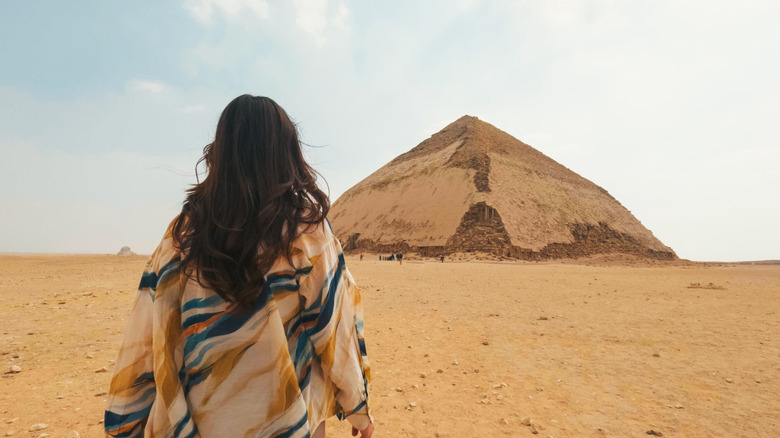
What many tourists don't realize about visiting Egypt is that while there aren't any strict laws around dressing, the country does abide by certain socio-cultural norms of modesty that extend to people's clothes. It's an unsaid rule that many vacationers break, showing up to the ancient sites in low-coverage attire that, though otherwise ideal for a holiday, might invite some critical stares at the pyramids and end up being one of those things tourists do that drive locals up a wall.
Avoid wearing anything too risqué, like skin-baring shorts or deep-neck tops, opting instead for clothes that cover your shoulders and knees. That said, respectful dressing shouldn't have to mean compromising on style; you can keep things fashionable with loose-fitting garments made of linen and cotton that have long sleeves, flowing silhouettes, and relaxed cuts. Covering yourself up at the pyramids is advantageous not just for cultural reasons but practical ones too.
The Egyptian sun is notoriously harsh and, in the absence of shaded areas around the pyramid complex, can come down very hard on visitors who aren't dressed for the climate. To that end, it is also advisable to carry a head covering, like a scarf or hat, and sunglasses to protect yourself from the heat. Keeping in mind the extended periods of walking involved in your day of sightseeing around the pyramids, put on comfortable shoes that won't wear your feet out.
Carrying enough essentials like water, sunscreen, and petty cash
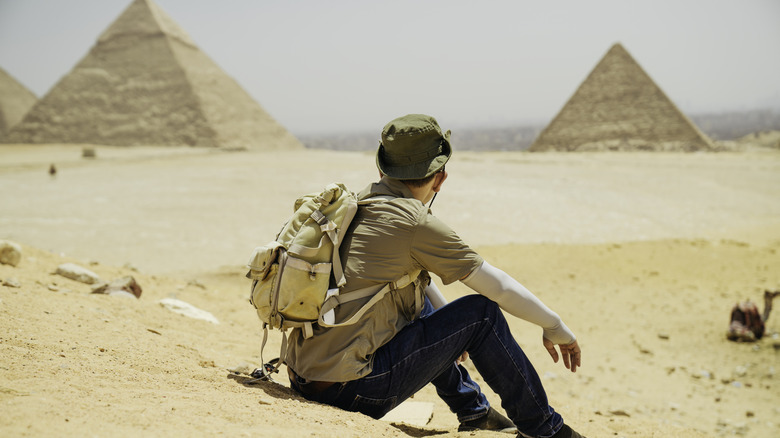
A visit to the pyramids can take up a full day, so armor up well before you go. Carrying enough water is one of the first musts. It's an oversight many people make, believing that they will sort out their thirst and hunger pangs directly at the tourist spot. And while that can be an option, with eateries both within and around the complex, the prices on-site will undeniably be higher.
Since carrying personal water bottles and small snacks, like energy bars and dry fruits, is allowed, it's best to use this permission to your advantage. Also throw in a couple of sachets of electrolytes, and you're set. Sunscreen is another essential that will serve you well around Egypt's pyramids, where the sun comes down hard, and exposure is all but guaranteed. Besides wearing protective clothing, re-applying sunscreen every few hours can be of additional benefit during your day of pyramid hopping.
Carry ample cash for handing out tips, buying souvenirs or food, or making other purchases. Though card-only ticketing policies are enforced at pyramids, such as Giza, cash is still the more dominant method of transacting with vendors and local businesses. It's best to get an exchange of Egyptian pounds beforehand, preferably in smaller denominations that will be easier for vendors to make change for. Don't forget to keep necessary IDs, including a copy of your passport, and basics like wet wipes, sanitizers, and power banks in your backpack too.
Being wary of vendors and tourist scams
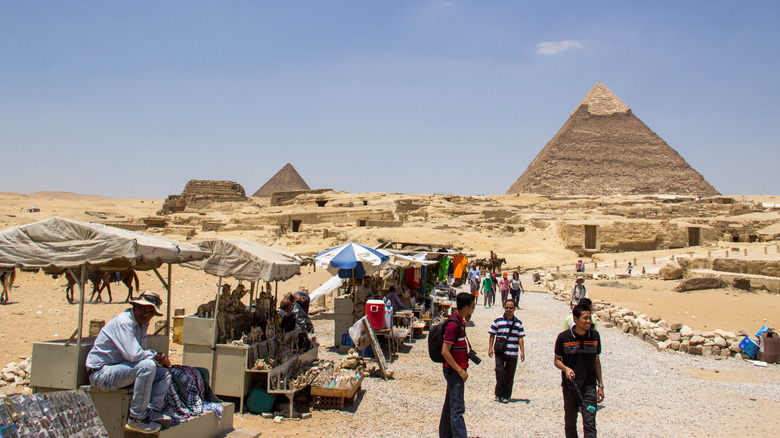
Like any popular destination where crowds abound, the pyramids in Egypt are not immune to common tourist traps and petty scams. Visitors often get swayed into these schemes upon arrival, and sometimes even before reaching the historical site. The blog Marlene On The Move noted that people surrounded the writer as soon as they stepped off the metro near Giza. "Every single one of them is trying to lead you somewhere, usually to a 'special entrance,' or a shop where they get a commission," they wrote, advising readers to avoid following random individuals posing as samaritans. Pushy behavior or a lack of credentials can be some glaring warning signs that a local guide isn't trustworthy.
While talking to locals can be one of the best ways to absorb foreign culture, do exercise some discretion in bustling tourist hotspots like the Egyptian pyramids, where even a friendly conversation with a stranger can come with strings attached. Some scams unfold so stealthily that it's hard to notice they're happening. A man could casually walk his camel into your frame while you get a photo clicked and then charge you for it. Or someone might place what they call a gift in your hand and before you know it, demand payment for it. Vendors at the site will often overcharge for souvenirs, but no matter how persistent (or sometimes aggressive) they may seem, it's best to avoid buying your knick-knacks from here.
Don't assume every part of the complex is accessible
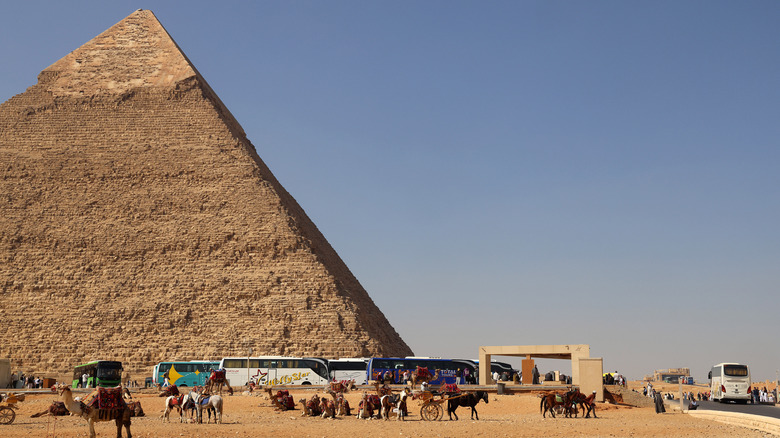
Once inside a pyramid complex, don't go wandering off to explore by yourself, no matter how much the mystery of the desert landscape calls out to you. Staying close to your guide or travel group is not so much a matter of safety — since it is virtually impossible to get lost around Egypt's open-plan pyramid complexes – as it is about making sure you don't go off-limits.
Not every pyramid and structure is penetrable or open to the public, even if the ticket you have purchased gives you admission to that general sightseeing area. This is especially true of popular sites like Giza and Saqqara with their many constructions, as opposed to a spot like the Meidum Pyramid, which has just one major pyramid structure that anyway has restricted access.
What's more, access permissions keep changing around the pyramids based on repair schedules, which can sometimes stretch on for several months. The Pyramid of Khafre in Giza, for instance, has seen many such rotational shutdowns and openings over the years. After undergoing a period of maintenance in the aughts, it was reopened in 2004, only to be shut again years later and reopened again in 2026. These conservation cycles can be hard to keep track of for regular visitors, which is why it's best to stick to pre-decided routes, stay close to your guide, and keep your tour within the areas your ticket gives you access to.
Bringing in prohibited photography equipment
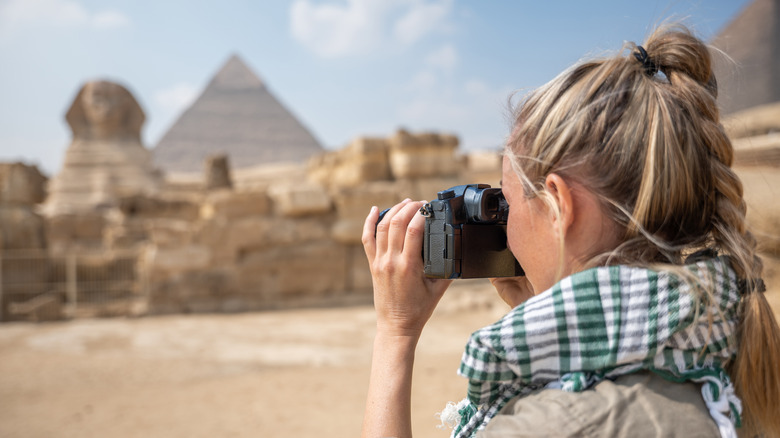
"Pics or it didn't happen" seems to be the general approach to travel in today's social media age. Despite this, or maybe because of it, many popular tourist destinations around the world have strange photography bans that prevent people from carrying potential hazards like selfie sticks or clicking pictures in high-risk zones. And while Egypt doesn't discourage tourists from taking photos, there are checks around the equipment you can and cannot carry inside pyramid complexes.
Drones are a strict no-no to begin with. Egypt maintains highly conservative regulations around recreational filming with drones, so much so that it is technically illegal unless a special permit is obtained from authorities, and it's virtually impossible to secure one. Besides security reasons, drone flying is also seen as a possible risk to monuments, especially those as old as the pyramids. Commercial shoots with elaborate paraphernalia like diffuser umbrellas, tripods, or huge lights will likewise require permits.
The general rule of thumb is that everything beyond personal, non-commercial photography and phone or other handheld cameras should be treated with discretion. Even greater caution should be exercised inside the monuments, many of which are tombs and have narrow walkways where flash photography or bigger camera setups may sometimes be restricted. Also, no matter how beautifully it adds to the cultural character of your shot, do not photograph locals without consent.
Not considering the ethical implications of camel riding
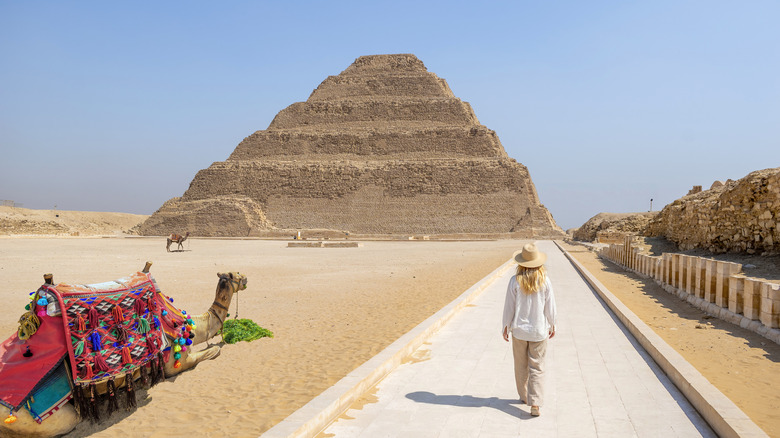
In an age of a mindful shift toward ethical travel, it would be an ill-informed idea to opt for camel rides around the pyramids in Egypt. Hopping onto one of these hump-backed desert dwellers might seem appealing to tourists, especially those who don't typically encounter camels or are visiting the pyramids for the first time. But more often than not, issues of animal cruelty hang low over this typical desert experience.
The camels around the Giza pyramids, for instance, are reportedly overworked, beaten, tied up, and treated as props for human entertainment. The treatment horses receive is no better either, according to PETA, which flagged a rise in the number of animal deaths around the tourist location. Their reputation for surviving in arid conditions can make it easy for people to underestimate their requirements, but camels are not immune to dehydration, exhaustion, or buckling under undue pressure.
Authorities in Egypt have taken stock of the situation over the years and in 2026, even moved to wind down camel and horse riding operations in Giza, The Star noted. Several companies that offer tour packages for the pyramids have also opted out of including this experience in their itineraries in light of increased animal welfare awareness. Also, considering that electric shuttle buses now conveniently transport tourists across the pyramid complex along pre-planned routes, the need to ride a camel essentially remains little more than a photo op.
Be prepared for things to get cramped inside the pyramids
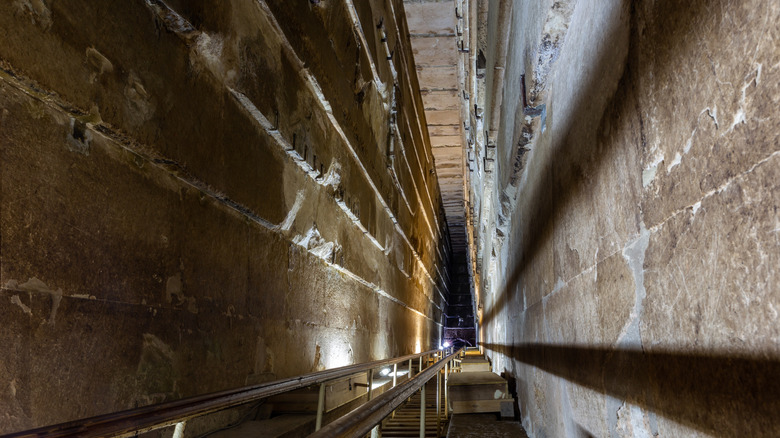
Considering the size of the structures, one might be under the impression that the interiors of the pyramids in Egypt are as spacious as the exteriors suggest. The network of chambers inside most of these ancient monuments, though, is actually quite narrow. Think cramped corridors, trapped smells, stuffy rooms, and steep walkways. As discussed on a Tripadvisor forum, the experience of entering the pyramids can be a thorough nightmare for claustrophobic people.
Tales of the pyramids being lined with blinding treasures and ancient mummies might create enough intrigue for you to pay a visit inside, in spite of the aforementioned conditions. But it would do well to know that the pyramids were plundered by grave robbers centuries ago and any remaining artifacts were relocated to museums, rendering the chambers empty today.
Once you're inside, there will potentially also be a lot of stooping, walking, navigating, and dodging along the way — more in some places than others. The pyramids in Dahshur, for instance, are notoriously difficult to navigate. And since many tourists share the enthusiasm of exploring these constructions, things can get crowded on busy days. Witnessing the architectural marvel that lies inside these pyramids in person might still be a grand experience for the truly passionate, but do go mentally and physically prepared.