
5 Must-See Art And Architecture Spots In Philly I Recommend As A Local
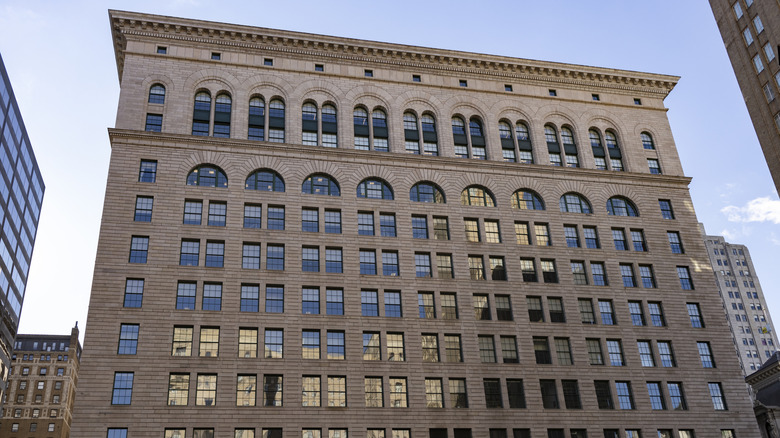
Heading into 2026, Philadelphia is in the spotlight — a fact that's especially apparent to those of us who live here. In addition to being one of 11 U.S. cities hosting the 2026 FIFA World Cup, Philly will be the site of a massive celebration for the United States' 250th birthday: as "Hamilton" fans know, the City of Brotherly Love played an important role in the country's founding, and the Declaration of Independence was signed right here at Independence Hall.
After spending most of my adulthood in cities abroad, including Rome, Prague, and Buenos Aires, I moved to Philadelphia six years ago. And I've seen firsthand just how historically vibrant this city truly is. Whether you're coming to town for a soccer match or spectacular fireworks on the Fourth of July, there are some art and architecture highlights you won't want to miss, from vintage skyscrapers and open-air mosaic installations to one of the most beautiful train stations in the country.
The Divine Lorraine
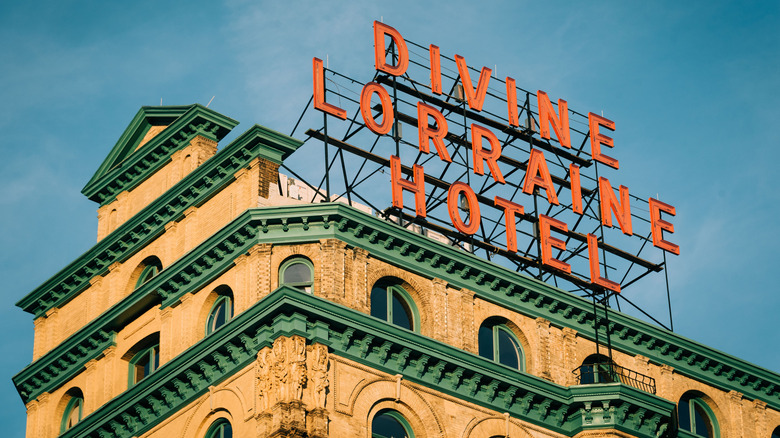
Start a mini-tour around Philly's architectural landscape at a locals' favorite, the stately Divine Lorraine. When I first arrived in Philadelphia, this unusual building — one of the city's first high-rises — caught my attention with its Victorian facade and a retro, bright-red marquee sign towering high over Broad Street. The 1890s-era landmark was first an apartment complex and later a luxury hotel, eventually becoming the first hotel in the country to be fully racially integrated.
Today, in addition to housing apartments, the Divine Lorraine is home to an upscale Italian restaurant that's open to the public. Occupying the same ground-level space that once served as a community kitchen where people could dine for 25 cents, the elegant Cicala at the Divine Lorraine is a far cry from its humble predecessor — but stopping by for dinner or drinks is a clever way to check out the building's glamorous interior.
The Wanamaker Building
For millennials like me, Philadelphia's Wanamaker Building is perhaps best known as the primary filming location for "Mannequin," a not-very-good (but fun!) movie that came out in 1987. Who can forget Kim Cattrall as a time-traveling Egyptian lady who comes to life as a mannequin in a Philadelphia window display? And while the setting is certainly memorable from its turn on the big screen, there's much more to the 12-story Beaux-Arts landmark.
Commissioned by industrialist John Wanamaker, this "palace of shopping" opened in 1911, occupying an entire city block between Market, Chestnut, Thirteenth, and Juniper Streets. Daniel Burnham — the same star architect behind New York City's Flatiron Building and Chicago's Union Station — took stylistic inspiration from the Palazzo Medici in Florence, Italy. The stately building has housed a series of department stores over the years, including a recently shuttered Macy's.
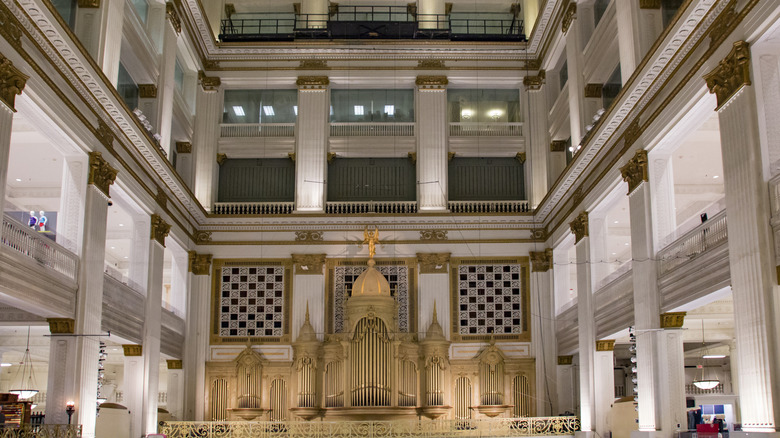
Now, the Wanamaker Building is set to undergo renovations to become a mixed-use commercial and residential complex. Luckily, its most famous feature will be preserved: the world's largest functioning pipe organ, a gilded masterpiece that recently made a majestic backdrop for a slate of pop-up performances by Opera Philadelphia, will stay in place in the building's marble-lined Grand Court.
The Bok Building
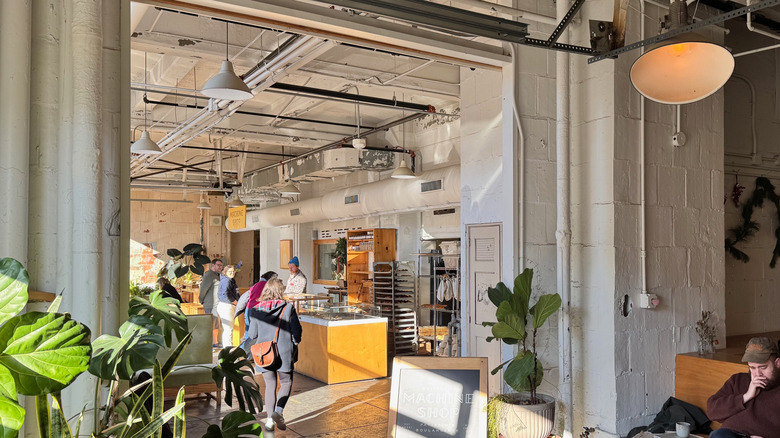
There's an interesting story behind one of the city's coolest spaces, the Bok Building (often referred to simply as "the Bok.") The nine-story Art Deco landmark, taking up an entire city block in busy South Philly, dates back to the 1930s. Funded through FDR's Public Works Administration, it was built as a technical school for thousands of local students to learn trades ranging from bricklaying and auto repair to cosmetology and culinary arts.
The school closed in 2013, and in the years since, the building has transformed into a creative hub. Hundreds of artists, makers, and designers rent out its workshops, and while many artist studios are private, anyone can walk inside the building's main spaces (open every day from 8 a.m. to 5 p.m.)
The Bok is also home to businesses that are open to the public, including Machine Shop, a stylish boulangerie and patisserie (open 8 a.m. to 3 p.m. Wednesday through Sunday), and Two Persons Coffee (open daily from 8 a.m. to 4 p.m.) In warmer weather, the seasonal rooftop Bok Bar is one of the best places in town to catch the sunset over the city skyline.
Philadelphia's Magic Gardens
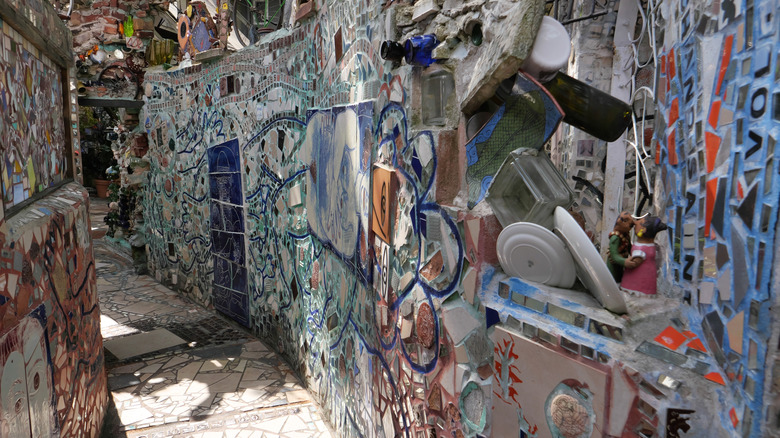
It's difficult to describe Philadelphia's Magic Gardens to someone who's never been there. Comprising a sprawling complex of enclosed and open-air "art environments" on South Street, this otherworldly destination is the brainchild of Isaiah Zagar, a local artist whose whimsical work can be found all around the city.
Step into the garden's colorful passageways to explore Zagar's eclectic mosaics made of ceramic tiles, broken bottles and dishes, mirror fragments, discarded bicycle wheels, and other reclaimed urban detritus that's been transformed into art. All of Zagar's work, including this quirky labyrinth, is meant to "trap people and change how they look, feel and dream," according to the artist.
Philadelphia's Magic Gardens are open from 11 a.m. to 6 p.m. every day except Tuesday. Admission at the time of this writing is $15 for adults, $8 for kids ages 6 to 12, and free for younger children. If you can, book a spot on a Morning Magic Tour ($25 per person, held on select days at 10 a.m.) to walk through the gardens with a knowledgeable guide. Find out more about visiting Pennsylvania's most unique urban art garden.
30th Street Station
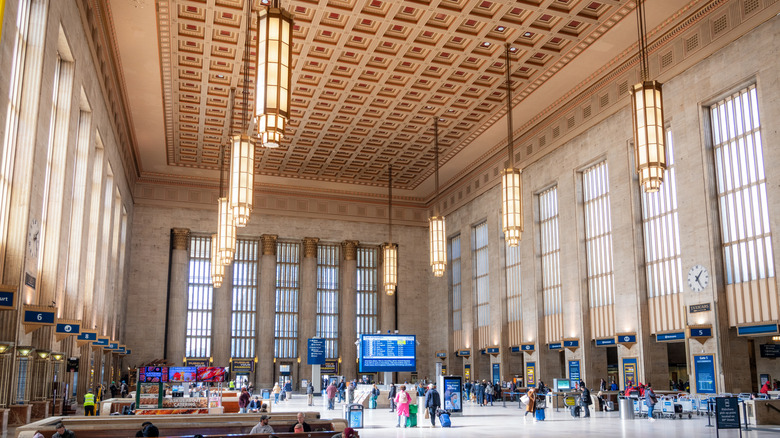
Depending on how you arrive in Philadelphia, you won't have to try very hard to see one of the city's architectural masterpieces. William H. Grey III 30th Street Station, a 1920s-era Amtrak hub on the banks of the Schuylkill River, is widely considered one of America's most beautiful train stations.
With its cool marble floors, soaring Corinthian columns, and eye-catching Art Deco chandeliers suspended from high coffered ceilings, the station's central hall looks straight out of a movie. And when you're getting off the train from New York, riding an escalator from the subterranean platforms up to the gorgeous main concourse, you can't help but feel like you're the one starring in it.
Art and architecture lovers coming to town should also consider going on a tour of the "mural capital of the world" with Philadelphia Mural Arts, and be sure to check out the Calder Gardens, the newest addition to Philadelphia's art scene. Dedicated to the work of Alexander Calder, who had family roots in the region, the striking museum is surrounded by lush native gardens and sun-drenched spaces. Read more about the best things you can't skip on a vacation to Philadelphia.