
5 Stunning Islands Across The World Just Like The Galapagos
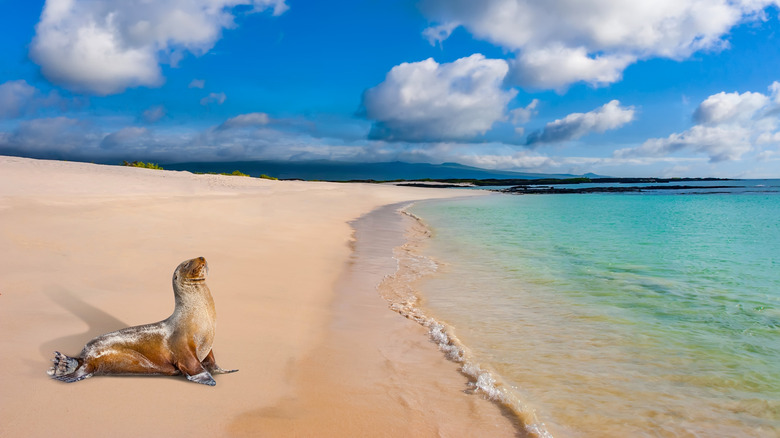
Wrought in a fire of molten lava, isolated out amidst the thrashing waters of the wild Pacific, and densely populated by weird and wonderful wildlife, Ecuador's Galapagos Islands are almost unique. So pristine that the entire theory of evolution could be mapped out through its distinct species, the "near-perfect family destination" is a wildlife wonderland with snorkeling bays and lava moonscapes.
However, the Galapagos Islands aren't alone in their otherworldly draw. Scattered over oceans and continents across the globe, an array of other islands has laid claim to being the "Galapagos of" each of their global locales. Distinguished by craggy volcanic coastlines and replete with unique endemic wildlife, these destinations are also renowned amongst animal enthusiasts and lovers of unblemished, isolated isles. If you're deterred by the price tag, the popularity, or the far-flung distance of the Galapagos Islands, these alternatives can offer a similarly spectacular experience.
Ballestas Islands, Peru
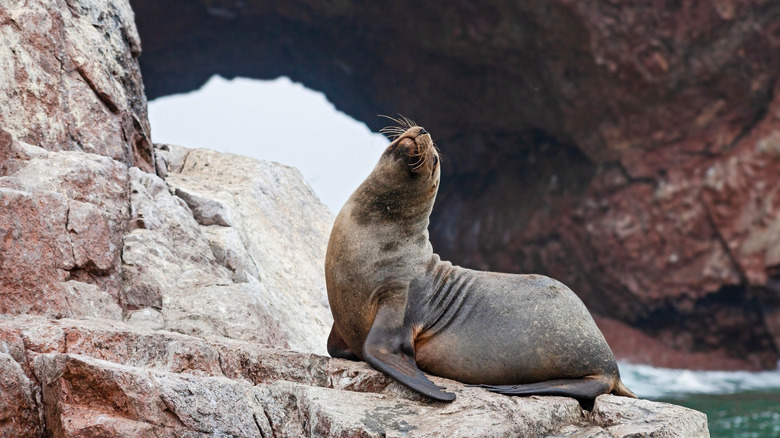
While local travelers may unfairly but affectionately hail Peru's Ballestas Islands as "the poor man's Galapagos," their stunning rock vistas and dolphin sightings make these underrated islands a treat to behold. A rocky archipelago exclusively inhabited by animals, the outcrop of rust-hued crag is an ideal day-trip destination for travelers looking to see wildlife without paying the Galapagos' price tag.
Located just off South America's west coast, they share much of the same marine life commonly found in the Galapagos. Plastered to its wave-lashed rock faces, herds of sea lions have to clamber over one another to acquire any free real estate in the prime sun lounging spots. Above their craning necks, flocks of sea birds whirl and roost, including the vast numbers of pelicans and waddling boobies found all over Ecuador's far-flung isles. They're joined by huddles of Humboldt penguins, the slightly larger cousins of the Galapagos penguins found farther north. Beyond the rocky rim of each island, the Pacific surface is skimmed by migrating humpback whales, leaping dolphins, and marine otters.
Found about 15 miles off the coast of the underrated beach town of Paracas, the islands are easily accessible to travelers visiting the Peruvian coast. Tour companies in Paracas offer daily excursions to the islands, on which visitors can spy the rare Galapagos-style wildlife from the comfort of the boat. The easiest way to access the gateway town is to catch a bus or rent a car to travel the 160-odd miles from the capital city of Lima, which has an international airport with direct flights to more than half a dozen U.S. hubs.
Haida Gwaii, Canada
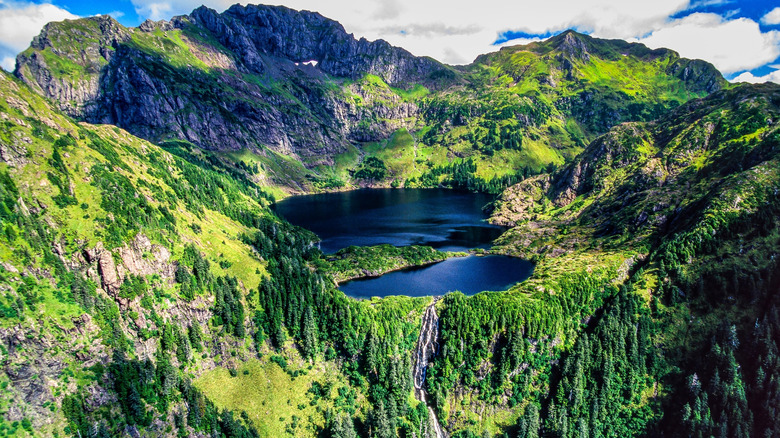
Doused by the characteristic steady rainfall of the Pacific Northwest and filled with thick forests of ancient evergreens, British Columbia's Haida Gwaii archipelago may not have the same tropical, equatorial heat as the southerly isles. Nonetheless, many refer to the islands as "Canada's Galapagos," including outlets like National Geographic, due to the wealth of unusual and endemic wildlife found on both. Haida Gwaii swaps sea lions for plodding black bears and iguanas for cute, weaselly Haida ermines, but both destinations are distinguished by their abundance of animals and prime wildlife-spotting opportunities.
Made up of more than 150 islands off the northern coast of British Columbia, tucked beneath the southeastern corner of Alaska, the archipelago is so far-flung that Go Haida Gwaii's byline is, "Once you've reached the edge of your world, ours begins." Its remoteness allowed it to flourish under the stewardship of its indigenous Haida population, resulting in the pristine condition of its temperate rainforests, mist-bleared shores, and volcanic topography.
Despite being tucked away in the northeast corner of the continent, accessing Haida Gwaii is a relatively straightforward process. Air travelers can catch a flight to the islands from Vancouver International Airport, a major transit hub that receives direct flights from most U.S. hubs. Those looking to island hop across the archipelago and take in the full breadth of its natural diversity can also join a small-boat expedition cruise, sailing past migrating whales and rugged coastal crags capped by dense green forests.
São Tomé and Príncipe
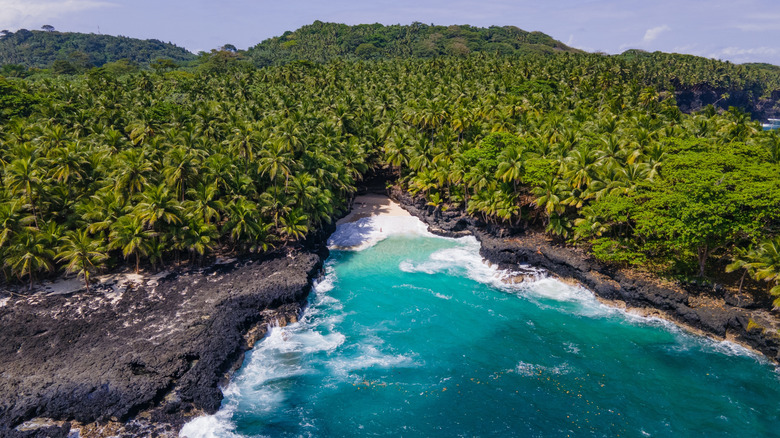
This smattering of islands strung out off of Africa's west coast has yet to become a hotbed of tourism. In fact, it is one of the world's least-visited island countries, despite being a pure paradise dubbed the African Galapagos. Roughly 170 miles off the coast of Gabon, São Tomé and Príncipe's diverse wildlife was given room to breathe. Between its soft sand beaches, turquoise waters, and the emerald forests that coat much of the inner isles, viridescent tropical birds and mega marine mammals thrive.
Much of the nation's verdant rainforests, mangroves, and grasslands are wrapped into Obo National Park, an essential destination for wildlife lovers exploring the island nation. Protecting almost 30% of the country, the park is teeming with slinking snakes, flamboyantly decorated frogs, and rare endemic birdlife with a variety comparable to the Galapagos themselves. Several species of endangered turtles scuttle onto the sand to lay and hatch their eggs between October and April, and boat tours are available to see migrating humpback whales and dolphin pods that travel just off the shores of São Tomé and Príncipe between August and October.
Though no U.S. airports offer flights to the far-flung African nation, it is easy to connect through other African or European hubs. São Tomé's airport has direct flights to Lisbon, Portugal; Accra, Ghana; and several other African cities. Upon arrival, the best and safest way to travel between islands is on one of the regular inter-island flights.
Komodo Island, Indonesia
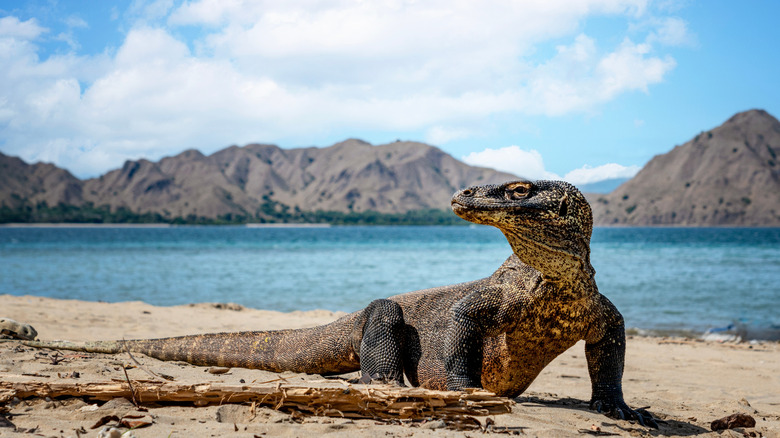
Few island nations on earth can compare to the enormous diversity and beauty of Indonesia, South East Asia's affordable, beach-filled tropical travel paradise. Spanning across more than 17,000 islands and seven major biomes, 12% of the world's mammal species can be seen there, 16% of the reptiles, and 17% of all birds. As such, several islands have been called the "Galapagos of Indonesia" or the "Galapagos of the East." But Komodo National Park and its eponymous Komodo Island are especially worthy of the moniker.
Most travelers venture to the sultry isle to spy a glimpse of the world's largest lizard: the gigantic, foreboding Komodo dragon. Though they may not breathe fire, the fascinating reptiles have populated the island for over one million years, living Ice Age relics whose ancestors once shared the planet with famous megafauna like the woolly mammoth and saber-toothed cat. Still a significant threat to the humans that travel to their island, they should be approached with caution. Park rangers accompany hikers on the 1.2-mile trek to Banunggulung, the best route for spotting the dragons in the wild. In addition to its famous reptilian inhabitants, Komodo Island offers exceptional snorkeling and diving amid its technicolor reefs, and otherworldly sun lounging on its pale pink sand beach.
There's no airport on Komodo Island itself, so visitors will have to catch a boat to access its pristine shores. Komodo Airport is actually in Labuan Bajo, on nearby Flores. The only direct flights depart from other Indonesian hubs or from neighboring Singapore or Malaysia. The most convenient is probably Singapore, where regular direct flights land from several U.S. cities.
Channel Islands, United States
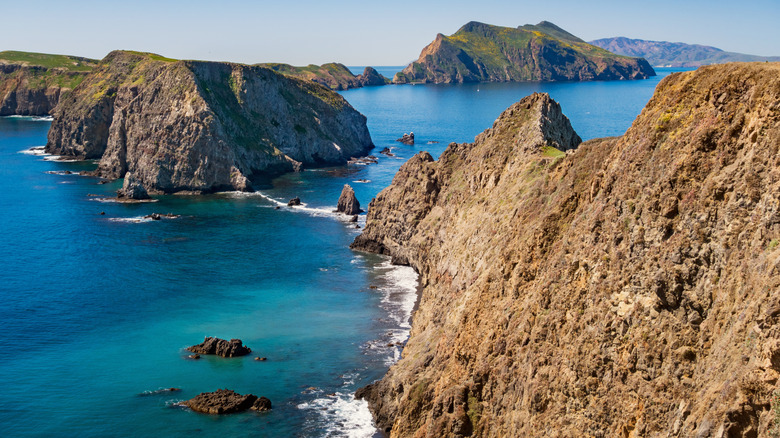
Comprised of a slew of quiet, craggy islands off the coast of California, this beautiful national park is best known as "America's Galapagos Islands." Unperturbed by the rest of the world for thousands of years, the islands' plant life and endemic animals evolved in isolation, resulting in rare encounters that travelers cannot find anywhere else on the planet. Its five tectonically forged islands, born millions of years ago from the furnace of a submerged volcano, are protected by the Channel Islands National Park.
While the wildlife varies from island to island, the best places for spying rare endemic animals are on Santa Cruz, Santa Rosa, and San Miguel, according to National Geographic. Hikers can take San Miguel's 13.6-mile round-trip trail to Point Bennett to witness a colony of more than 100,000 seals and sea lions, and explorers on Santa Cruz and Santa Rosa can scout for island foxes and island spotted skunks. Meanwhile, all travelers can hop on a marine tour cruising through the Channel Islands National Marine Sanctuary to spy some of the 27 species of whales and dolphins that have been seen here.
There are no hotels on the islands, no restaurants, and no significant tourism infrastructure to impede the wild coastal views. As such, there's no possibility of flying in, and travelers need to catch a boat from mainland California. Routes run to almost all the islands with varying seasonal schedules, the majority of which depart from Ventura Harbor. Just outside the city of Oxnard, the port is only an hour away from Los Angeles. Once on the islands, there is no transportation other than your own two feet.
Methodology
Each of the destinations selected claims, or has been assigned, the common moniker of the "Galapagos of ..." (their location): For example, the "poor man's Galapagos" or "Peruvian Galapagos," "Canada's Galapagos," the "Galapagos of Africa," the "Galapagos of Indonesia," and "North America's Galapagos." Many islands claim similar titles. In fact, Natural Habitat Adventures compiled a list of 25 "Galapagos" destinations around the world.
This list was influenced by the writer's travels to these destinations, as well as to the Galapagos themselves, which allowed for first-hand confirmation of the claim. Each island destination possesses a distinguishing feature typical of the Galapagos, such as abundant and unusual wildlife, volcanic rock formations, and exceptional biodiversity. Additional research was conducted based on expert recommendations, visitor blogs, and tourism office publications to gauge the experience of other travelers visiting these remote islands.