
12 Eerily Abandoned Mansions That Were Once-Thriving Pieces Of US History
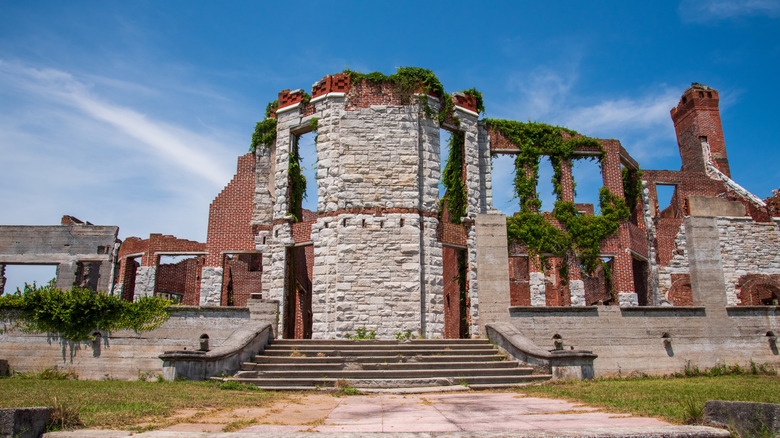
History is revered, right? Not always. Throughout the United States, there are plenty of once-stunning historic mansions that, although featuring distinguished architectural styles and esteemed former inhabitants, have been left to rot, leaving just shadows of their former grandeur, including this once-thriving Victorian mansion hidden in a golf course.
Some have even befallen that fate despite their places on the National Register of Historic Places or status as National Historic Landmarks. The reasons for their abandonment run the gamut, from damages too pricey to repair to murderous pasts. Unlike in their heyday, they're now overrun with greenery, graffiti, and fire damage.
Islands rounded up some of the eeriest of these American mansions, stretching from the Catskills of New York to the suburbs of California. To decide which made the cut, we determined which have the most interesting histories, including the former home of Abercrombie & Fitch co-founder David Abercrombie, and mansions that were the sites of infamous murders. We also considered which fell the furthest from grace and once had the most impressive features and amenities.
Arlington Estate, Natchez, Mississippi
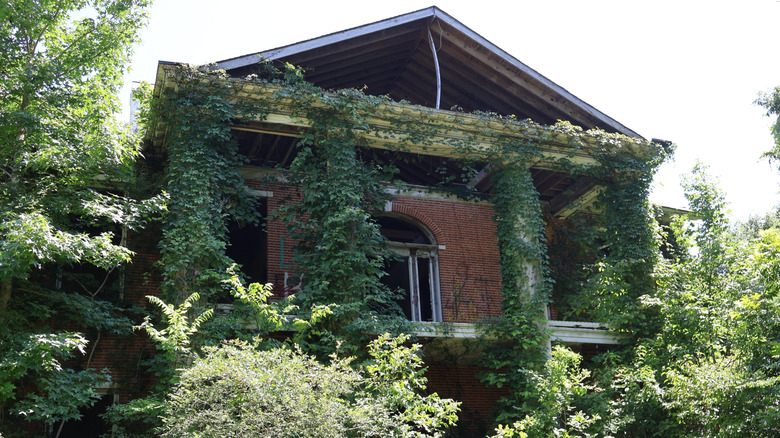
The hilltop Arlington Estate is an important Federal-style structure in Natchez, Mississippi, the oldest city on the Mississippi River. The estate is also on the National Register of Historic Places, a National Historic Landmark, and is home to trees listed by the National Live Oak Society. However, all of those accolades haven't shielded the estate from neglect. This red brick home is in ruins and has even been called one of the state's most endangered sites. The two-and-a-half-story property has endured fire and vandalism, and surrounding greenery has grown over its walls and columns. Inside, graffiti covers the walls and wood debris lines the floors.
For nearly a century, the property has been owned by the Vaughn family, who lived there through the 1990s. Their son, who is the current owner of the property, has been fined for neglect. The dilapidation is a far cry from the Arlington Estate's early days, when it was thought to be built for John Hampton White and his wife, Jane Surget White, possibly by architect Levi Weeks or by Hampton White himself in the early 1800s. However, the couple died soon after moving into their new home, with Hampton White succumbing to yellow fever and Surget White dying just a few years later.
Ashlar Hall, Memphis, Tennessee
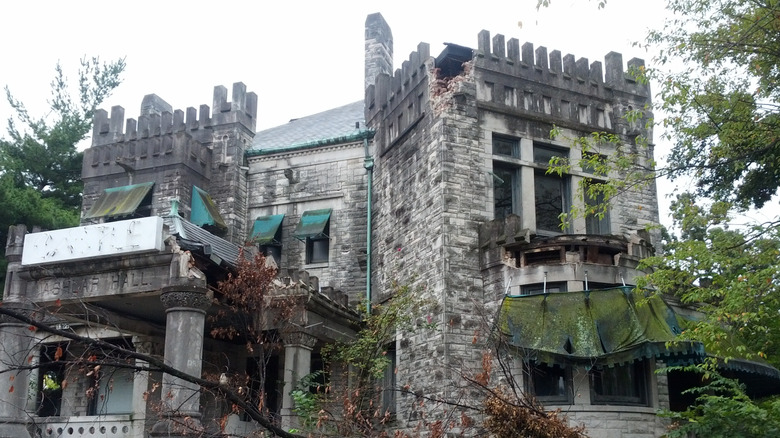
Like the Arlington Estate, a place on the National Register of Historic Places, hasn't been enough to salvage Ashlar Hall in Memphis, Tennessee. The 11,000 square foot property on 3,000 acres was built by Robert Brinkley Snowden in 1896 as his opulent personal home. It included servants' quarters, stained glass imported from Italy, and a pool. Brinkley Snowden spent $25,000, which equates to nearly $1 million today, to build the home. He lived in the estate — named after its Ashlar stone materials — until his death in 1942. After that, the two-floor mansion was a restaurant during the 1950s before it was sold to Robert "Prince Mongo" Hodges in 1990, when Ashlar Hall's troubles began.
Despite being a millionaire, Hodges was known as a bizarre local figure, having claimed to be more than three centuries old and born on another planet. Hodges also ran in countless Memphis mayoral elections but never won a race. He transformed Ashlar Hall, which he dubbed "The Castle," into a wild nightclub until the fire marshal changed the club's occupancy from 451 to 88, effectively ending its bar tenure. Since then, it's served various uses, including as a nonprofit for veterans and a theater, but has mostly sat abandoned. These days, its wallpaper is peeling, and its walls are covered in graffiti. A sign from the castle's days as a nightclub, as well as a forgotten piano, remains inside.
The Cape Romano Dome House, Florida
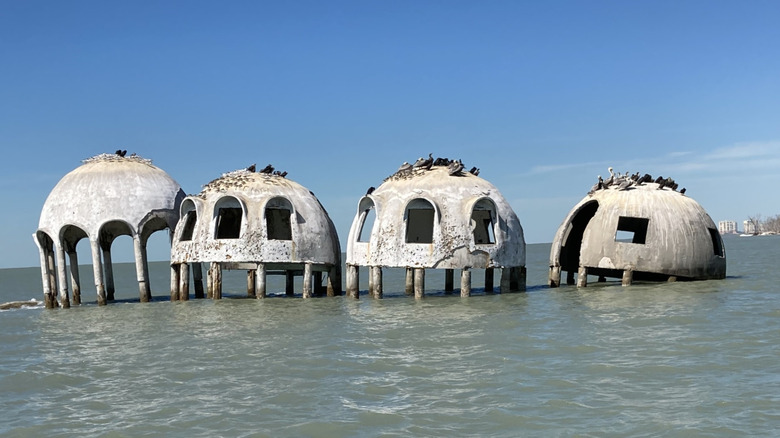
Take one look at the six white concrete domes that hover above waters off Marco Island, Florida, and you'll think you're looking at the remains of a spaceship. However, the structure, called the Cape Romano Dome House, was actually the 2,400-square-foot vacation home of retired oil producer Bob Lee, who began building in 1980. Lee intended to make his property hurricane-proof, and also save space and foster sustainability. The domes were made of local sand, and rainwater was amassed and purified for use.
However, the local environment soon worked against the Cape Romano Dome House, and the idea to make the house hurricane-proof didn't come to fruition. Hurricane erosion brought water levels to unprecedented heights, and Lee sold the home to a new owner, who planned to move it to a new location. That didn't work out when the county deemed the home unsafe and ordered its demolition.
In less than 10 years, its value plummeted from $300,000 to just $125. In the coming years, storms — including Hurricane Ian in 2022 — brought the Cape Romano Dome House to its knees. Now owned by the state, it sits partially underwater with sea life being its only residents. However, that hasn't stopped tourists from visiting, who have climbed atop the domes and etched their names on them.
Dundas Castle, Roscoe, New York
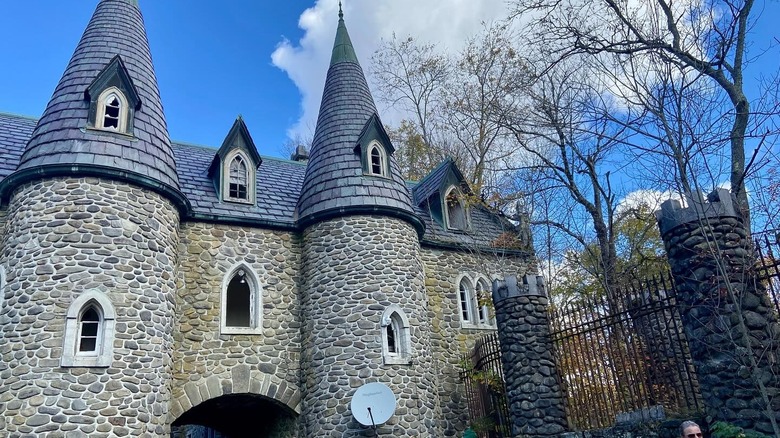
The story of Dundas Castle reads more like a horror film than the story of a real-life castle. It begins in the 1880s, when Bradford Lee Gilbert constructed the castle as a summer home for him and his Scottish wife, who inspired the castle's Scottish nickname of Craig-E-Clair Castle after the name of a Scottish village. The castle is in Roscoe, New York, the 'gateway to the Catskills.'
In the early 1900s, the castle was purchased by Ralph Wurts-Dundas. He sought to make the castle appear more medieval with a courtyard, an L-shape, an Elizabethan and Gothic Revival style, and grand staircases. With a European flair, Wurts-Dundas also imported a slate roof from England, white marble from Italy, and iron gates from France for his castle. It resembles Dundas Castle in Edinburgh, Scotland.
Unfortunately, he died in 1921 before he could complete the transformation of his new home. Soon after his death, his wife, Josephine Wurts-Dundas, was committed to a sanitarium. Some people claim her ghost haunts the property, although there is no evidence that she — or anyone else — lived there. Their daughter, who inherited the castle, was also committed to a sanitarium after she trekked to England with the help of a mystic to find "St. John's Gold." After that, the castle was used as a kids' summer camp and then a retreat for the Prince Hall Grand Lodge of the Masons, which owns it today.
Dungeness Mansion, Cumberland Island, Georgia
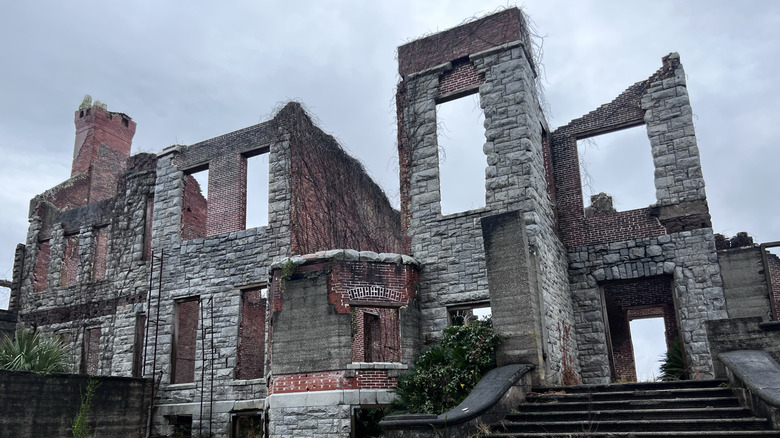
Owning nearly the entirety of a private island sounds great in theory, but it didn't quite work out for Thomas Carnegie, Andrew Carnegie's brother. During the late 1800s, Thomas and his wife Lucy began building Dungeness Mansion, a 59-room St. Ann-style mansion on the 36,000-acre Cumberland Island in Georgia. The island, of which they owned 90%, is hidden south of Savannah and is Georgia's largest barrier island, full of wild horses and beachy campgrounds.
Thomas first planned the island to be his winter home and then his retirement home. It had an indoor pool, squash courts, a golf course, and 40 buildings to house 200 servants. Although he died in 1886 before Dungeness Mansion was completed, Lucy and their kids lived there, as well as in other homes they built on the island full of beaches, forests, and marshes.
However, the Great Depression made the island even more economically unfeasible, and the family began to vacate their once-grand estate. That abandonment became more dire in 1959 when Dungeness Mansion caught fire for three days — thought to be arson — leaving just the pile of ruins. Today, people can visit the ruins, which are part of the Carnegie Island National Seashore.
Elda Castle, Ossining, New York
Abercrombie & Fitch is a household name, and brand co-founder David Abercrombie was a bigwig in his heyday, using his fortune to complete a 25-room medieval Scottish-style castle in 1927 in Ossining, a village hidden in New York's Hudson Valley that's a cute riverside gem with hillside views and quaint shops.
Abercrombie named his three-story home Elda Castle, an acronym he molded from the first letter of his children's names — Elizabeth, Lucy, David, and Abbott. Located on a 300-acre property with horse trails, a pool, and two ponds, the home featured locally quarried stone, arched windows, a spiral iron staircase, servants' quarters, and stunning views. It also included a living room with a dumbwaiter, a three-car garage, a gun room for Abercrombie's vintage rifle collection, and a conservatory.
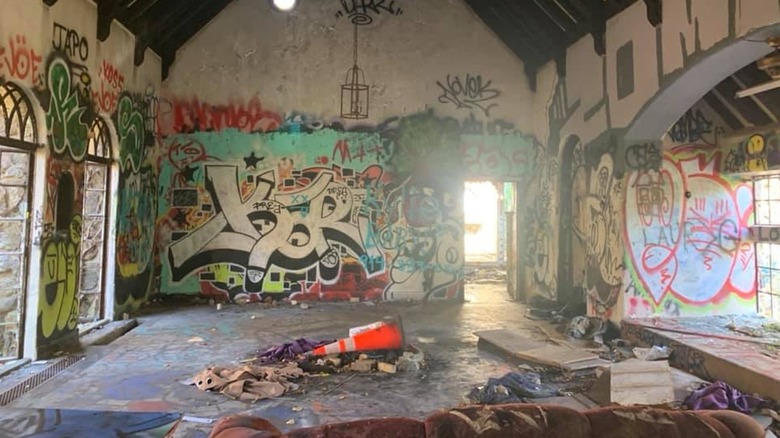
However, following Abercrombie's death a decade later after suffering rheumatic fever, Elda Castle began to falter. It saw several owners, including a paint research company and a couple who sought to transform it into a conference center. Efforts failed, and the castle sat abandoned and vandalized after 2012, without functioning plumbing or electricity. It became even more derelict after 2022, when a fire engulfed the castle. It was purchased by a new owner in early 2025 for $1.5 million after eight years on and off the market.
Ha Ha Tonka Mansion, Camdenton, Missouri
Camden County is home to Ha Ha Tonka Spring, a natural spring whose name translates to "laughing waters" in the language of the Osage indigenous people. So, when businessman Robert Snyder decided to build a three-story European-style castle in the area, he named it Ha Ha Tonka Mansion. Snyder used locally quarried sandstone to start building the 20-room castle on 2,750 acres in 1905.
However, Snyder never saw his plans come to fruition. He died in a car crash before the castle could be completed, leaving his wife and his brother George to continue his dream. Later, his son Robert Jr. continued their efforts, and by 1921, he was able to move in, although Ha Ha Tonka Mansion remained incomplete. When he moved out a few years later, the mansion fell into disrepair. But Josephine Ellis later signed a lifetime lease, and by 1939, she was hosting private events there after a renovation. The events included garden club parties, women's club meetings, weddings, and rotary meetings.
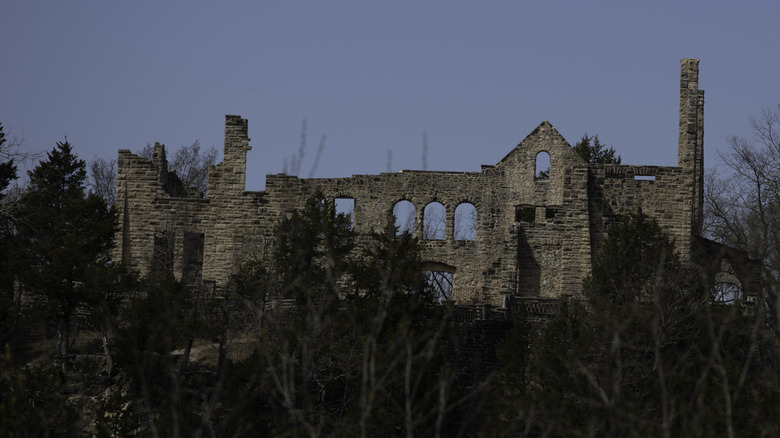
Ha Ha Tonka Mansion's newfound glory was short-lived. In 1942, it caught fire due to a fireplace ember. Its ruins sat abandoned until 1979, when the Department of Natural Resources bought the property and opened it as Ha Ha Tonka State Park, making it one of Missouri's largest natural springs and a unique state park. Today, people can visit the park and see the remnants of the once-grand mansion.
Los Feliz Murder Mansion, Los Angeles, California
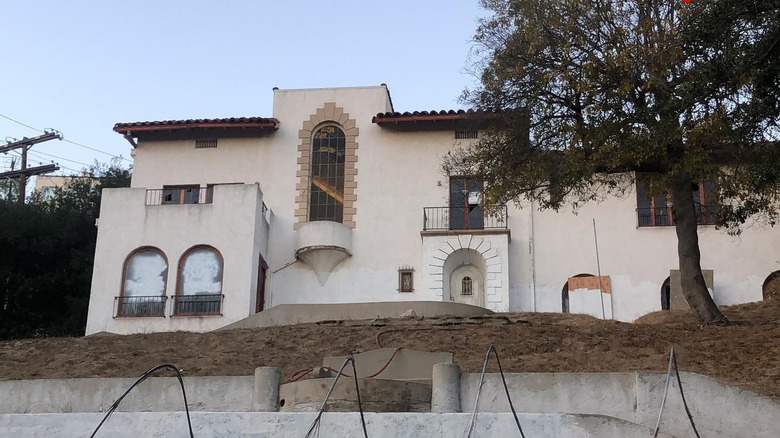
On December 6, 1959, a seemingly wealthy doctor murdered his wife in a five-bedroom, 5,000-square-foot home in the Los Feliz neighborhood of Los Angeles, which has since been dubbed the Los Feliz Murder Mansion. Riddled with financial difficulties, Dr. Harold N. Perelson had been treated for schizophrenia and other psychiatric disorders. As the subject of countless blogs and articles that theorized hauntings, the home has sat abandoned since the killings, despite several buyers who strangely never moved in. However, it turns out the abandonment isn't quite so mysterious.
Following the murders, the home was purchased by Emily and Julian Enriquez, who later bequeathed it to their son, Rudy. Although he never moved in since he didn't need the colossal size, he used it for storage, and kept it in memory of his parents. The attorney who bought the mansion in 2016 for $2.28 million didn't move in either, due to permit issues they encountered when trying to renovate it. That legacy only continued with the next owner, Ephi Zlotnitsky, who bought the mansion in 2020 as a real estate investment and unsuccessfully tried to sell it again two years later. He faced foreclosure on the home in 2024.
Allan Lucy Murder House, Uniontown, Alabama
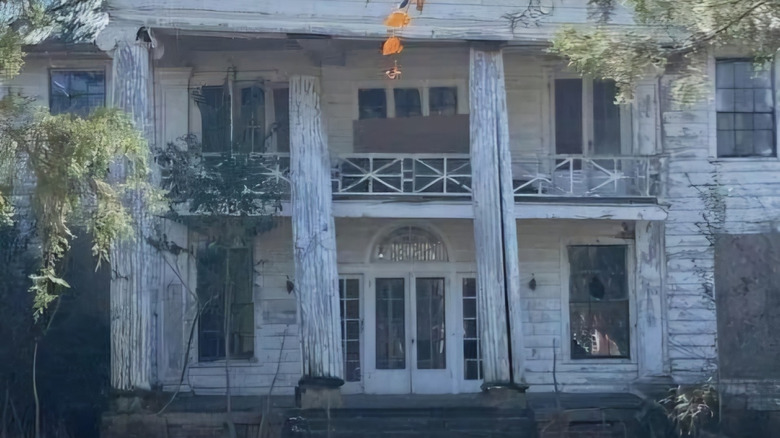
The Los Feliz Murder Mansion isn't the only home on this list abandoned after its dark past. The same fate befell the 1918 Hardie-Coleman House — otherwise known as the Allan Lucy Murder House — in the Uniontown Historic District in Uniontown, Alabama. The two-story, neoclassical revival-style home was once the residence of the Lucy family and their 13-year-old adoptive son, Allan, until they claimed he ran away to Florida, where he was born.
But nearly a decade later, in 1994, when the property was sold to new owner Kelly Kirby, Allan's body was found here during renovation and inspection efforts. Adoptive father Philip Lucy, who had a violent past and had been dishonorably discharged from the Army after beating a soldier, was found guilty of Allan's murder and sentenced to life in prison. After a fight, he had struck Allan in the head, killing him, an account shared by Philip's son, Jason. Philip wrapped Allan's body in a Disney blanket with some of his belongings in a trash bag under the porch.
Today, construction materials are still in the rooms, awaiting the renovation that never came. Outside, tall grasses and trees have engulfed the property, and some of the once-grand columns on the front façade have collapsed. The house is now owned by the Elmendorf Air Force Base in Alaska.
Lynnewood Hall, Elkins Park, Pennsylvania
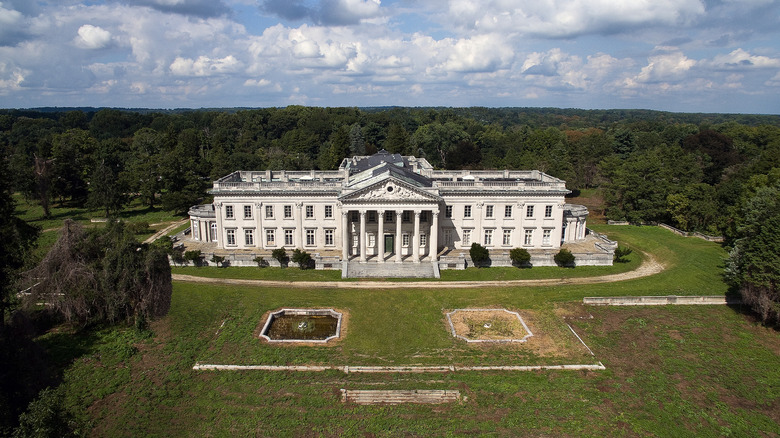
Spanning 70,000 square feet and resembling the White House, Lynnewood Hall in Elkins Park, Pennsylvania, has been called one of the greatest surviving Gilded Age mansions in the country. And rightfully so — it features 110 rooms, an art gallery, an indoor pool, and a 1,000-seat ballroom. But just because it's survived doesn't mean it's thriving. Although nicknamed "The Last American Versailles," Lynnewood Hall is now abandoned, its rooms ghostly spaces where diplomats and royalty once visited.
The home was built between 1898 and 1900 for Peter Arrell Browne Widener, a former Philadelphia city treasurer, oil investor, butcher shop chain owner, streetcar magnate, and art collector. After amassing his fortune, he wanted a home where he could showcase his artwork and also raise his family, and thus Lynnewood Hall was born. The mansion, designed by architect Horace Trumbauer, had 100 servants and included a 117-acre farm, a half-mile race track, horse stables, a power plant, and a bakery. But after Widener died in 1915 and one of his sons, who inherited Lynnewood Hall, died in 1943, the home began to lose its light.
Lynnewood Hall spent time on and off the market, eventually serving as a theological school. However, the controversial school struggled with maintenance costs, leading to its decay. Today, costs to revive the mansion remain astronomical, but its future may be auspicious — in 2023, Glenside Local reported the Lynnewood Hall Preservation Foundation purchased the landmark.
Wyckoff Villa, Carleton Island, New York
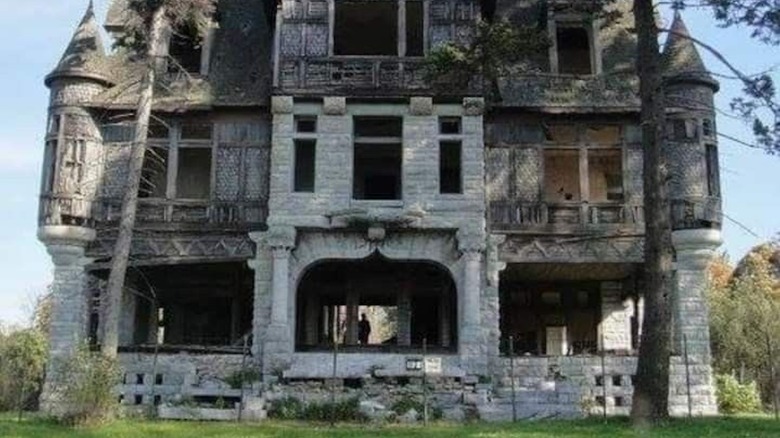
After William Wyckoff hit it big by developing a typewriter for the Remington Arms Company, he used his newfound cash to have architect William Henry Miller design a vacation home for him on Carleton Island, a remote island in Cape Vincent, New York. In 1895, Wyckoff Villa was unveiled with at least 50 rooms, 11 bedrooms, three waterfronts, a stone foundation, and a tower.
However, Wyckoff never got to enjoy it — he died from a heart attack on his first night in his new home. He bequeathed the home to his sons, but by 1927, it had seen its last residents. Even after being listed for just $495,000 in 2022, Wyckoff Villa continues to sit empty and deteriorate.
It lacks its windows and doors, which were taken for use during World War II, and parts of its roof are missing. That exposure to the elements only accentuated the villa's demise. Now, the costs to bring it back to life are sky-high, which are only amplified by the villa's island location. The villa isn't connected to any utilities, nor does it have bathrooms.
Wyndclyffe Mansion, Rhinecliff, New York
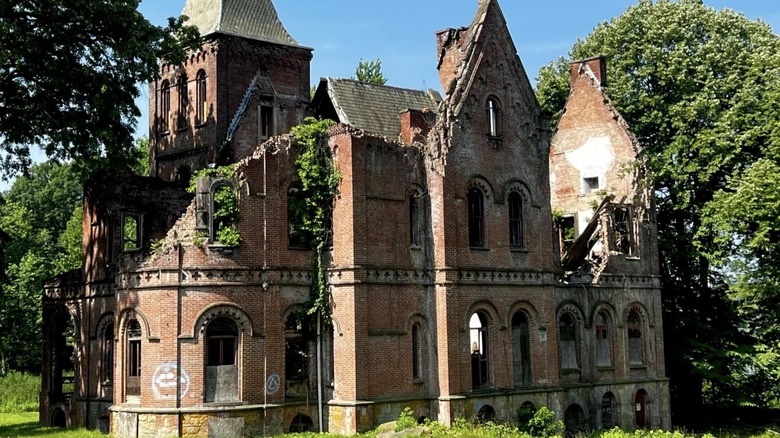
Judging by its forlorn appearance today, it's hard to imagine that Wyndclyffe Mansion in Rhinecliff, New York, was once so grand that it inspired the saying "keeping up with the Joneses." Owned by millionaire Elizabeth Schermerhorn Jones — related to the Astors and aunt of Edith Wharton — the 1853 brick Gothic and Norman-style mansion was designed with 24 rooms, three floors, and a tower with commanding views of the 80-acre estate. It also included a carriage house, boathouse, and a dock, as it overlooks the Hudson River.
But Jones' ownership was the glory days of Wyndclyffe Castle, when it inspired other high-society members to build their own imposing homes in the area. After Jones died in 1876, Wyndclyffe Castle saw several owners and name changes. Following the Great Depression, it was abandoned by the 1950s. Today, it continues to decline, with some of its floors missing.