
12 Most Jaw-Dropping Train Stations Across The US
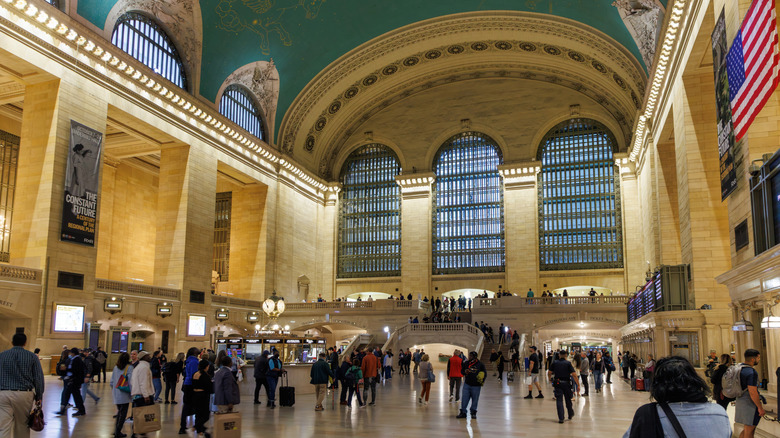
Many of us travel in and out of train stations without more than a glance around our surroundings. We're eager to get to our next destination, with our eyes glued only to our phones or a sign sharing which platform our train will arrive at. But if we only stopped to look around, we would see that America's train stations are full of beauty, with many of the nation's best dating back more than a century and full of amazing murals, towering ceilings, sunny skylights, and intricate details molded with care by famed architects.
Islands rounded up the most beautiful of these stations, ranging from Grand Central Terminal in New York City, known for housing the biggest Tiffany-glass clock in the world, to the one-of-a-kind Union Station in Los Angeles, California, sporting a unique Mission Moderne style. To determine which stations made the cut, we evaluated those that have the most jaw-dropping features like grand columns, works of public art, and original details. We also considered which are most often called beautiful by media such as Thrillist and National Geographic, and have also been recognized for their importance, like being named National Historic Landmarks or sites on the National Register of Historic Places.
Chicago Union Station, Chicago, Illinois
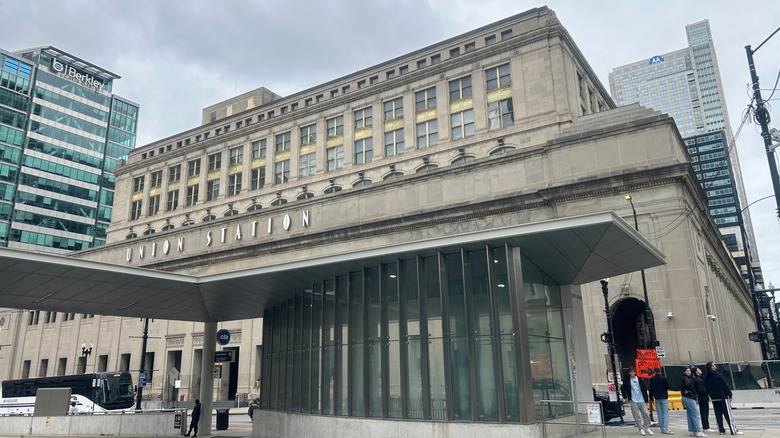
The design of the Chicago Union Station in the West Loop neighborhood was planned by architect Daniel Burnham. The Beaux-Arts style station includes a 115-foot-tall skylight; Bedford limestone quarried in Indiana; oak benches; light fixtures and chandeliers adorned with birds, bees, butterflies, and flowers; and statues signifying day and night — which are all original details that harken back to the station's 1925 completion, when it was constructed for $75 million (the equivalent of more than $1 billion today).
Burnham would likely be pleased to see what the city block-sized station became, as it has been named as a Chicago landmark and one of America's Great Places by the American Planning Association. It's utilized by three million Amtrak passengers every year and 100,000 Metra passengers every day.
Chicago Union Station has undergone renovations performed by the firm of Graham, Anderson, Probst, & White that started in 2010 to bring it up to modern speed, like the installation of a heat pump, sprinklers, electrical transformers, showers, and charging stations for passengers, as well as a new air conditioning system. Those renovations also included aesthetics — the station enjoys a revamped travertine on the Canal Street stairs and modern finishes in the Metropolitan Lounge.
Denver Union Station, Denver, Colorado
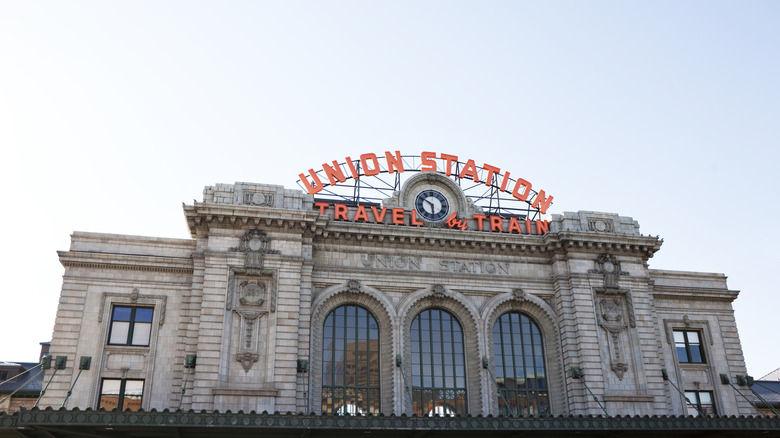
Denver Union Station in the Lower Downtown neighborhood of Denver, Colorado, has hosted countless passengers ranging from common folk to Queen Marie of Romania and former U.S. President Theodore Roosevelt. It's a Denver landmark, on the National Register of Historic Places, and one of the Denver destinations that looks even cooler in person. However, the future didn't look so bright at the get-go. Its first rendition, built in 1881 as the tallest building in the West, was destroyed by an electrical fire stemming from a women's restroom chandelier after just three years, and its second rendition became too small for use within 20 years. Finally, the current Beaux-Arts style station was unveiled in 1914, eventually seeing 50,000 people every day during its peak in the 1940s.
The 880-foot-long Denver Union Station was completely renovated in 2014, but it looks like it's still in its 1940s glory days. The station has many detailed features: blue leather Pullman car-inspired drinking booths; metal buckles, brass fittings, and caning inspired by vintage suitcases; custom columns; and bar signage that looks like old station signage boards. Those details have earned Denver Union Station plenty of accolades, including being named as Best Reuse of a Historic Building by Denver Westword, one of the Most Beautiful Train Stations in America by Thrillist, and a Best Visual Identity finalist by the Hospitality Design Awards.
Grand Central Terminal, New York City, New York
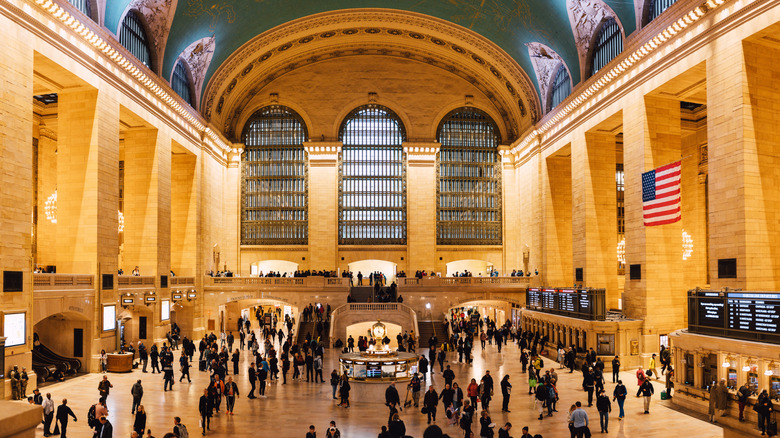
Upon New York City's Grand Central Terminal opening in 1913, The New York Times wrote that it was "not only the greatest station in the United States, but the greatest station, of any type, in the world." As the years passed, it was clear those words were true. It was the busiest train station in the country and even had its own art gallery, art school, movie theater, and history museum.
Today, the Beaux-Arts style station used by more than 21 million people annually is arguably the most iconic and one of the most beautiful on the planet, with no stunning train station list complete without it. But with the world's largest Tiffany-glass clock valued at $10-$20 million, a vaulted plaster ceiling with 2,500 stars portraying a background Mediterranean sky, and sculptures of Roman gods, how could it be forgotten?
Those design details are spread throughout the 275 by 120-foot station with 30 platforms — which is more platforms than any other station in the world has. It was designed by two teams of architects under Reed and Stem, and Warren and Wetmore. It's only been accentuated since their efforts, as the station has been renovated and expanded several times and now has a food hall, five restaurants and bars, a market, and 68 stores. It also has one of the country's most stunning bars. The station is a city landmark and is on the National Register of Historic Places.
King Street Station, Seattle, Washington
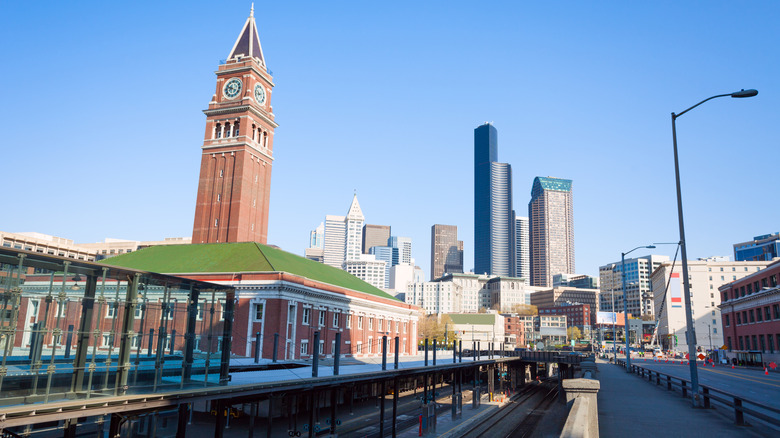
The Great Seattle Fire of 1889 in Seattle, Washington, had one silver lining. After the fire destroyed the city's wood train station, the King Street Station was built between 1904 and 1906 in what was referred to as Railroad Italianate style, a combination of Beaux-Arts, Neoclassical, and Italian Renaissance styles. With an L-shape design, it included a clock tower inspired by the campanile on the Piazza San Marco in Venice, Italy, as well as plaster ceilings, fluted Corinthian columns, a large bronze chandelier surrounded by smaller chandeliers, and a terrazzo floor with square mosaic tiles.
However, these details lost their original glamour as train travel became less popular during the 1900s and the station became dilapidated. Cheap renovations only hastened that demise — until train travel was needed in the city once more as local highways became increasingly busy.
Once that became clear, the National Register of Historic Places-recognized station enjoyed a $56 million revamp (which is equivalent to more than $80 million today) that was unveiled in 2013 after 15 years of work. Despite the modern timeframe of the renovations, the station is lit in its former glory, with a restored decorative plaster ceiling, polished terrazzo floor, and new terra cotta roof. Plus, the marble that once graced the walls was reinstalled, the formerly boarded windows were opened, and a new chandelier was mounted. The station was also revamped with sustainability in mind, as it now utilizes LED lights, low-flow fixtures, and natural ventilation.
Moynihan Train Hall, New York, New York
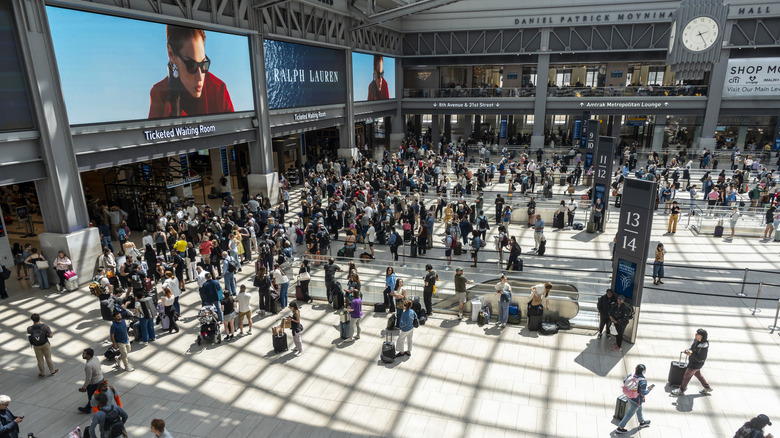
The Moynihan Train Hall in New York, New York, doesn't have the long history that the other stations on this list have, but it's just as beautiful. Its 2021 opening as part of the Penn Station complex unveiled a 92-foot skylight that creates a bright ambiance that's a stark contrast to the rest of Penn Station, as well as a ceiling with more than 500 glass and steel panels. Public art installations further color the space. The station also utilizes former details of its home inside the Beaux-Arts style Farley Post Office Building like formerly hidden steel trusses and arched windows. From here, you can also hop on this scenic U.S. train ride that's a coast-to-coast journey from skyscrapers to bayous.
The 255,000 square foot Moynihan Train Hall was built nearly 60 years after the original Penn Station was demolished after also being built by McKim, Mead and White when the need for train travel had lessened. But the need for an expansion of Penn Station became apparent when a half-million more people were using the station in 2010 than they were at the time of the demolition. So, the Moynihan Train Hall was born, named for project steamroller and former New York Senator Daniel Patrick Moynihan, giving the station 50% more capacity. With little current use for the Farley Post Office Building as well as a convenient location for a Penn Station expansion, a work of adaptive reuse was born.
William H. Grey III 30th Street Station, Philadelphia, Pennsylvania
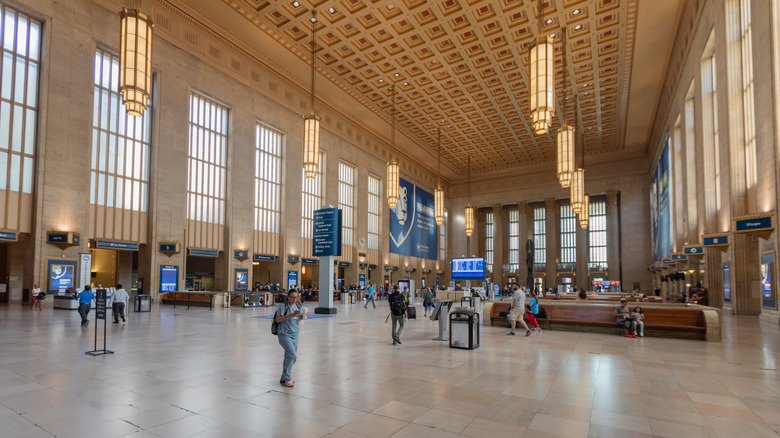
The Neoclassical-style William H. Grey III 30th Street Station in Philadelphia, Pennsylvania, was built in 1927 with eight stories, Corinthian columns, Alabama limestone, nearly 100-foot coffered ceilings, Art Deco chandeliers, and cathedral windows. One of America's best train stations, it has been named as one of the most beautiful train stations by outlets like Architectural Digest and National Geographic. The 30th Street Station was named for former U.S. representative William H. Grey III, who rallied against proposed Amtrak budget cuts and also fought for station renovation funding. It's now one of America's busiest Amtrak stations.
Listed on the National Register of Historic Places, the 30th Street Station also retains many of its original details and grandeur due to several renovations that have taken place over the years. Those include a $75 million Main Concourse renovation that lasted from 1988 through 1991 (which is more than $183 million today) and a 500,000 square foot renovation. Some of the changes that the station has undergone have also made use of the station's unique former spaces, like a non-denominational chapel that was used as a morgue during World War II, which is now a conference room.
Santa Fe Depot, San Diego, California
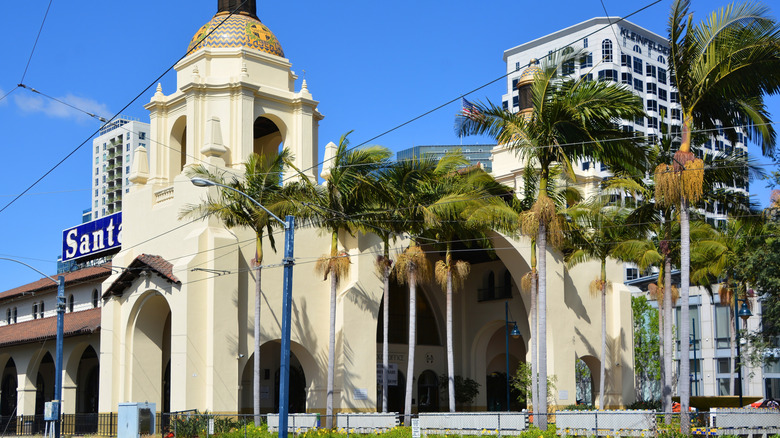
These days, San Diego, California, is chock-full of contemporary glass and steel buildings. But standing as a testament to the past is the Spanish colonial and mission revival style Santa Fe Depot, constructed by architectural firm Bakewell and Brown in 1915 and still standing as one of the biggest stations in the state. The station has plenty of features that date back through its century-old history, like original oak benches, 55-foot ceilings in the waiting room, ornamental tile work, nearly a dozen arches, and two 90-foot towers with blue and yellow tile domes. It's been visited by everyone from American presidents to celebrities.
However, the Santa Fe Depot could have become a pile of rubble if not for the work of the Save Our Heritage Organisation, San Diego's Historical Site Board, and former city mayor Pete Wilson. A modern redevelopment plan almost had it eliminated in 1972, before the modern redevelopment relocated to a new location after pushback. Then, rail modernization projects in the 2000s attempted to change the depot's historic design. Fortunately, people fought for its preservation, and the station is still resplendent in its historic beauty.
Union Station, Kansas City, Missouri
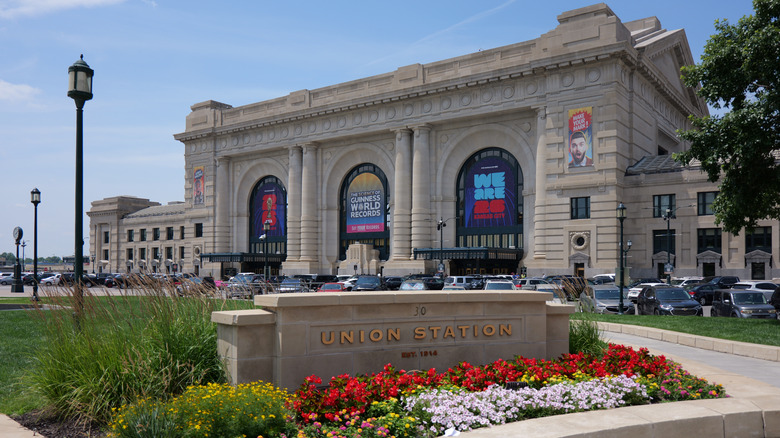
With a whopping 850,000 square feet, the Beaux-Arts style Union Station in Kansas City, Missouri, has captivated crowds since it opened in 1914, now attracting over two million people annually. And although more than a century has passed since its debut after being built by architect Jarvis Hunt, the station is still just as magical, featuring an ornamental plaster ceiling, grand columns, and several works of art showcasing the city's storied history.
Union Station got its start after Kansas City's former station in West Bottoms, built in 1878, was destroyed by flooding. Coupled with that disaster, it was obvious that the city needed a larger space for the increased amount of train travelers — which came to fruition in 1945 when more than 678,000 people utilized it while returning home from World War II.
But these days, Union Station is more than just a train station. It's also a living history museum, as it's home to Union Station Stories, an exhibit that explores its past, which includes a historic train conductor uniform, information on celebrities who have used the station, and architectural details. Plus, it has a model train gallery with 80 working model trains that visitors can watch encircle miniature communities. Or, to see a real train in all its glory, head to the station's Freight House Bridge, from which you can watch the trains passing below. The bridge also offers access to the Freight House District, which has several restaurants.
Union Station, Los Angeles, California
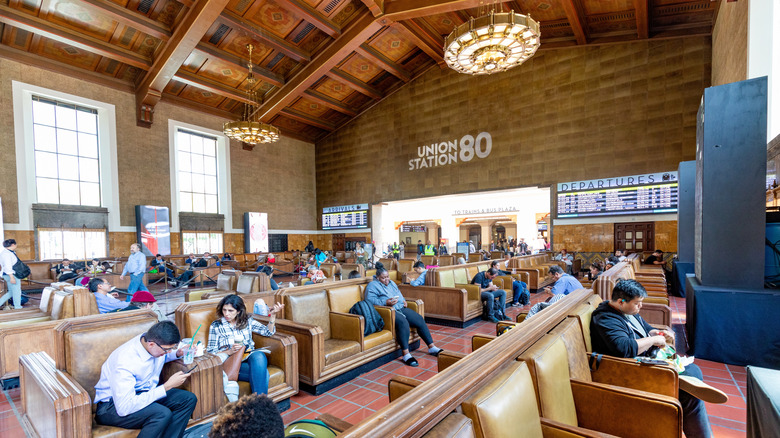
Union Station in Los Angeles, California, is the biggest railroad passenger terminal in the region, but its stunning looks don't end with its size. It also utilizes a unique blend of Spanish Mission and Art Deco styles, called Mission Moderne, created by architects John and Donald Parkinson for its 1939 construction. It was built in order to consolidate a trio of other local stations.
$11 million dollars — which would be more than $263 million today – was spent to give the station details like 40-foot windows, Art Deco chandeliers, hand-painted ceiling tiles, marble floors, a 100-foot clock tower, and walnut wood beams. It paid off — the station survived the car boom of the 1950s and is listed on the National Register of Historic Places. It's no surprise that it's even been called "the last of the great train stations." Plus, it's convenient — it has connections to Amtrak, the Los Angeles Metro, Metrolink, Greyhound, Megabus, and the Flyaway Bus, which offers transportation to and from LAX International Airport.
Union Station, Washington, D.C.
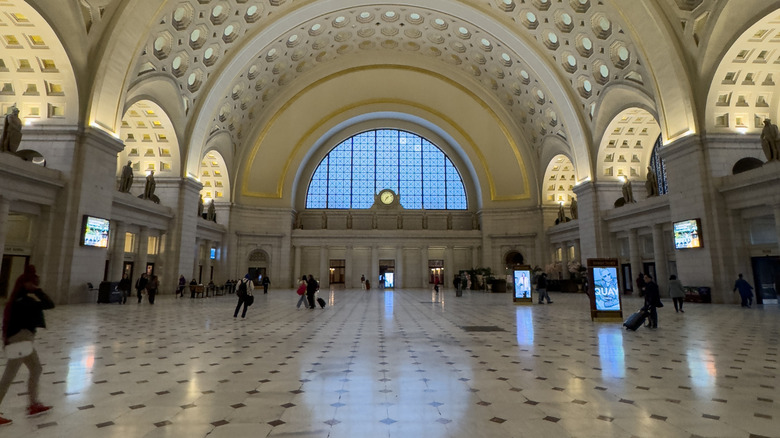
Washington, D.C., is full of some of America's greatest buildings, including the U.S. Capitol and the White House. But standing at the center of it all has long been Union Station, which sits at the crux of Massachusetts, Delaware, and Louisiana Avenues and First and E Streets NE — making it clear why it's known as "the grand gateway to the capital." It's even been named as one of the Great Public Spaces in America by The American Planning Association.
It was designed in 1907 for $125 million (which is equivalent to more than $4.4 billion today) by architect Daniel Burnham – who also designed Chicago Union Station — in a Beaux-Arts style with rostral columns and flagpoles topped with eagles across 200 acres with 75 miles of tracks. He purposely implemented Greek and Roman figures throughout the station, which is designed along classical lines. When Burnham designed it, it was the biggest train station in the world. Inside, it's even more beautiful, featuring a 96-foot barrel-vaulted ceiling with 22-karat gold leaf, a 626-foot-long loggia, and vaulted bays with pendant lighting, all which are seen by tens of thousands of people every day. However, keep in mind that this Amtrak train route is shutting down in 2026, leaving Washington DC travelers with fewer options.
Union Terminal, Cincinnati, Ohio
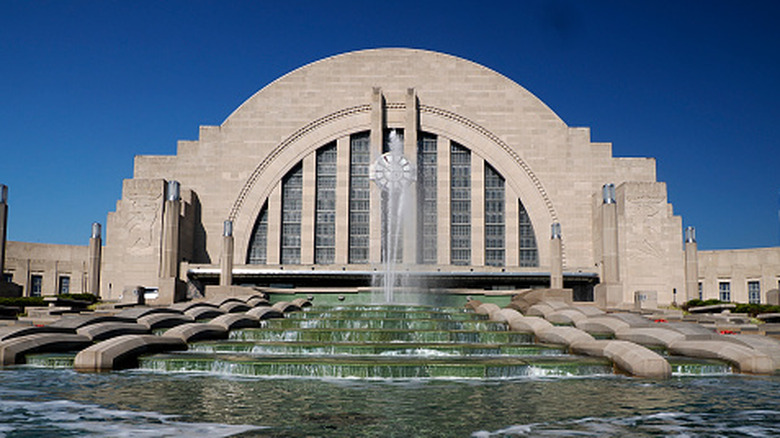
During the 1920s, it became clear in Cincinnati, Ohio, that a station was needed to merge more than a dozen rail lines. So, Union Terminal was born in 1933 in an Art Deco style. What's now one of the most beautiful train stations in America was designed by French-born architect Paul Cret and fellow architects Alfred Fellheimer and Steward Wagner. The station cost $41 million (which is equivalent to more than $1 billion today). Now a National Historic Landmark, the renovated 500,000 square foot station features a limestone and brick façade, the Losantiville dining room, and original painted murals by French artist Pierre Bourdelle.
The murals were especially important to Cret, as he intended for the terminal to hold tons of public art. A $228 million renovation was completed in 2018 after three years of work involving more than 2,400 workers. Plus, being that Union Terminal houses the Cincinnati Museum Center, the renovated station also includes revamped galleries, classrooms, laboratories, and self-select exhibits. It also has new mechanical, electrical, plumbing, security, and data systems.