
10 Hot Spring Destinations In Italy That Have Thermal Spas And Beautiful Views
We may receive a commission on purchases made from links.
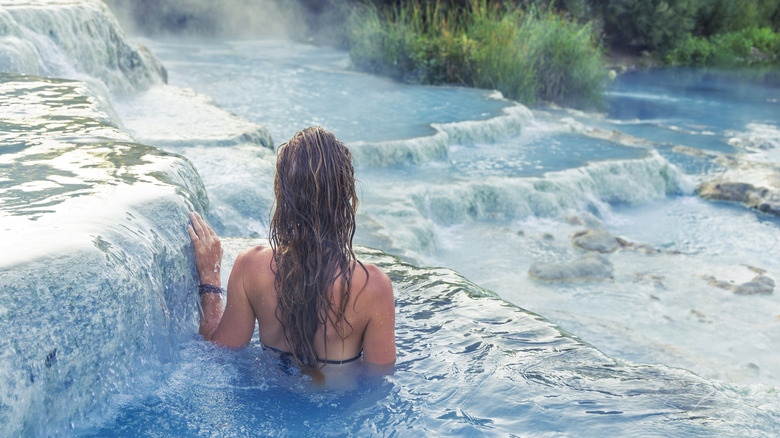
There's a moment between stepping into a steaming hot pool and the outside world fading away when a hot spring vacation to Italy suddenly makes sense. The Romans were the first to realize this magic. They transformed natural hot springs into elaborate social hubs where wealthy citizens built grand retreats, and emperors maintained private complexes. Even regular folk gathered to bathe, debate, and do business in these thermal sanctuaries.
Italy's thermal springs come framed by medieval hilltop towns, volcanic islands, alpine peaks, and rolling Tuscan countryside. The views alone are reason enough to visit. But it's that combination of healing waters and extraordinary scenery that makes these destinations truly unforgettable. The secret to them lies underground. The country's volcanic geology heats rainwater as it filters through, loading it with minerals such as sulfur, calcium, and magnesium. It then resurfaces with that fabled therapeutic potential.
Some of the benefits they promise are supported by science, but the evidence is still in development. We can't pretend to be experts — if you have a specific health condition, consult a doctor. But while we make no medical claims, we will say this — nobody ever regrets getting into a thermal spa in Italy. It's getting out that's the tough part. We consulted travel publications, specialist regional guides, and first-hand travel blogs to compile this list. Each destination was chosen for its first-class thermal spas, and each was explicitly confirmed for stunning views. So all you have to do is simply show up, get in, and enjoy the rewards.
Saturnia, Tuscany
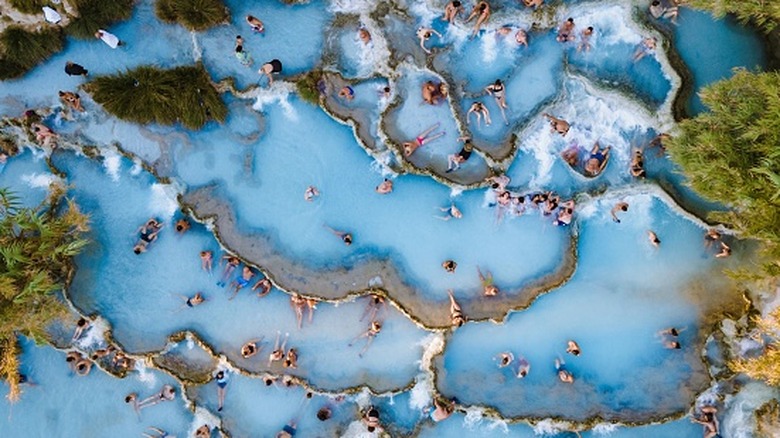
Legend has it that during a battle between Jupiter and Saturn, the giant planet struck Earth with a thunderbolt. The exact point where it was said to strike is where you'll now find the aptly named spa town of Saturnia in Tuscany. It's said that the celestial strike drew sulfurous water from the ground, and that water has been continuously running for over three millennia.
After spending around 40 years filtering through the earth, it surfaces at a steady 99.5°F. It's rich with sulfur and something called Saturnia Bioplankton. You won't find this organic mineral anywhere else, and it's prized for its cleansing and restorative properties. In fact, the Romans regarded the water as a divine blessing. Travelers to the region can still experience that divinity at this hilltop town in either a natural setting or at a world-class thermal spa.
Cascate del Mulino, a few miles outside town, is where to go if you want to experience natural hot springs in the heart of Tuscany. The pools there have been worn into travertine by centuries of the flowing spring. Waterfalls tumble around you, and the golden Tuscany countryside spreads wide in every direction. Bathing here is free and year-round, with winter a time to enjoy the steaming water at its most elemental. If it's pampering you seek, Terme di Saturnia, an internationally acclaimed thermal spa, offers guests indoor and outdoor pools. There are hot and cold vascular circuits for boosting circulation, steam saunas, and a private indoor area. Mud balneotherapy, Bioplankton skin therapies, and a range of massage treatments are also available.
Bagni San Filippo, Tuscany
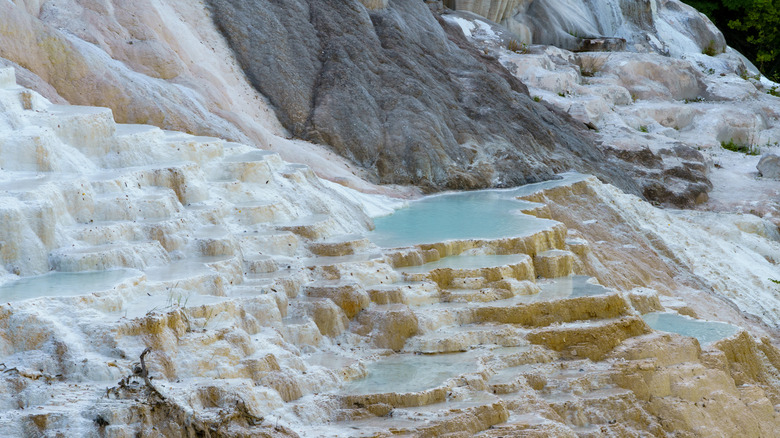
In the lush woodlands of Val d'Orcia, on the eastern slopes of Monte Amiata, is Bagni San Filippo. This is a remarkable spot for relaxation in hidden hot springs. The water here gushes out of the ground at a scalding-hot 118°F. As it threads its way through the trees and tumbles over centuries-old limestone formations, it cools to a comfortable bathing temperature.
It flows into the hot spring basins at Fosso Bianco. This is where you'll find the famous "White Whale," a vast formation of hulking calcium. It's known for its arresting sight of spearmint-blue pools spilling across limestone shelves. The color startles against the deep green of the surrounding trees, and the formation is in a constant state of flux. The water carves out new channels and shapes with each passing season, and winter rainfall further changes things. It adds organic matter that creates shades of olive or amber to the imposing structure.
Fosso Bianco is free to anyone who makes the walk. If you come in the early morning, the forest is silent, save for the sounds of water moving through the trees and the breeze gently disturbing the leaves. You'll find mud accumulating at the pool beds. It's rich in minerals, and visitors bathe and work it into their skin. A short walk away, the Terme San Filippo Resort channels the same spring into a more structured wellness center. There's a thermal pool in a parkland setting with professional mud therapy, hydrotherapy, and massage. The Tuscan city of Siena is just 41 miles away, but it is best to reach Bagni San Filippo by car, as public transport is infrequent.
Petriolo, Tuscany
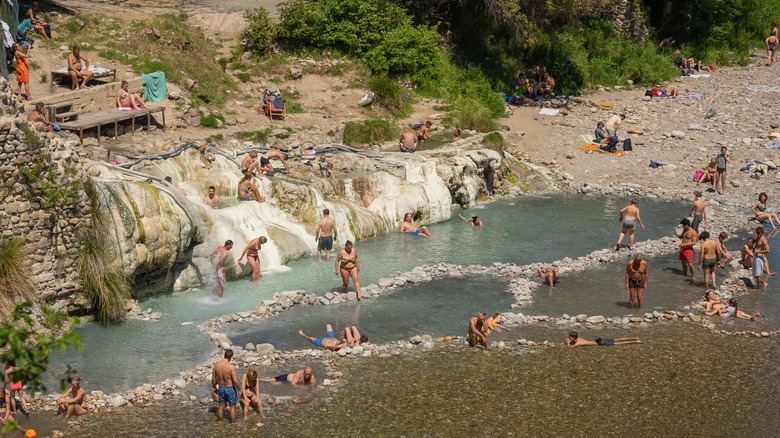
In the green hills between Val di Merse and Maremma in the heart of Tuscany is a place where woodland presses in on all sides. It sits in a primordial peace and silence that recalls something older and wilder than today's world. Bagni di Petriolo's hot springs have drawn visitors since antiquity. The Roman statesman Cicero wrote about them, and the poet Martial put them in verse. Pope Pius II made repeated visits to seek relief from the gout that plagued him, while members of the most powerful Renaissance families made frequent visits. It's a historic place, and it shows.
The medieval walls and watchtowers of Castello Termale di Petriolo date back to the 15th century. They still encircle the Petriolo thermal springs, with a single Roman bath of the original four still standing. Its curved arches face the Farma River, where the hot mineral water tumbles down, collecting in pools before reaching the river. The water gushes out at 109°F at the source but cools to a bathable 95°F further downstream.
The sulfur-rich water is loaded with hydrogen sulfide, calcium, and fluoride and provides the skin with anti-inflammatory and regenerative benefits. They are also said to ease joint pain, loosen muscles, and clear the respiratory tract. The Petriolo thermal springs are free to use. Nearby, the Terme di Petriolo channels these same ancient waters into a full thermal spa experience. Mud treatments, essential oil massages, and a full range of thermal therapies are all available at this spa, which has been in operation for over six centuries.
Bormio, Lombardy
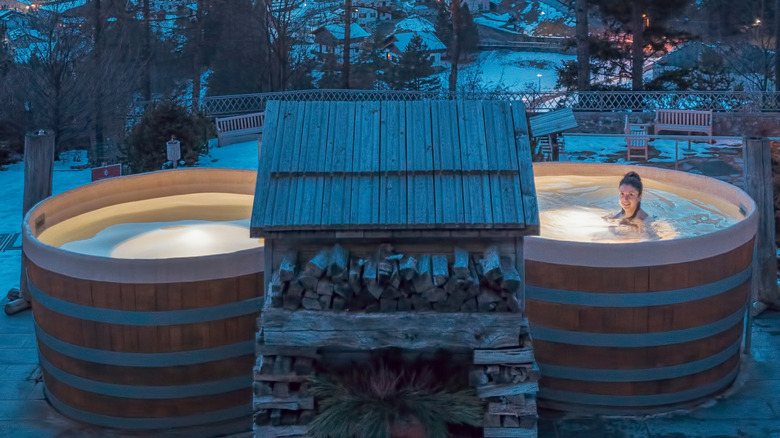
Just 125 miles north of Milan is Bormio, a town that sits at over 4,000 feet in the Italian Alps. It's one of Italy's premier ski resorts, having hosted the men's Alpine competition at the 2026 Winter Olympics. But it is also home to the largest thermal park in the Alps. Bormio is nicknamed "Wellness Mountain." It draws on nine natural hot springs from the slopes of Monte Reit, and after a hard, cold day on those slopes, these thermal waters are the perfect way to warm your bones.
The oldest of the town's three spas is QC Terme Bagni Vecchi. It has been attracting soakers for more than 2,000 years. Pliny the Elder referenced them in his Naturalis Historia, the ancient world's pioneering attempt at a scientific encyclopedia, while da Vinci mentioned them in his Codex Atlanticus. The spa is built into a cave system carved from the mountain bedrock, and each of the nine baths is named after the eras that shaped it. At its heart lies a stunning outdoor infinity pool, carved from stone and perfectly positioned within breathtaking surroundings. Overlooking the Stelvio Pass, Italy's highest mountain pass, it offers spectacular open-sky views and dramatic mountain landscapes.
Down the road, the QC Terme Bagni Nuovi spa dates back to the 19th century. A mere newcomer in comparison, but no less beautiful. Its Art Nouveau architecture surrounds seven outdoor pools arranged across beautifully manicured gardens. If you're looking for something more family-friendly, Bormio Terme in the town center has kid-friendly pools and relaxing spa treatments to rejuvenate parents.
Ischia, Campania
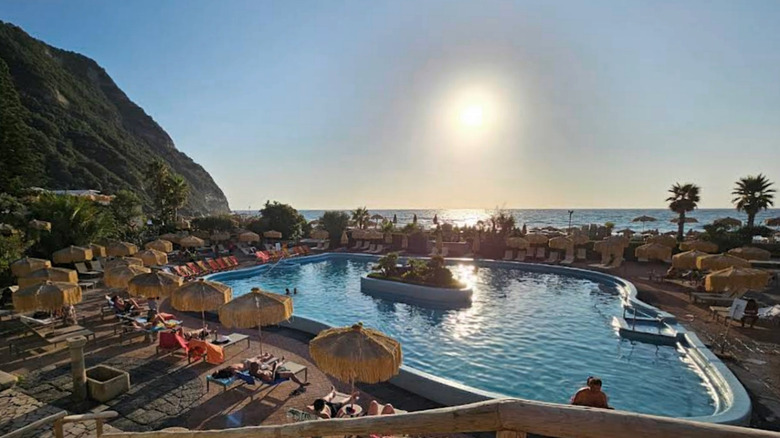
Ischia is a large volcanic island in the Tyrrhenian Sea about an hour from Naples by ferry. Nicknamed "L'Isola Verde" ("the Green Island") for its lush, mountainous landscape, it is every bit as alluring as nearby Capri, but without the crowds. The thermal waters have defined the island for thousands of years. The ancient Greeks were the first to bathe here, but it was the Romans who created public thermae across the island and established the springs as wellness centers.
One of the best free springs is at Baia di Sorgeto, a natural cove on the island's southwestern shore. Here, hot water from underground rises through cracks in the cliffs, forming natural rock pools of different temperatures. The water can reach as high as 194°F, and generations of islanders have actually been using some of the pools as cooking pots. In the sea, it's a more bathable 98°F, even in winter. But on top of great picnics and bathing, the half-moon crescent and turquoise water cupped between the steep volcanic cliffs are also very beautiful.
Of course, the island still offers plenty of luxury thermal spa resorts, too. Among them is the ancient Roman cave baths at Terme di Cavascura Thermal Day Spa. Volcanic mud treatments are the specialty there, but at Giardini Poseidon Thermal Park, you'll find 20 open-air pools lining the Bay of Citara. A short drive away at the Bay of San Montano, gardens filled with contemporary art installations define Negombo Thermal Park. However, all the thermal resorts and parks are open only between mid-April and October, while the free springs are available for your pleasure year-round.
Chianciano Terme, Tuscany
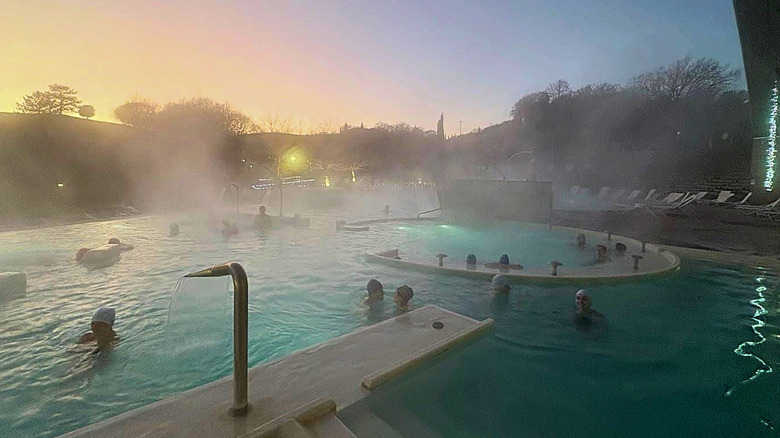
Four springs rise from the grounds at Chianciano Terme, a spa town in the province of Siena, Tuscany — and each does something different. Acqua Santa, Acqua Sillene, Acqua Fucoli, and Acqua Santissima help with things like arthritis, rheumatism, and circulatory problems. This specialization has drawn visitors to the town since Etruscan times, around 2,500 years ago. It sits between the valleys of Val d'Orcia and Val di Chiana and is surrounded by wooded hills thick with oak, beech, and chestnut trees, with Mount Cetona and Mount Amiata rising on the horizon.
Terme di Chianciano is the town's single spa complex. It's split into three distinct centers. The Theia Thermal Pools number seven in total. They are distributed indoors and outdoors and offer whirlpools, saunas, and Turkish baths. The Sillene Thermal Center offers mud treatments, inhalation therapies, and even physical rehabilitation. But the most distinctive is the Sensory Thermal Bath. It's a circuit of more than 20 environments that combines things like heat, scent, light, and sound for deep relaxation.
There's a free area to explore, too. The nearby Acqua Santa Park is part of the complex. It's a historic 17-acre garden with tree-lined walkways, manicured flower beds, and ancient trees. It plays host to summer events of live music and cinema, and is where you'll find the Acqua Santa spring. But you drink this thermal water rather than bathe in it, and it's said to aid with digestion, cholesterol, and liver disorders.
Vulcano, Sicily
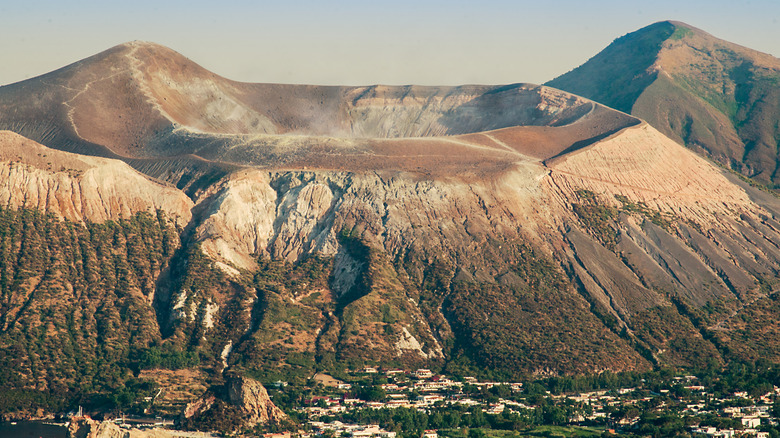
Roman mythology held that the island of Vulcano is where Vulcan, the god of fire, kept his underground forge. It's one of the Aeolian Islands, a small volcanic archipelago off the coast of northern Sicily, and you can reach it by hydrofoil or ferry from Milazzo. A short walk from the port is Pozza dei Fanghi, a natural pool of briny, sulfurous, mildly radioactive mud that sits at an approximate temperature of 82°F. Bathers have been soaking here for thousands of years. It's said to soften and revitalize the skin. However, before visiting, check for updates because the mud pool has experienced on-and-off closures since 2020 due to high volcanic gas levels.
Next door is the Acque Calde, the place to come if you're interested in swimming in geothermally heated open sea. Submarine fumaroles push the warmth up through the seabed, heating the water around you as you swim. The setting is quite unlike anywhere else on the island. You've got the black-sand shoreline of Spiaggia Sabbie Nere, the electric-blue water of the Tyrrhenian Sea, and the geologically active Gran Cratere della Fossa watching over it all. On the northern tip of the island, the Therasia Resort Sea & Spa is built high up on rugged cliffs and is the place to stay for thermal water treatments. It also features Turkish hammams and saunas, as well as infinity pools with stunning views across the archipelago. The resort is open only during the high season, from April to October.
Viterbo, Lazio
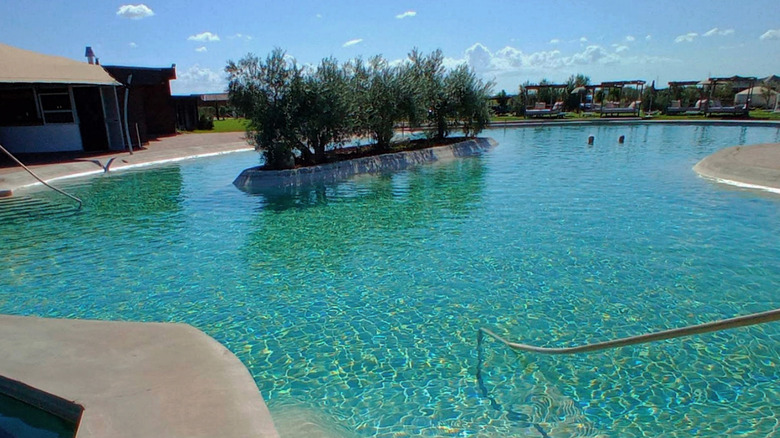
Tuscany might grab all the headlines, but nearby Viterbo is a laid-back city of art and medieval charm with thermal spas at a fraction of the price. At its heart is a well-preserved center of stone alleyways, ancient fountains, and grand papal buildings built over one of the richest thermal basins in Italy. All the spring waters in the area are packed with minerals such as sulfur, calcium, and magnesium. They are thought to offer relief from a range of conditions, from skin problems to cardiac and respiratory issues. Of course, you can simply just dissolve in their warm embrace, too.
Just outside Viterbo, you'll find natural pools tucked into the open countryside. It's far enough from the city's bustle to feel like a proper escape, and the most famous is Bulicame. Here, water bubbles up from a natural crater that feeds into open pools surrounded by countryside that's so peaceful it feels like time has stopped. These springs have drawn many notable figures over time. Dante saw fit to mention them in his Divine Comedy, while Michelangelo even sketched them.
Terme di Vulci is a spa hotel about an hour's drive from Viterbo. It has four large pools with temperatures ranging from 86 to 108°F, and there's nothing but wide-open countryside in every direction. Back in the city, there are several more thermal spas, including Terme dei Papi, where you can indulge in a steaming hot outdoor pool. You can follow that up with a long dip in a dimly lit natural grotto, then round things off with an invigorating run through hot and cold pools that will jolt your body back to life.
Abano Terme, Veneto
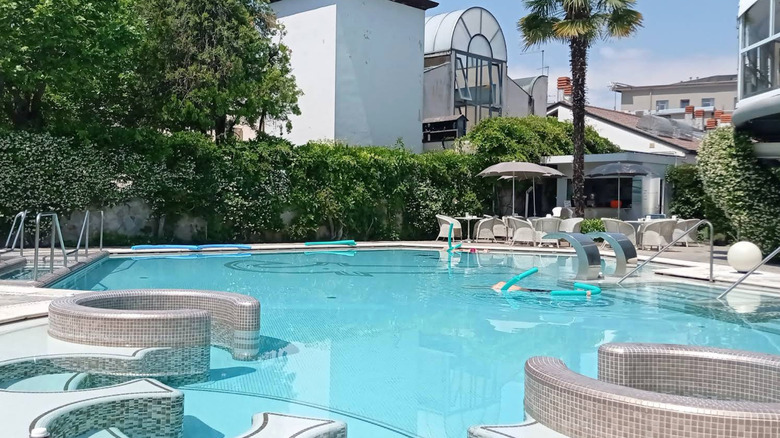
Tourists have flocked to Abano Terme to relax or ease ailments for over 2,000 years. It's a tradition so deeply rooted in the town that its very name is derived from the Greek term for "away from pain." It sits at the foot of the Euganean Hills, and from the town you can see a cluster of volcanic peaks, their slopes hiding medieval walls and castles among trees that shift with the seasons. In the center of Abano Terme, tree-lined squares alongside elegant architecture and quietly humming cafés give off a feeling that the town has long understood the art of relaxation.
Much of this calm is down to the dozens of thermal spas spread across town. Each offers its own mix of traditional mud therapies, mineral water treatments, and modern wellness programs. They all maintain their own supply of maturing mud, which they keep in dedicated basins where the spring water, sunlight, and open air slowly work their transformative effects.
Hotel Terme Formentin is one of the best. You'll find it right in the middle of town. It's a place that attracts loyal repeat visitors year on year and features a large thermal pool that softly shimmers in the open air. In winter, when the darkness turns sharp and cold, slipping into that steaming water feels quietly magical. Abano Terme is just 45 minutes away by train from Venice. So if you're on a vacation there, schedule in a relaxing few days here if you feel the need to get away from the crowds the City of Canals inevitably attracts.
Pantelleria, Sicily
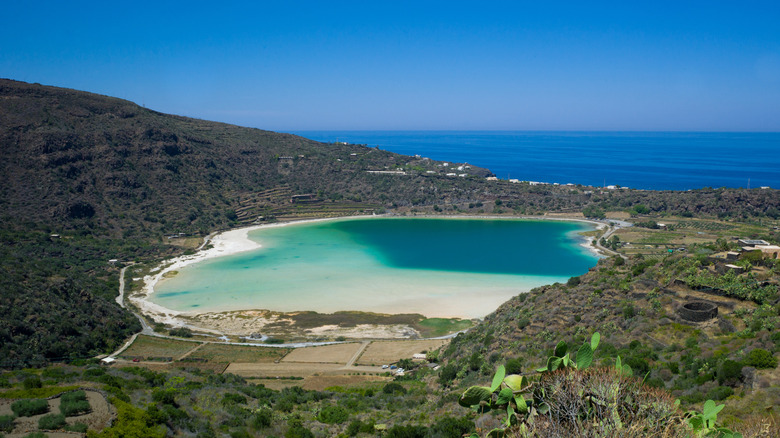
Often called the "Black Pearl of the Mediterranean", the volcanic island of Pantelleria sits between Sicily and Africa. It's a secret island of endless blue waters, black lava cliffs, hidden coves, and crater lakes steaming in the hills. According to legend, Odysseus himself once hauled his war-battered body to these shores to let the thermal waters heal him. The most famous spot is Specchio di Venere, a round crater lake of almost supernatural stillness that mirrors the volcanic hills above. Bathers come here to smear its silver-gray mud across their skin. The sun soon bakes it, and when it cracks, they wade into the warm thermal waters to dissolve it away. Flamingos pick their way through the shallows here, adding a hint of pink to these volcanic shores.
At Cala Gadir on the east coast, hot geothermal water escapes from the rock and merges with the sea, filling a series of waist-deep travertine pools on the way. The basins offer a variety of temperatures, allowing visitors to "Goldilocks" the most suitable. Above it all on Montagna Grande, the island's highest point, the Bagno Asciutto is a natural tunnel of dry volcanic steam. It's similar to a Turkish bath, and after a good sweat, you can step outside for some of the island's finest views. You'll see the Sicilian Channel glittering below, caper terraces tumbling toward the water, and, if you're lucky, Tunisia on the far horizon. There are also several spa hotels on the island for some luxurious pampering. Among them are the vineyard-surrounded Sikelia Luxury Retreat and the Al-Qubba Wellness & Resort, which offers yoga and hammam treatments.