
10 Once-Thriving US Quarries That Now Lay Eerily Abandoned
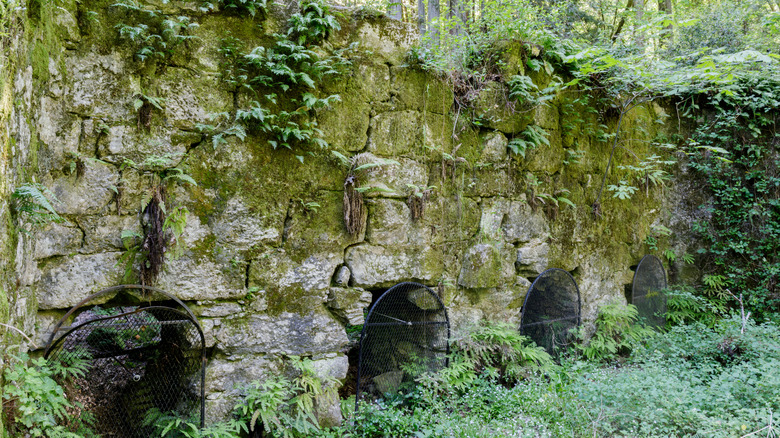
Quarries around the United States were once critical industrial sites that supplied stone, marble, limestone, and other materials that were used to construct some of the nation's greatest buildings and monuments. Today, many quarries have fallen into ruin. Many former quarries are now filled with otherworldly remnants of America's industrial age, which spanned from the late 18th century to the early 20th. Some have been completely reclaimed by nature, while others have been partially transformed into parks, recreation areas, or historical sites.
From once-thriving travel destinations that no longer exist to the creepiest abandoned amusement parks in the world, people are often fascinated by defunct places. Here, we'll visit 10 once-thriving U.S. quarries that now lie eerily abandoned, focusing on locations where visitors can still experience at least some of the quarries' remnants. Sites like Massachusetts' Becket Quarry that are closed to the public and lack an eerie appearance outside of the park were excluded. Some off-limits quarries, like Empire Quarry and Lone Star Quarry, were included because the surrounding area is still accessible and unsettling. These destinations are simultaneously historical landmarks and ghost towns.
To put together this guide, we turned to a variety of sources, including the University of Northern Illinois, the Herald Times, the Indianapolis Star, the Sacramento Bee, CBS News, and Atlanta Magazine. Government websites, official land trust pages, and official city websites also provided information. Among these were Visit Bloomington, SantaCruz.org, Mass.gov, Missouri State Parks, and the Town of Becket.
Empire Quarry (Indiana)
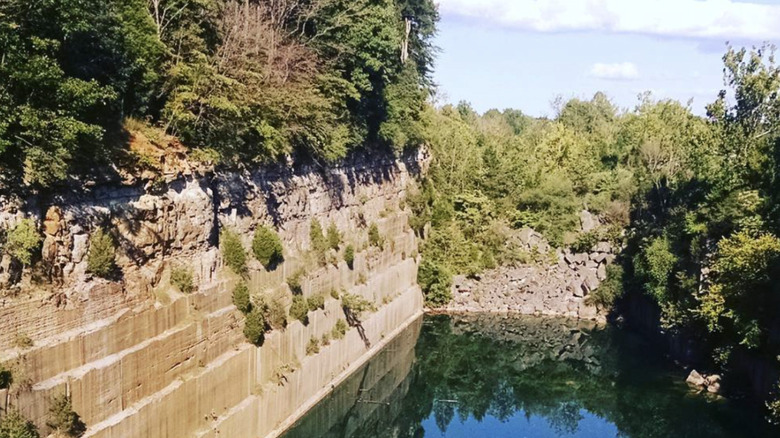
Indiana's Empire Quarry is among the nation's most recognizable. This former limestone quarry near Bloomington was immortalized in pop culture as the swimming hole in the critically acclaimed 1979 film "Breaking Away." Long before Hollywood discovered it, though, Empire Quarry helped shape one of America's most recognizable skylines. Manhattan's iconic Empire State Building contains about 19,000 pounds of limestone from this site. From 1827 until the mid-20th century, Empire Quarry and other Indiana limestone quarries supplied materials for other legendary buildings, too, including the Pentagon and the National Cathedral.
Empire Quarry also became famous for its appearance after industrial operations ceased. The abandoned quarry pit was filled with deep blue water that contrasted with the limestone walls. Lack of upkeep resulted in scrubby overgrowth that looks like a scene out of the Fallout video game series. This surreal landscape had a mysterious feeling, drawing "Breaking Away" fans, urban explorers, and students from nearby Indiana University who wanted to take a swim; for many IU students, taking a dip at Empire was something of a rite of passage.
That chapter closed, though, in 2018 when the quarry was filled in due to safety concerns. At the time of the closure, local authorities said that more than two dozen accidental cliff-diving deaths played a major role in the decision. While Empire Quarry itself sits on private property, the surrounding area maintains the creepy, forgotten atmosphere that made swimming and diving here so appealing to college kids and adventurers. After driving down some southern Indiana backroads, which feel quite isolated in and of themselves, you'll see the craggy limestone walls, underbrush, and overgrown forests that give this location its weird vibes.
Lime Kiln Quarry Ruins (California)
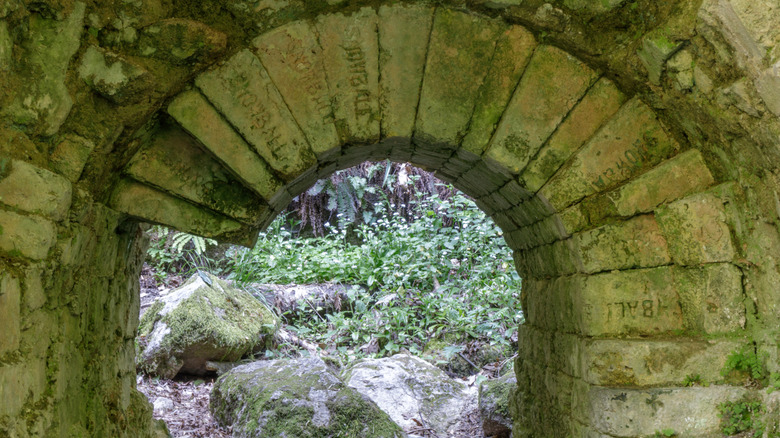
Northern California's Lime Kiln Quarry Ruins feel like the setting of a ghost story. Found on land owned by the University of California, Santa Cruz, this site is home to tall brick kilns, decaying buildings, and abandoned 19th-century industrial equipment, all of which have been left to the land. The result is one of the most disquieting quarry sites in the nation. Even the way the Lime Kiln Quarry site was discovered is a bit haunting. Local resident Jim Wood had been trying to find the ruins since 2000, but it took a 2021 wildfire that ravaged the Santa Cruz Mountains to fully uncover them. Wood told the Sacramento Bee, "It was like discovering a Mayan pyramid in the jungle."
Today, there are three key hiking trails that pass through the Lime Kiln Quarry Ruins. The Fall Creek Lime Kiln trail leads experienced hikers to the biggest remaining limestone kiln structure in the Golden State. This kiln looks out of a Gothic romance, with crumbling stone walls, moss-covered chimneys, and arched doorways. The Pogonip Lime Kiln trail, suitable for beginner to intermediate hikers, also features structures that could have been plucked from a Grimm Brothers tale, including the popular rock — or cairn — garden where unused limestone piled up over the decades.
The easiest trek here, the Cowell Lime Kilns trail, is not as dramatic or hidden as the others, but it lets visitors experience the history of this site, which operated from the mid-19th century and peaked in the 1920s. Unlike many former quarries that have been redeveloped, the Lime Kiln Quarry Ruins are unsettling because they still look wild, especially once people get into the thick of the forested area. Much of the site has decayed naturally, giving it a hauntingly beautiful appearance.
Quincy Quarries Reservation (Massachusetts)
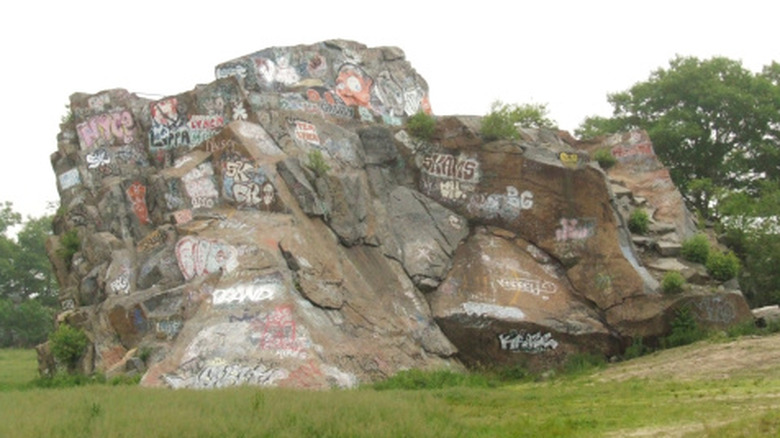
A road trip through coastal Massachusetts takes drivers through plenty of charming New England towns. In the 19th century, coastal Quincy earned the nickname "Granite City" thanks to the sheer number of granite quarries that were founded within the town's boundaries. Today, although the granite industry isn't the booming business it once was, Quincy hasn't forgotten its industrial past. In fact, the Quincy Quarries Reservation hiking and rock climbing site retains some haunting reminders of the quarries that once operated here.
Perhaps the most unsettling fact about these quarries is their danger. Like Empire Quarry in Indiana, the swimming holes in Quincy's former stone mining sites have been filled in. City officials lacked the manpower to effectively monitor the area's 20 quarry sites, and several children died in accidents. Today, the spookiness at the Quincy Quarries Reservation can be felt in its history and by looking at the remaining rocks. Years of graffiti now cover many of the formations, giving the entire park a creepy urban decay look.
To learn more about the history of the granite industry in this area, visit the Quincy Quarry & Granite Workers Museum. This educational destination offers a comprehensive look at how it shaped this region with historic photos, exhibits, and even online programming.
Kelleys Island Quarry (Ohio)
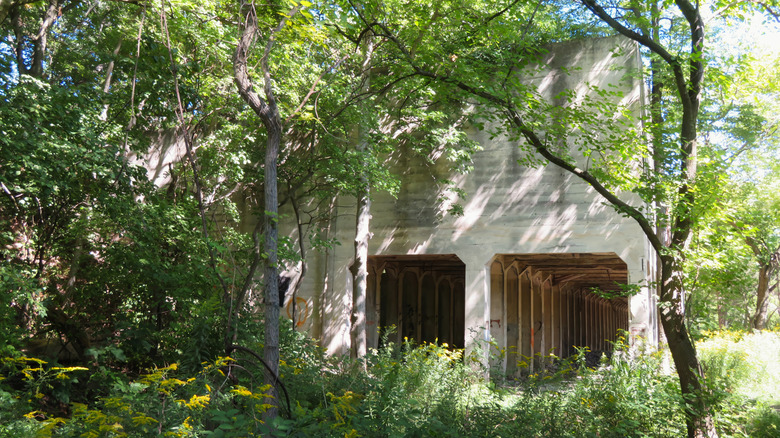
Kelleys Island Quarry very much feels like it could be the setting for a mystery novel. Although the island as a whole is an under-the-radar all-season getaway with award-winning food, the Kelleys Island Quarry feels like a destination Agatha Christie could have created. Only publicly accessible by ferry (private boats and planes are also welcome) on Lake Erie, this limestone quarry feels quite remote, which automatically gives it a slightly chilling quality. At one time, Kelleys Island was home to multiple quarries, all of which merged into the Kelleys Island Lime & Transport Company in 1886. The company operated on the island until 1940.
Although quarrying operations have long since ceased here,there are numerous reminders of the island's industrial history. While much of the heavy equipment is gone, remnants of the quarrying era can still be found throughout the small isle. The limestone crusher, which is now part of Kelleys Island State Park, is the largest remaining ruin. This building has a ghostly feel, especially on foggy mornings when one can almost imagine the ghosts of 19th-century limestone workers hauling rock here. Visitors can also see other industrial relics, including train trestle ruins and converted quarry sheds.
Another feature that gives Kelleys Island a somewhat eerie air is its Glacial Groove formation. This geological feature is a holdover from an Ice Age that occurred 20,000 years ago. Experts have concluded that the glacier that created these 430-foot-long crevices was about a mile thick! The glacial grooves themselves have an otherworldly look that resembles an alien landscape. Visitors can go to the Glacial Grooves Geological Preserve to experience this natural wonder. The destination, combined with the defunct historic quarry, makes Kelleys Island as much a destination for people who love abandoned places as it is for wine enthusiasts and relaxation seekers.
Lone Star Quarry (Illinois)
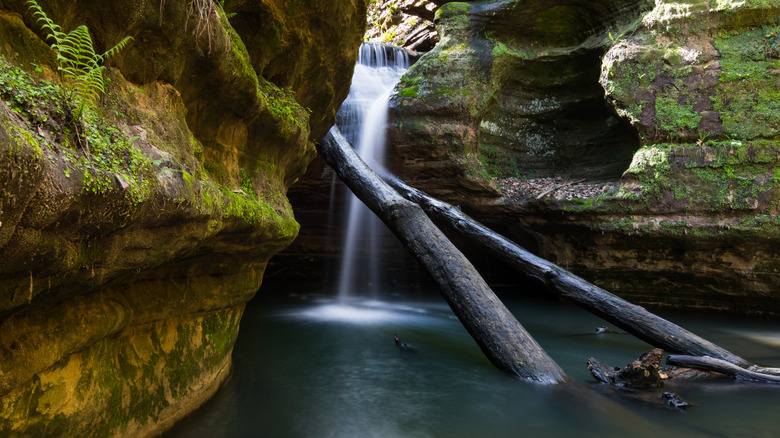
Nowadays, Starved Rock State Park in Illinois is a wildflower wonderland known for its scenic trails and waterfalls, but it also has a rich history as a limestone quarry. Throughout the 19th and 20th centuries, Lone Star Quarry was a major employer in tiny Oglesby, which currently has a population of about 4,400. Since it ceased operations, this quarry site that now lies within the state park has become well-known among fossil hunters because of its incredible concentration of prehistoric marine fossils. Trilobites, ancient sea snails, crinoids, brachiopods, and many other types of fossils have been found here.
This site, and the entirety of Starved Rock State Park, has a creepy quality that has more to do with its isolated feeling off of main trails, millions of years of history, and general background than with the physical remnants of its mining days. Starved Rock State Park's very origin is eerie, as a matter of fact. The park got its name from an 18th-century Native American tale in which a group of Peoria people were inadvertently involved in a skirmish with the Pottawatomi and Ottawa on what are now park grounds. The Peoria took refuge on a large rockface, ultimately starving to death while surrounded by enemy troops.
There are also stories about hauntings here. One popular tale involves a trio of housewives who decided to take a girls' weekend away from Chicago in 1960. All three ladies' bodies were discovered days later in a Starved Rock canyon. Since it was still winter weather, the snow and slush made it impossible for detectives to properly investigate. According to legend, their ghostly screams could be heard for years. The man ultimately convicted of the killings died in 2025, but his family is seeking a posthumous pardon. Near Halloween, the park hosts ghost-hunting hikes, and what could possibly be eerier than that?
Bellwood Quarry (Georgia)
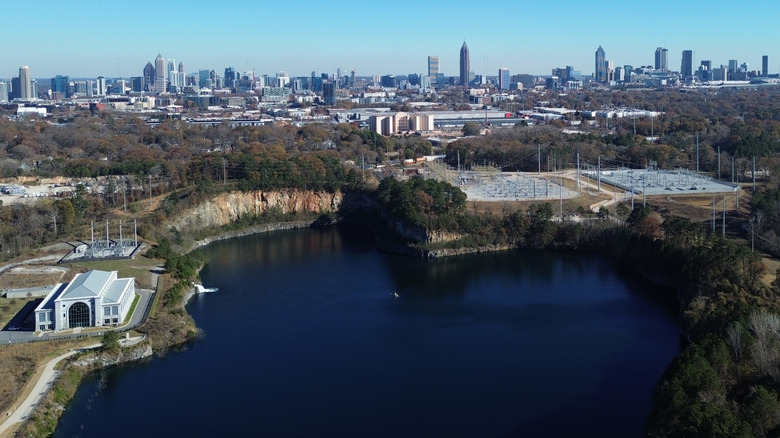
At first glance, Bellwood Quarry seems like an odd fit for a list of scary abandoned places. Today, this granite quarry that functioned for more than 100 years before its 2007 closure has been transformed into part of Atlanta's Westside Park, where young professionals, families, and retirees alike all gather to hike, play, picnic, and enjoy a slice of the outdoors in this vibrant, affordable Southern city that was named America's best summer travel spot in 2026. If you look past the renovations, the excavation pit and granite walls are almost more bizarre because they're juxtaposed against such a happy, family-friendly setting.
With cliffs as high as 450 feet, Bellwood Quarry more strongly resembles abandoned mining towns in the Western United States than the rest of Georgia. Although a modern park sits just steps away, the quarry area transports visitors to another time and place entirely. From the Grand Overlook observation deck above the lake, parkgoers can look down into a pit that once provided granite for Georgia's sidewalks and buildings. The site also functioned as a chain gang camp, where prisoners once labored under oppressive conditions. Considering the weight of that history is enough to give anyone chills while standing here.
On the far side of the quarry lies a forested area with an ethereal prehistoric quality that looks completely untouched by time. Unlike many abandoned quarries where the pits have been filled in, part of Bellwood's creepiness comes from its sheer scale. It's easy to see why this site has served as a filming location for multiple science fiction productions, including "Stranger Things" and "The Walking Dead."
Elephant Rocks Granite Quarry (Missouri)
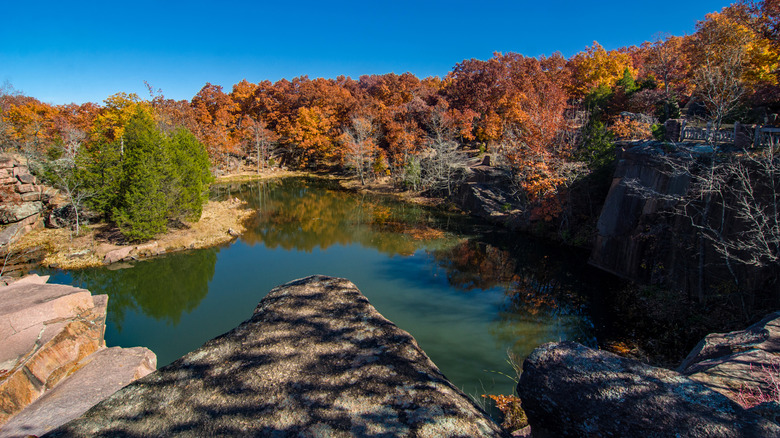
Missouri's Elephant Rocks State Park doesn't look like the site of a former industrial operation. It gets its name from the fact that some of the rock formations here resemble a series of circus elephants, with some rocks even serving as large, floppy "ears." Long before the area became a state park, this was an active granite quarry. Starting in 1869, workers mined Missouri's famous red granite from this site. The rock was used nationally and played a part in St. Louis' boom at the turn of the 20th century. Quarrying activity here stopped by the 1950s.
Today, the terrain is rough and prehistoric-looking, with two main hiking trails available to visitors who want to enjoy the granite formations. Visitors can see evidence of the park's industrial past, with deep drill marks still carved into some of the rocks. One notable remaining structure here is the former railway engine house. It has a ghost-town look, located deep in the woods with overgrown trees and brush surrounding it. This stone building was the site of a bustling railroad operation during Elephant Rocks State Park's quarry days. People exploring the park can also happen upon abandoned railroad tracks, almost like a ghost train could arrive at any moment!
Another unsettling fact about this one-time quarry is that a man drowned here in 2018. The 24-year-old fell off a cliff into a quarry pit that had turned into a lake. Adding to the creepy vibes is the fact that Missouri Red granite is often used for headstones in cemeteries. These moribund facts, combined with the weathered quarry remnants and undeveloped forests throughout the property, give Elephant Rocks State Park an unquieting vibe that would give any visitor goosebumps.
Brownstone Quarries (Connecticut)
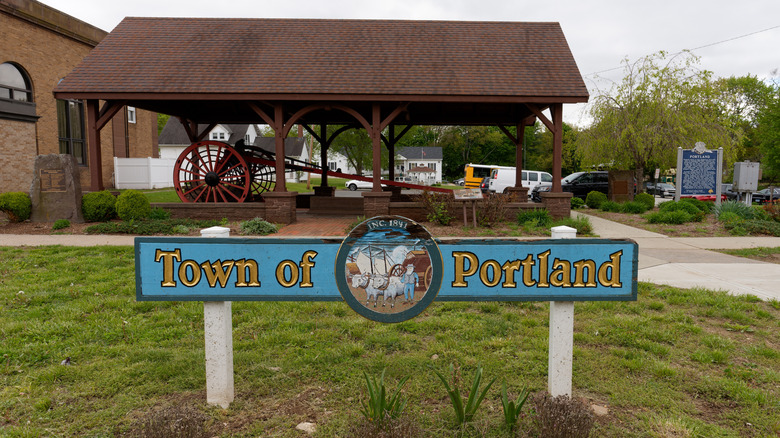
If this list were ranked by ghost stories alone, the Brownstone Quarries in Portland, Connecticut, would quite possibly top the list. Operations at these historic quarries began in 1690, but it was in the 19th century that this stone's popularity skyrocketed. For over 200 years, the stone quarried from Portland's pits became a staple throughout the Northeast. Today, New York City's iconic brownstone residences sell for millions of dollars, especially throughout Brooklyn and the Bronx.
Over time, active stone mining operations ceased at the Brownstone Quarries, and they filled with water, as abandoned quarries tend to do. In this case, however, the water came quickly. During a famous flood in 1936, the quarry pits were effectively drowned as the Connecticut River rose to nearly 40 feet! Today, scuba diving enthusiasts often visit the North Quarry in Portland. This spot has even become a popular place for novice divers to complete their open water certification tests. This site has a horror-movie aesthetic, with monolithic stone walls and the feeling that anything could be lurking just beneath the surface of the water.
The Portland Brownstone Quarries are also well-known in paranormal circles. According to Paranormal Printing, people who visit this location often report "inexplicable sounds, fleeting apparitions, and sensations of being watched." In addition to unexplained events at the quarry sites, Portland residents have reported other inexplicable happenings over the years, as well, giving this entire town a rather unsettling air.
Dorset Marble Quarry (Vermont)
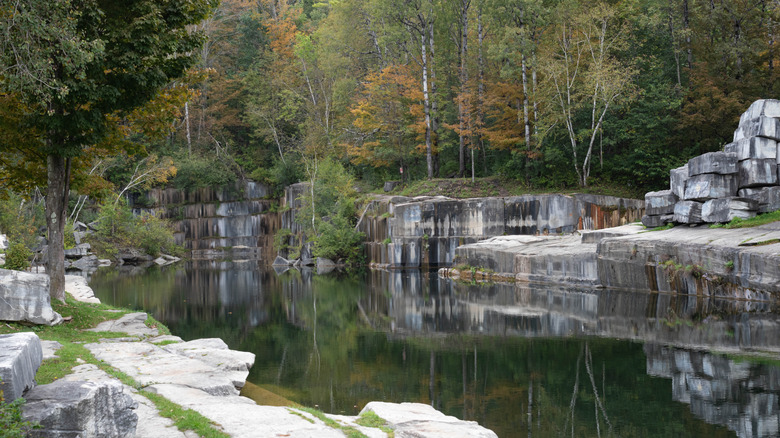
Dorset Marble Quarry was the first commercial marble quarry in the United States. Founded in 1785, the marble that was mined from this site was used to create some of the nation's most recognizable buildings, including the Supreme Court, the United States Senate, the Jefferson Memorial, and various structures at Harvard University. Although this site was abandoned as an active quarry in the late 19th century, it remains easily accessible to visitors. The site is especially popular during the summer season, when the former quarry pit becomes a public swimming hole.
Despite its popularity, however, there is an unnerving aspect to this site. For starters, people are required to sign a liability waiver before they are allowed to enter the grounds. This can be done online. Once inside the quarry, the experience can be thrilling in a slightly terrifying way, depending on how much of a daredevil you are. The highest cliffs here stand about 20 feet tall and thrill-seekers free dive off them, plunging into the water below.
Furthermore, nature has reclaimed much of the site, adding to the deserted feeling at this historic location. Massive chunks of raw marble are still scattered throughout the property, giving the impression that the Dorset Quarry workers simply left one day, never to return. In some ways, the feeling here is similar to the haunted trails and ghostly tales nearly a thousand miles south in North Carolina, especially during the fall when bare trees and crunchy leaves give distinctly Sleepy Hollow vibes. While it's undoubtedly beautiful, the feeling that the Headless Horseman could come riding through the woods is never far away.
Halibut Point Quarry (Massachusetts)
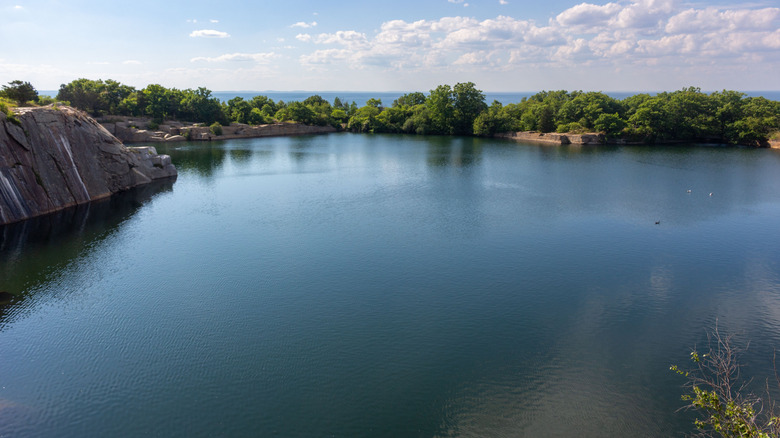
Today, Halibut Point Quarry is known as Halibut Point State Park at Halibut Point Reservation, but before it was a peaceful palace for reflection, it was a major Massachusetts quarry. Beginning in 1840, granite workers mined stone here that was used in buildings and bridges from New Orleans to New England. Perhaps the most famous structure to use Halibut Point's stone is the Brooklyn Bridge. By the end of the Roaring Twenties, quarrying here ceased; however, the land was not purchased by the state of Massachusetts until 1981.
Nowadays, the eeriness of Halibut Point does not come from abandoned quarrying equipment or rusted railroad tracks. Instead, the isolation of this location makes it feel desolate and chilling. The huge granite cliffs here are a reminder to park guests that they are entering a world that has been there for hundreds of millions of years, and will likely remain long after they are gone. The Cape Ann Granite slabs found at this site are believed to have existed for an astounding 440 million years, meaning that prehistoric creatures made their home at Halibut Point long before humans ever existed.
Unlike some former quarries on this list that are disquieting because of their industrial remnants and crumbling structures, Halibut Point is eerie as a result of time itself. Standing here amid stones that predate the dinosaurs by about 200 million years, it's impossible not to be reminded of the finite nature of life and humanity's time on Earth. This is enough to make any visitor feel the weight of our planet's history.