
9 Tips From Pilots And Flight Attendants For Surviving Motion Sickness
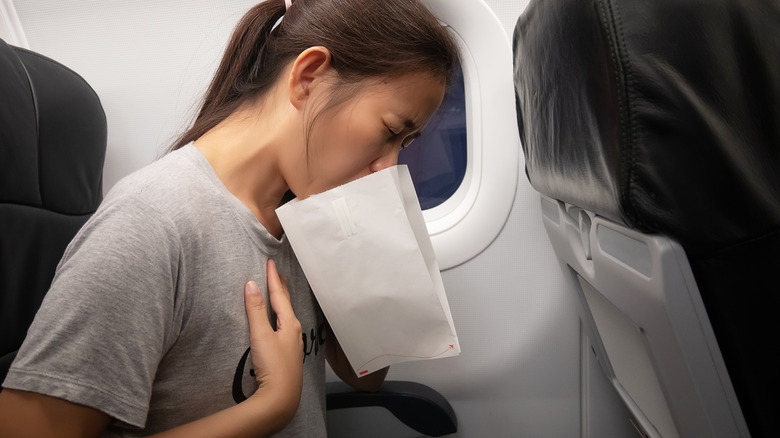
No matter how inviting the location, no matter how much forward planning has been put into designing the perfect vacation, the fact remains that getting from A to B is generally the least exciting part of the whole escapade. And that goes doubly so for those of us who suffer from motion sickness. It's an affliction that affects one in three of us and is platform-agnostic when it comes to when and where it will strike.
Some people find even the prospect of traveling in a car as a passenger nauseating, while others fear the motion of the ocean to the extent that they simply will not set foot on a ship. And then, there's the dreaded airsickness: planes do not pull over, nor can you retreat to a private cabin to take care of business should the need arise. Emotophobes, avert thy gaze: while in the air, bouts of nausea are sometimes a shared experience.
For something so disruptive, the cause of motion sickness is surprisingly simple. As you travel, your eyes tell you one thing, such as that you are sitting down in a vehicle minding your own business, and your inner ear, detecting motion, quite another. All of which begs the question of what, if anything, can be done about it? Well, first up, we're neither doctors nor pharmacists; pharmacological countermeasures exist, but this isn't the place to go looking for them. What we can do, however, is examine what some other experts — namely pilots and flight attendants — have to say on the matter. Such distinguished individuals have spent more time in the air than most people spend taking showers. We've scoured the internet for blogs, vlogs, articles, and forum threads for some insider information that might very well save, if not your life, then at least your lunch.
Sit over the wings
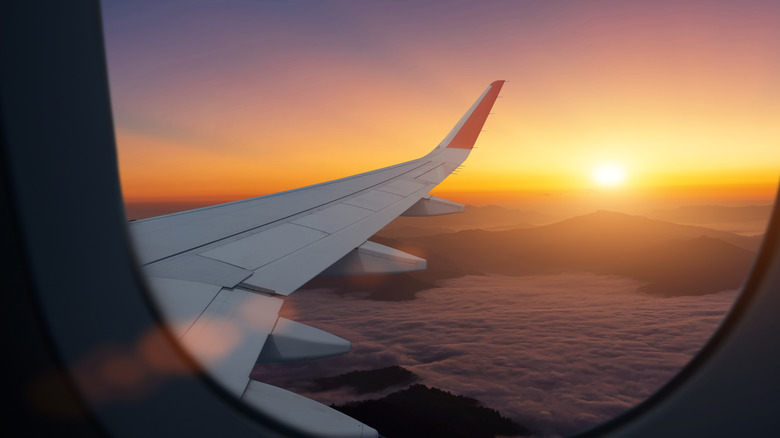
Anyone trying to figure out why flights in the past were not that great should turn their attention to some basic principles of aviation. The rougher the weather, the rougher the ride. Flying at high altitude takes some of the sting out of a patch of severe weather, but only to a point; in the case of thunderstorms, pilots prefer to navigate around them. Such efforts are hardly in vain, but for those of us who lean towards the queasy side of the jet-set spectrum, a flight entirely turbulence-free would be much appreciated. The last thing a delicate stomach needs in the face of a bout of inner-ear dissonance is jostling.
Which is why it's annoying that harsh weather is not the sole culprit here. There are different types of turbulence. Clear-air turbulence is a jarring phenomenon that occurs at high altitudes when planes fly through unexpected wind shear. Mechanical turbulence sounds like engine failure, but it is, in fact, a plane-shaking disruption to wind patterns caused by obstacles below. Mountains can cause turbulence, as can finding yourself in the wake of another aircraft, but most of the time, it's simply the air rising and falling as its ambient temperature dictates. Regardless, turbulence cares not one jot for your delicate constitution.
Still, passengers are not entirely without agency in this matter. According to airline pilot Joey Miuccio, where you choose to sit has some bearing on how much ragdoll motion you're going to experience. In a video posted to Facebook, he offered the following advice: "If you hate turbulence, sit over the wings. That's closest to the airplane's center of gravity, so you'll feel less bouncing and side-to-side movement compared to the back of the plane. The farther back you sit, the more amplified the motion feels."
Keep your eyes on the horizon

Pilots are trained to both use and never quite trust their eyes. The higher you fly, the more difficult it becomes to gauge altitude, and while a glance at the terrain below can often prove useful, the view ahead is often nondescript during the day and entirely featureless at night. Which is a shame, because keeping your eyes focused on the horizon is one of those pro-tip ways to stave off a gurgling belly.
Indeed, according to flight training experts Go Fly, "Ensuring that the cockpit is well ventilated and that your eyes are on the horizon for the majority of the time is helpful." It's a good tip, although one that only works in certain circumstances. Firstly, the obvious. If you aren't close to a window, you're out of luck. You need a line of sight on a real horizon; drawing a line on a piece of paper and staring at it doesn't work. Secondly, for the technique to work, the horizon needs to be Earth-fixed, which is to say, you need a point of reference. Across land or at low altitudes, fixed points are ubiquitous, but at 30,000 feet, it's not always so simple. The sun — which you should never look at directly — the moon, or even a lone star will do the trick, but absent those, you'll simply find yourself staring into an abyss full of placebos.
It's also true to say that the trick works best if you are looking in the direction of travel. Having never flown an airplane, I cannot attest to that, but since staring out of the window at the lateral-facing horizon isn't one of those things that can get you banned from an airline, it's worth a try. It certainly works for me. Most of the time.
Point the air vent at your face
Stepping outside for a breath of fresh air is one of those time-honored ways of settling a turbulent stomach. Probably. It's easy to fall into the trap of folklore passed on from generation to generation without having truly been tested: Vitamin C, for example, doesn't really help with colds. Don't shoot the messenger. Fortunately, the notion that a cool breeze has an antiemetic effect is backed by some pretty solid science. And, even more fortuitously, as far as aviation professionals are concerned, the hack most definitely works.
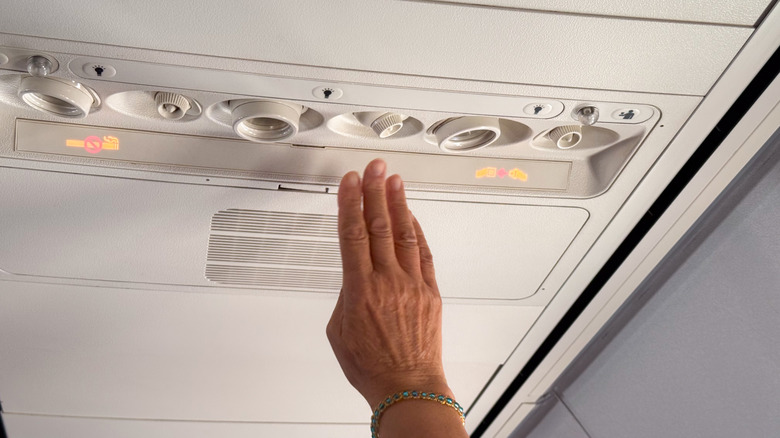
Ok, stepping outside for some fresh air isn't a sensible option at 30,000 feet, which is why making use of the air vents is a preferable way to achieve the same effect. Indeed, according to one flight attendant. "Cool air can lower the risk of airsickness, so we always suggest keeping the air vent above your seat on," she told Ocean Florida (via the Daily Mail). For those of us who already enjoy a chill on our face as we crowd out the universe using the best pair of noise-canceling headsets we can afford, it's an easy tip to digest. And for skeptics who like more roughage in their science diet, the news is no less satisfying.
The stomach-settling effect frigid air has on our bodies is a function of core temperature. As motion sickness takes hold, capillaries in the skin open and heat begins to leak out. The body then compensates by trying to warm things up, and that in turn causes us to feel flushed. The theory goes that such action also occurs when the body suspects it has been poisoned, something known as defensive hypothermia. It may sound crazy, but the TL;DR version of things is that by avoiding the cold sweats, you can steer clear of the paper bag in front of you.
Chew ice, gum, or suck on a mint

The mind is a curious thing, and those who dismiss the idea of psychosomatics as pseudo-scientific nonsense simply aren't up to speed on the latest research. Put simply, a psychosomatic effect occurs when a physical condition or symptom worsens because of mental stress. Anxiety can make you sick in chronic ways and immediate ways alike; so yes, you can worry so much that you throw up.
The biological process at play here is as well understood as it is deeply upsetting. Anxiety is a function the body's fight or flight reflex. Yes, physiologically speaking, there is no difference between a benign phobia and finding yourself facing down a Sabre-toothed tiger armed only with a set of travel Scrabble: In both instances, adrenaline is released, blood flow is diverted from the gut, and your stomach has something of a temper tantrum, which in turn brings on waves of nausea. Thanks for that, parasympathetic nervous system.
The take-home point of all this is as follows: anxiety in the absence of an actual threat to your well-being is little more than wasted energy. And for those facing anxiety about how the motion of the airplane might make them feel, the trick is to simply keep your mind otherwise occupied. Indeed, as one veteran flight attendant noted (via Travel Loving Family), "I am regularly asked by passengers for some ice to chew on – the ice gives them something to concentrate on". Ice, which has the added benefit of cooling you down, which is nice, but the real intent here is simply to distract the mind. Mints and gum work in the very same way, minus the cooling-down bit, and are just as effective at tricking the brain into a Zen-like superposition that no amount of turbulence can dislodge.
Ditch the books and movies and embrace audio
Anyone who spent time considering '80s travel trends that are now impossibly outdated will know that in the days before back-of-the-seat entertainment systems, passing the time on a long-haul flight was fraught with limitations. Films were shown on a central screen; you got what you were given, and no, you couldn't ask them to pause the movie so you could nip to the loo. Nobody had cell phones; tablets were the stuff of a madman's dream; and as for music, well, noise cancellation was still decades away. Oh, and Walkmans were loud and bled sound; they were a genuine irritant to some. Still, at least we had books. Nobody could take that away from us.
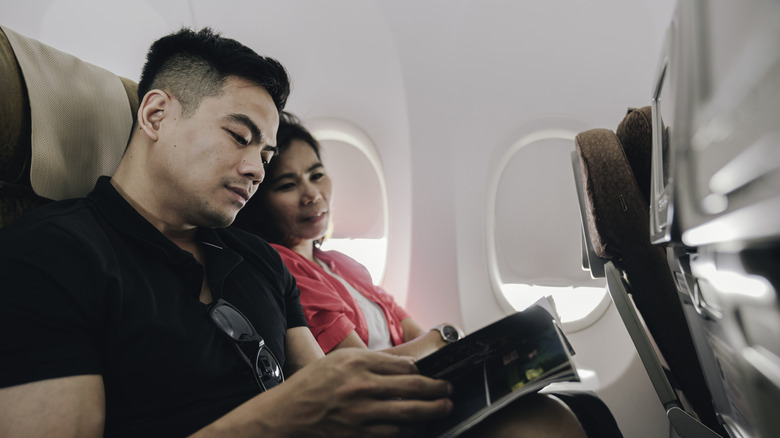
Not that reading a book has ever been solely responsible for making people feel queasy on an airplane. Watching in-flight films can distract, yes, but they can also confuse the inner ear yet further, and with predictable results. Thankfully, options abound. As one former British Airways cabin crew veteran told Ocean Florida (via Wales Online), "If watching TV exacerbates your sickness, most in-flight entertainment systems will have a wide variety of audio shows to listen to, which are more suitable for those who experience motion sickness."
Science certainly concurs with the sentiment. As your eyes fix on a given point, be that the page of a book, phone, or screen in front of you, your inner ear continues to sense any change in velocity. Pilots, and drivers for that matter, are in control of a vehicle and can predict said banks, turns, accelerations, and decelerations with relative ease. Passengers cannot. Thus, nausea ensues. As before, it is far better to look at the horizon to reassure your recalcitrant ear that all is well.
Wear loose-fitting clothes
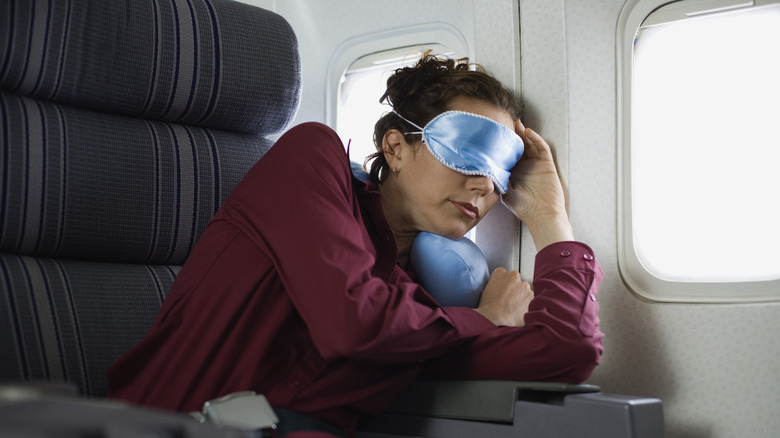
Wearing loose-fitting clothes is one of those things people should know about before embarking on their first long-haul flight, irrespective of whether said person suffers from motion sickness or not. It's just good practice. Of course, for those afflicted with said inner-ear rebellion, the second thing they should learn is that you should never try to hand a used sick bag to a flight attendant. Between those two observations lies tip number seven. Always keep things light and breezy.
Such advice extends even to pilots. Indeed, flight training school AeroGard stresses, "In order to prevent motion sickness before flight, it's recommended to wear loose fitted clothing and to eat a light snack 2-3 hours before flight." More on pre-flight meals later, but for now, the question centers around why clothing choices matter in the first place.
Well, it turns out that it's all about outward pressure on the abdomen. Tight clothing restricts the stomach's natural elasticity, and with nowhere else to go, there is a chance of acid reflux finding its way up into the esophagus. Which is not something you want if you are already beginning to feel queasy. But tight clothing can also irritate the vagus nerve: You'll find it — metaphorically speaking, don't actually go looking for it — running down the length of your torso and linking your brain to your heart and digestive functions. The vagal response is generally harmless, but when combined with a penchant for motion sickness, you really should stay on its good side whenever possible.
Drink ginger ale

Those of us who prefer to shy away from over-the-counter or prescription medications, given the opportunity, often turn to tried and tested ways of dealing with medical issues. Making sure you are well hydrated is an excellent first port of call; dehydration can, itself, unsettle your stomach. Still, the question remains: what, if anything, should you drink when your stomach begins to protest? Abby Duun, an Ocean Florida Rep and long-haul flight veteran, says the answer is something of a no-brainer. "One of the best things you can do to minimize nausea on a flight is to order a ginger ale. The combination of carbonation and ginger's medicinal properties can help to ease stomach issues if you're feeling nervous," she said (via Wales Online).
Ok, there are two things to unpack there. Ginger has been used as a medicine for over 5,000 years, and scientific approval of its efficacy is also well established. The compounds in ginger are believed to increase gastrointestinal motility. In short, it speeds up the process of digestion. Ok, so what about carbonation? Well, spoiler alert, fizzy drinks tend to make us burp, and that action can often release gas trapped in the stomach. The cold fluid may also soothe the stomach and cool you down while the sugar floods your brain with the kind of happy hormones that made 7-11's Big Gulp cups so popular in the first place.
Unfortunately, the one-two punch of ancient wisdom and industrial-scale carbonation doesn't work for everyone. Some people find that fizzy beverages make motion sickness worse. In such cases, you can opt for ginger tea instead. It tends to work just as well.
Keep your head still
Anyone who has ever played a racing game might have found themselves leaning into the turns they make despite the total lack of real-world deceleration they are actually experiencing. It's a known phenomenon; it's not restricted to the playing of video games, and the reasons behind it are more complicated than you might think, if not yet fully understood. Indeed, it falls mostly under the umbrella of vection, or the illusion of self-motion. In short, you can sometimes feel like you are in motion even when you most assuredly are not. Kind of the opposite of what happens while trying to read a book as a passenger in the car. But then, an airplane isn't a car.
Leaning into a turn while flying can create what is known as the Coriolis effect. As a plane turns, the fluid in your ear matches the movement and then settles, indicating to your brain that the turn has been completed. By looking down at a book or up at an air vent, you create an additional axis of motion. This sends fluid into another one of your inner ears' canals and your stomach into knots. For this reason, pilots are trained to keep their heads firmly rested against their flight seat. Indeed, in an analysis published in the FAA Safety Briefing magazine in 2024, they emphasized the importance of "practicing moving your head as little as possible during instrument cross-checks or scans," advising pilots to "keep your head as still as possible when reaching for charts and other objects on the flight deck."
What boils down to a matter of health and safety for pilots — nobody wants to see a pilot overcome with vertigo — is a matter of quiet contemplation for passengers.
Avoid spicy food

What sounds like good advice for a first date is, in fact, yet another way of staving off the dreaded air-travel-induced stomach flux. Let's be real here: spicy food is the enemy. Flight training experts at AeroGard are clear on what not to eat prior to flying, suggesting you should steer clear of "large meals, especially those that are spicy, high in salt, protein, or dairy products."
Such notions require deconstruction. First up, the avoidance of large meals is straightforward. The larger the meal, the longer it takes to digest, and, if you do find yourself reaching for the sick bag, that could prove to be something of a tactical error. Next, spicy food is loaded with capsaicin, an ingredient derived from chilies that fools your tongue into thinking it has just been set on fire. It has several uses outside of its culinary ubiquity, but its use as a spicy additive to food dates back well over 2,000 years. To be clear, capsaicin does not actually burn the mouth; it simply activates a few pain receptors. Still, that irritation can be carried down all the way from the esophagus into the stomach itself. That can lead to heartburn, acid reflux, chest pain, and, of course, bouts of diarrhea. Spoiler alert: you don't want to experience any of these things on a flight, motion-sickness-prone or not.
That leaves salt and dairy. Salt is the easier of the two to unravel. Too much salt can dehydrate the body, which leads to reduced blood flow, headaches, and, yes, nausea. QED. Taking dairy out of the equation, however, seems a little extreme. Despite what you've heard, no, we are not all secretly lactose intolerant, but enough of us are that it's best to avoid the bloating effect it can have on those who are intolerant and just don't know it.