
9 Things You Didn't Realize Could Get You Banned From A Passenger Train
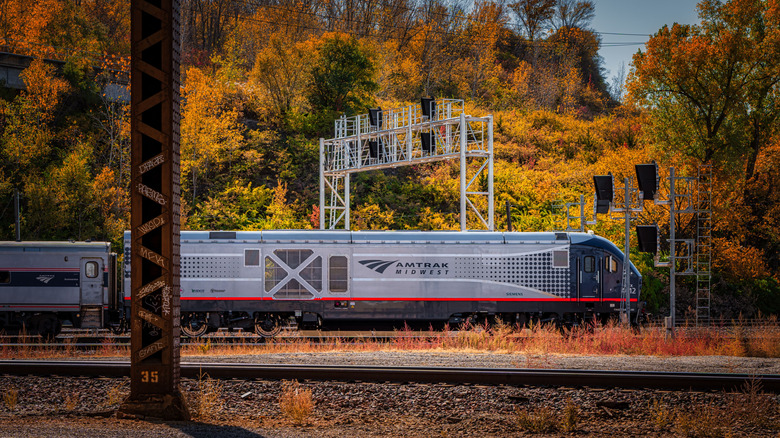
Although the invention of personal vehicles and the rise of air travel lessened the popularity of passenger trains, especially in the United States, this type of trip still gives travelers access to an array of experiences that no other mode of transit can provide. From train trips to see the best fall foliage in Europe to the most scenic Amtrak routes across America, booking a train ticket opens up a world of adventures that most people wouldn't otherwise get to enjoy.
There are some obvious things that can get one banned from public transportation of any kind, including trains. Harassing staff members, getting into physical fights with other passengers, and blatantly ignoring instructions during emergencies are clear no-gos. However, numerous surprising things can also get you barred from a railway, some of which you've probably never even stopped to consider. Here, we look at nine things you didn't realize could get you banned from a passenger train.
To put together this guide, we turned to official policies from various train operators, including Amtrak's Conditions of Carriage, rules for the U.K.'s Northern and Southern airlines, and policies from UAE-based train lines. We also looked at news reports from the BBC and other high-authority blogs like Amtrak Station Pro, as well as incidents detailed on Reddit and Quora.
Drinking your own alcohol in the wrong car
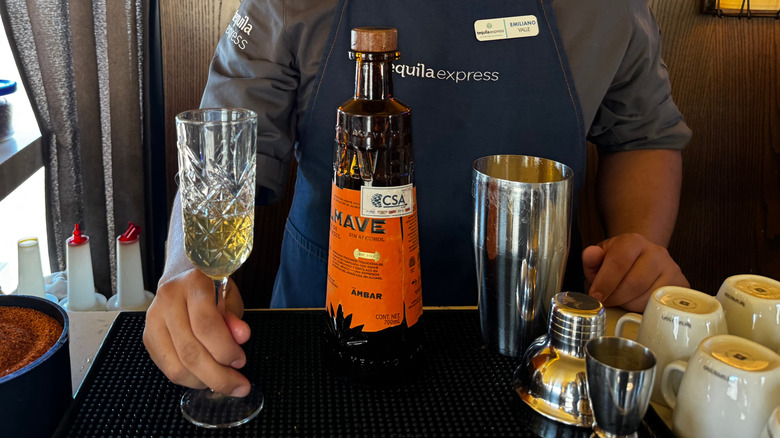
Since train passengers don't have to drive themselves to their destinations, they might find that part of the fun is having a drink or two en route. While many railways, including Amtrak, have cocktails, beer, and wine available for purchase and immediate consumption in their dining cars, bringing (and drinking) your own alcohol onboard has its own unique set of rules. On Amtrak, for instance, passengers are allowed to board with closed containers of alcohol in their baggage. However, they are not permitted to drink it everywhere.
Amtrak specifically prohibits travelers from opening or consuming their privately purchased alcohol anywhere outside of their own sleeping car. This means one cannot take an alcoholic drink they brought on board into a dining area, a lounge, or any other part of the train. Furthermore, as one Redditor pointed out, coach class riders are unable to consume any alcohol they packed, since they do not have access to sleeper cars.
The consequences for breaking the rules can go well beyond having your beverage confiscated. As another person on Reddit noted, attempting to circumvent the regulations by pouring alcohol into a travel mug in coach means "you risk getting kicked off the train if a train crew employee sees you drinking your own stash of alcohol." In addition to getting banned from a journey for drinking personal alcohol outside of permitted areas, anyone who is visibly intoxicated runs the risk of being removed, as well. Thus, it is extremely important to drink responsibly.
Using a curse word
While there are likely quite a few surprising things you didn't realize could get you banned from an airline or a train, using a stray curse word is definitely near the top of the list (literally, in this case!) As one Reddit poster shared, they were denied boarding an Amtrak train after muttering a single profanity under their breath during a frustrating interaction in which a crew member asked to see their ticket type after apparently being unwilling to assist with luggage. Per the tale, there were even "other passengers who heard it and could confirm it was something I said to MYSELF." The story sparked heated debate in the comment section.
In the official Amtrak Code of Conduct manual, "obscene language" is, in fact, grounds for removing a passenger. However, the manual also indicates that extreme action should only be taken in extenuating cases, which this particular incident seemingly was not. On Reddit, one user noted that the language used in the situation at hand did not appear to fit the "legal definition" of the word "obscene." It is, of course, worth noting that obscenity can be subjective, and what qualifies as obscene language for one person might differ for another.
Others, however, did not think the denial of boarding was beyond the pale. One Redditor was reticent to believe "that OP was 'cursing at themselves' when it was in reaction to a question (seeing the ticket is a very fair request) of the employee." Another poster was sympathetic, writing, "Seems like it was just a bad conductor. Unfortunately if the conductor doesn't let you board, there's nothing you can really do in the moment." While isolated profanity won't automatically get one banned from a train ride, this is a great reminder that staff members do have the right to remove or refuse service to passengers whose language is considered abusive or disruptive.
Disregarding bicycle storage policies
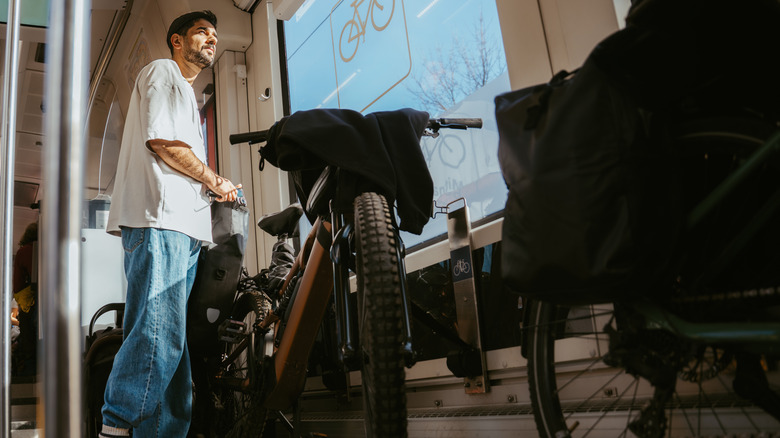
Bringing your bicycle on a passenger train can be an amazing way to explore destinations like grand, scenic American national parks via Amtrak. There are, though, rather strict rules for traveling on a train with a bike. Many first-time train travelers, and even seasoned passengers who aren't used to packing their bicycles, don't realize that they can't simply park the bike near their coach seat or even store it in a Sleeper Car on an Amtrak train. Instead, they must adhere to very particular regulations.
Per Amtrak rules, carry-on bicycles can weigh up to 50 pounds and must be kept in bike rack areas that are equipped on specific trains. Five stations nationwide also offer a checked luggage option that also applies to scooters. Other systems, like the Capitol Corridor trains, have similar policies regarding onboard bike storage. The Massachusetts Bay Transportation Authority, meanwhile, sometimes allows passengers to secure their bikes on the front of the bus or keep them in the cabin when trains are not busy. Riders should follow crew instructions on this line since they may differ from one journey to another. Depending on the route, cyclists may also have to reserve a bike rack spot in advance.
Ignoring rules about bicycle storage on a train can have serious consequences. One Reddit user took issue with being asked to remove the front wheel of their cycle, per train policy, even verbally disagreeing with the conductor. A commenter on the Reddit thread reminded them, "If you get belligerent they can definitely kick you off." While vertical bike storage rules are not popular among all cyclists, aisles and walkways on trains need to remain clear in case of emergency.
Trespassing across the tracks to catch your train
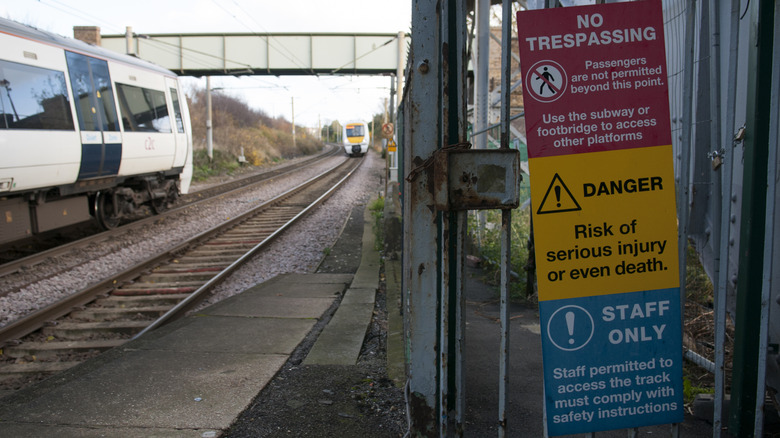
When you're running late and racing to catch your train, it may seem like cutting across the tracks is a good shortcut to get to the departure platform. It never is. In reality, this is an incredibly dangerous (not to mention illegal) mistake. In the United States, the Federal Railroad Administration (FRA) works tirelessly to ensure that travelers are informed about the potential hazards associated with trespassing, an activity that leads to over 500 annual deaths.
In its official Trespass Toolkit, the FRA even provides engineering and architecture teams with tips for designing trespass-proof railway stations. Seasoned train travelers have probably realized that many stations are laid out so passengers access their platforms via designated pedestrian crossings. Ignoring these labeled routes and walking across the tracks is not only a violation of federal law, but may lead to local legal consequences. In Texas, for example, trespassers can be fined $500 or be sentenced to jail time.
In addition to the safety risks and possible criminal charges, trespassing on the tracks at a railway station could jeopardize your trip. The Trespass Toolkit dictates that railroad employees or police officers may refuse boarding to passengers who are caught on the tracks. Specifically, the "aim is to discourage individuals from trespassing to reach platforms." The FRA gives a wide berth to station authorities, so it's highly likely that trespassers won't be allowed to board their trains at the intended departure time.
Sneaking into crew-only areas
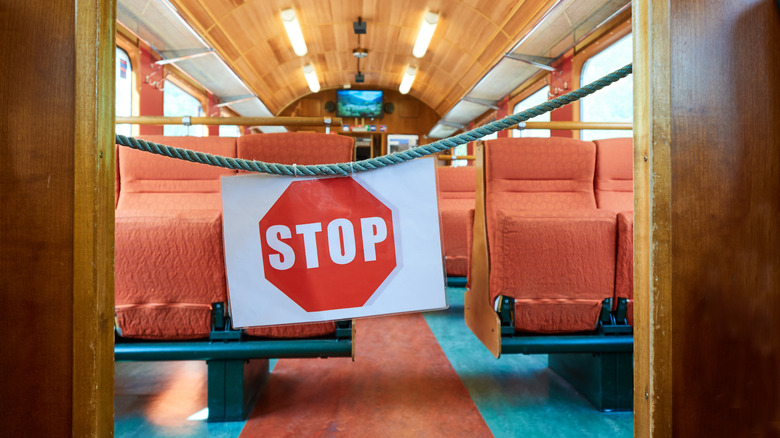
Whether you're taking America's greatest cross-country train journey or enjoying the latest scenic European train routes in 2026, being in a train car seems to encourage a spirit of exploration. However, there is such a thing as too much exploring. Entering crew-only areas can lead to unwanted consequences for both passengers and train employees. Restricted areas on passenger train cars like Amtrak often contain operational equipment and safety controls, employee living spaces, and food service sites that travelers should not access.
Even if you think entering one of these areas is a harmless prank, be aware that the train operator won't view it as such. In fact, railroads take unauthorized access so seriously that Amtrak has even terminated employees for disregarding company policies. In one 2026 case, an Amtrak worker was fired after he gave a non-employee access to restricted areas. The termination report notes that the former staffer cannot be rehired at any point, which proves just how seriously the company takes this violation.
If a door on a passenger train is marked for employees or authorized personnel only, stay out. Even if you're tempted to sneak a peek for a behind-the-scenes photo, it is not worth the potential consequences. Since employees can be fired for allowing passengers into restricted sections of a train, it's safe to assume that travelers can also be banned for the same behavior. Furthermore, some legal precedents set the stage for criminal trespassing charges to be filed, as well. It is simply not worth the risk for train riders.
Using someone else's ticket
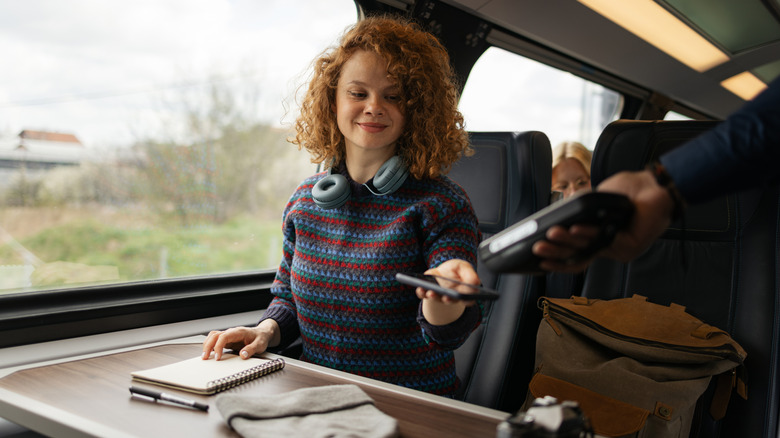
If a friend or family member has a non-refundable train ticket, but can no longer take their trip, it might seem harmless to use the ticket yourself rather than letting it go to waste. Unfortunately, rail operators don't tend to see it that way. Depending on the railroad company and the type of ticket or railcard in question, transferring passage to another person without going through the proper channels can have major consequences. In a Quora discussion about this topic, one commenter noted that repercussions can "include fines for fraudulent use, impersonating another person and fare evasion."
Train brands like Amtrak issue standard paper tickets and e-ticket barcodes to specific passengers, with discounts tied to that particular person's personal details. In addition to potentially meeting the requirements for legal fraud, using another person's ticket could mean that you are riding at a discounted rate for which you are not personally eligible. During the onboard ticket scanning process, conductors may ask for ID to verify a passenger's information. If the name on a traveler's ticket doesn't match their government-issued ID, action is likely to be taken.
In the case of Indian Railways, using someone else's ticket results in, at a minimum, paying the difference in fare along with a fine. However, attempting to travel with an illegitimate ticket on multiple occasions or causing a ruckus when caught can "lead to legal action or even removal from the train." Railways in Dubai have similar policies. Riders in the United Arab Emirates can be fined for attempting to use discounts for which they don't qualify or for sitting in another ticketed passenger's seat.
Pulling the emergency brake without a real emergency
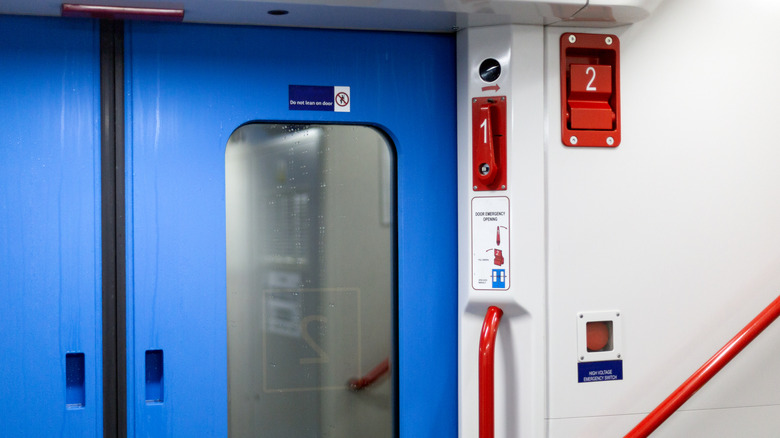
There is a reason that passenger trains are equipped with emergency brakes. Their sole purpose is to protect travelers and crew in the event of an actual emergency situation. In the United States, the Virginia Railway Express specifically advises that the emergency brake system should only be enacted when "the forward motion of the train presents an imminent danger to life and limb." Pulling the brake as a prank or to force the train to stop because you missed your station can not only disrupt service for everyone else onboard but result in a ban for the jokester.
On Quora, a user questioned what would happen in England if they triggered the emergency brake simply to get the train to stop at a station that wasn't on its schedule. Commenters quickly advised against this course of action, with one fellow Quora user noting that the likely outcome would be a swift investigation of security tapes while the train continued moving, followed by an arrest. Another person on the thread agreed, writing that the conductor "wouldn't stop and the transport police would be waiting for you at the next stop!"
A Reddit discussion about someone pulling the emergency brake on an Amtrak train had similar reactions. One Redditor said, "If they got caught, they very well may be looking at a lifetime ban from Amtrak at the very least." Perhaps no train system, though, has more issues with pranksters pulling emergency brakes than New York's Metropolitan Transportation Authority (MTA). Emergency brakes in the city's subway trains were triggered unnecessarily over 1,700 times in 2023 alone. MTA authorities have repeatedly warned of the dangers, including train derailments, that can happen when the brake is pulled.
Ignoring quiet car rules
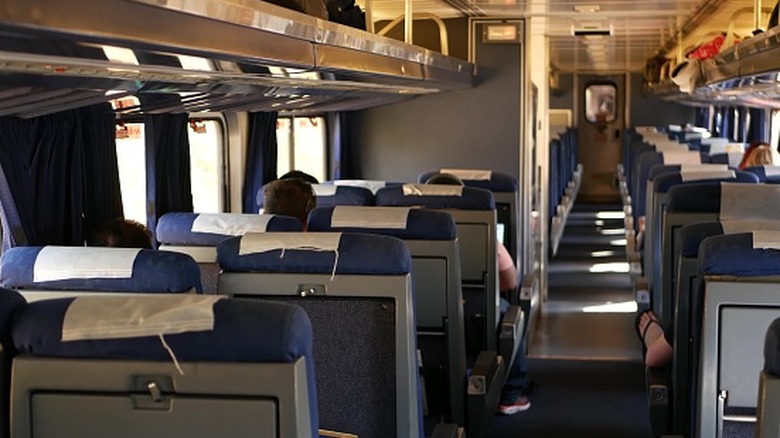
The concept of Amtrak's Quiet Car — a non-reservation car designed to have less noise than the rest of the train — is appealing to many train travelers who are hoping to get work done, read a book, or otherwise enjoy a respite from the real world during their journey. Quiet cars have rules prohibiting loud conversations, phone calls in any capacity, and device volume loud enough that others can hear it. The idea is that this space should be calming and serene at all times.
While experiences on Quiet Cars do vary, one person on the Amtrak Unlimited forums shared that they once witnessed a situation in which a woman was talking on her phone in the quiet car. In this case, the "conductor scolded her loudly and told her to go back to the area between the cars to finish her conversation." In another situation, a person shared on Reddit that they saw a conductor issue a formal write-up and incident report when a fellow passenger ignored repeated quiet car warnings.
Another Redditor chimed in, sharing details about what this citation could mean. They explained that they've been informed that if a traveler "gets reported multiple times that their account is flagged and blocked from making reservations," effectively banning them from Amtrak travel. At the end of the day, no matter what your personal feelings are about occasional noise in the Quiet Car, this space exists for a reason, and it's important to respect the peace of those who choose to sit there.
Surreptitiously smoking or vaping
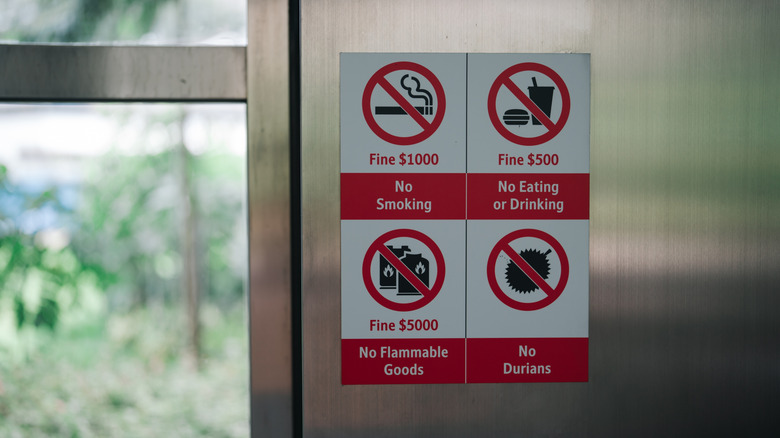
Most travelers know that lighting a cigarette or using a vape on a plane can lead to a fire and is, therefore, strictly prohibited by federal law in many nations. But what about on passenger trains? They actually have many of the same rules. In both the United States and the United Kingdom, attempting to smoke or vape on a passenger train can bring about a very abrupt end to your trip.
Amtrak has regulations against smoking and vaping throughout its trains and stations, including in restrooms and in Sleeper Cars. In a Reddit discussion about whether one could surreptitiously vape in private quarters on Amtrak, a Redditor cautioned that "there is a smoke alarm in each room and bathroom, and vaping has been known to set off the alarm. If you are caught, you could be removed from the train." In specific cases on long routes, crew members may allow smoke breaks on the platform during scheduled stops. This is, however, done at the discretion of the team on that train.
Rail operators across the pond also take their smoking and vaping policies seriously. In the United Kingdom, both Northern and Southern railways have warned their passengers against engaging in these activities. Northern officials have said in no uncertain terms that they will ban or remove passengers who are caught using cigarettes or vapes. Southern has taken a slightly softer approach, posting to social media: "It's illegal to smoke on our trains or at stations, where we also don't permit the use of e-cigarettes."