
The Spookiest Destinations In The World For A Horrifying Halloween Getaway
We may receive a commission on purchases made from links.
For many, the annual plunge into the macabre is little more than a mark on a calendar. October 31, All Hallows' Eve, marks the first of a three-day Christian festival of the dead, with origins that trace back all the way to pagan times. Its eventual reinvention as a secular celebration came much later, transforming into the familiar tropes of candy, costumes, and things that go bump in the night.
Opinions on the more supernatural elements of the night are divided. In both the U.K. and the U.S., around one third of the population believes in ghosts, and for such people a night spent in a haunted house can be a thing of terror. But even skeptics among us are not immune to the inherent creepiness of certain locales. The feeling of eyes upon us as we trudge through a dense forest. The sudden realization that we are not alone as we creep along floorboards warped with the memory of the ages. The flash of lightning that lets us consider the depth of the surrounding shadows. Such moments are chilling, yes, but within the right conditions they can also be a whole heap of fun. Why else celebrate Halloween?
What follows are some of the spookiest places we could find, all of which would make an ideal place to spend a Halloween break. We've visited most of them, though we included a couple of entries simply because their reputation preceded them. Some claim to be haunted; others carry with them feelings of oppression that have nothing to do with the supernatural. Regardless, each is spooky enough on their own, without needing rumors of hauntings to add to their mystique.
Poveglia Island, Italy
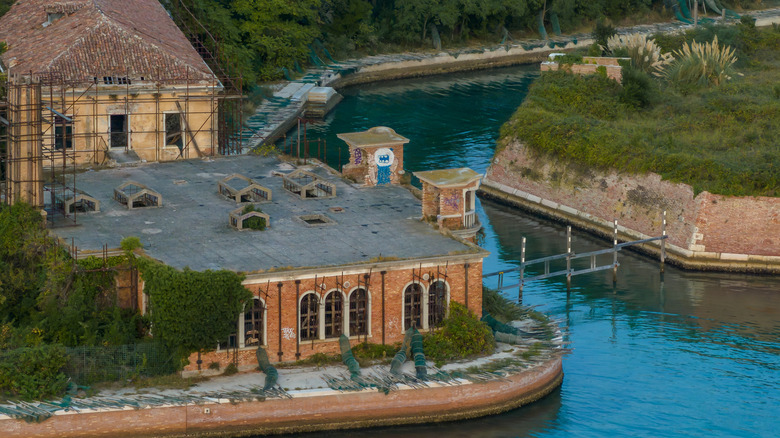
Lists of the world's most haunted places are rife with crumbling edifices, the solemn sloped walls of medieval fortresses, or copses of ancient woodland littered with rheumatic trees. Rarely do you find an entire island labelled as a veritable hotspot of ghoulish activity. And yet, nestled in the depths of the lagoon that wraps its arms around the half-submerged city of Venice, you'll find just that: Poveglia, the world's most haunted island, is said to resonate with the wails of the long-suffering dead. And, while you likely won't be able to visit the island itself – you cannot set foot there without special permission — you can view it by water, which only ups the spooky factor.
Poveglia is actually three islands, not one. The southernmost Poveglia Octagon is what remains of a 14th-century structure built on a man-made landmass. Its two larger neighbors, however, formed naturally. The northern island remains a place of wilderness, but to its south, the ruins of buildings can still be seen from the shore. The buildings once housed those suspected of carrying the plague into the city. Such people were often abandoned to their fate. Some claim that half the island is made of human ash thanks to the practice of burning the bodies of those who succumbed to disease. Others point to a psychiatric hospital; legend has it that the spirits drove the director to climb to the top of a clock tower and leap into the swirling fog below.
Regardless of the truth, the island remains an imposing reminder of its own dark past. Dense foliage has overwhelmed many of the low-lying structures, now made unsafe by age, and sailing past its so-close-you-can-touch-them moorings as the sun goes down is one of those images that stays with you forever.
Castle Dracula, Transylvania, Romania
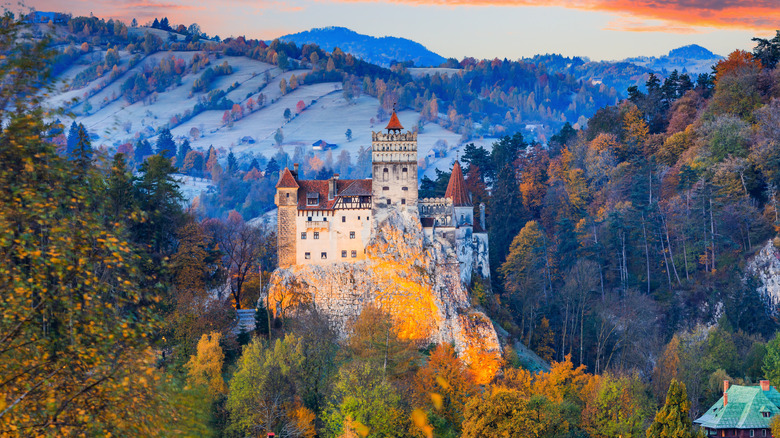
You will find the city of Brasov some 110 miles north of the Romanian capital of Bucharest. The city is an affordable fairy-tale town set within deeply forested hills. For visitors wanting a spooky detour, Dracula's Castle — known locally as Bran Castle — lies a mere 30-minute drive to the southwest in Bran.
First things first, the elephant in the room. Dracula isn't real; he's a literary figure conjured from the mind of Irish writer Bram Stoker. Less well known is the fact that Stoker drew on a real-life historical figure: Vlad the Impaler, a 15th-century Transylvanian prince known by his sobriquet, Dracula, meaning the son of Dracul. The castle did not belong to Vlad, nor did he ever live there. Indeed, the building's connection to Bram's famous villain stems from two possible events. First, Vlad may have been imprisoned in the castle's dungeons briefly in 1462. Second, the fortress closely resembles Bram's description of Dracula's castle with disturbing accuracy.
We know for a fact that Bram never visited Transylvania, but he researched the area in meticulous detail and drew inspiration from books, maps, and illustrations. Still, Bran Castle is as close as you'll ever get to Dracula's fortress. With its magnificent courtyards, labyrinthine secret passages, and hidden torture chambers, a visit is bucket-list-worthy. At night, you can hear wolves howling in the nearby forests, and yes, when the fog rolls in, the sense that you are an extra in a 1970s horror movie is palpable. A special Halloween event takes place every year; it's a highly coveted experience that lasts until the wee hours of the morning. Booking early is recommended.
The Catacombs, Edinburgh, Scotland, United Kingdom
Edinburgh has many strings to its bow: it is the capital of Scotland and home to the country's devolved government. It is a place of cobblestone streets and castle views. And as for purported hauntings, there are many. The Black Mausoleum at Greyfriars' cemetery is said to be the home of a violent poltergeist. In the 1820s, Scotland's very own rippers, Burke and Hare, stalked their victims at the 16th-century White Hart Inn, which stands to this very day.
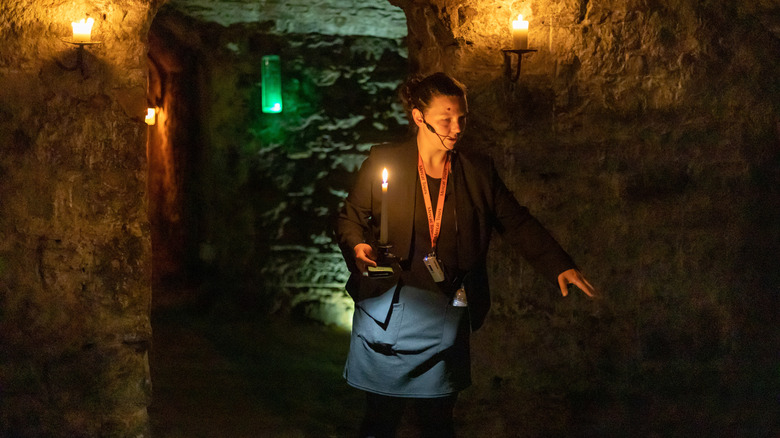
Tales of ghosts are common, but Edinburgh's real terrors lie beneath its ancient streets. The South Bridge vaults were built towards the end of the 18th century as a series of workshops and storage areas directly under the newly constructed bridge of the same name. Today they remain a cavernous reminder of the city's ancient past, with links to underground thoroughfares, including the Blair Street vault, a well-recognized pit stop on the city's infamous ghost tour. Its resident spook, Mr Boots, is often described as a tall man in a blue raincoat, wearing boots of faded leather. While that in itself might not be the most terrifying outfit, his tendency to suddenly appear in doorways and demand people leave is overshadowed only by the fact that some visitors have left the tour with rather odd marks on their skin. As to the phantom's identity, the jury is still out. Some have suggested he was a former landlord, smuggler, or perhaps even a body snatcher. Whatever the truth might be, a trip down to the old vaults on the last day of October is not for the faint-hearted.
Kutná Hora, Czech Republic
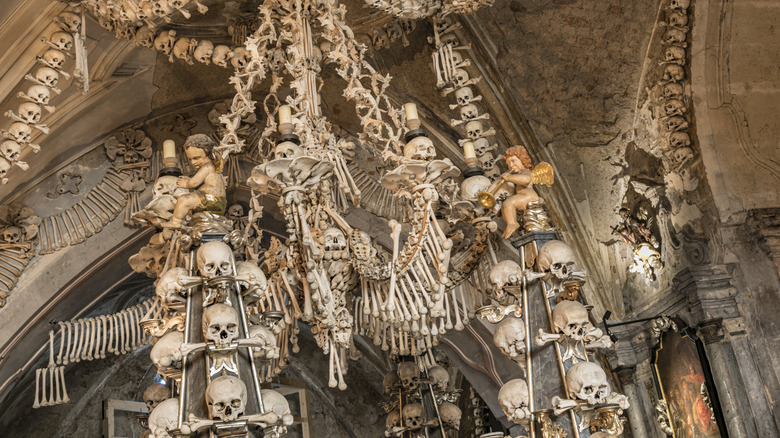
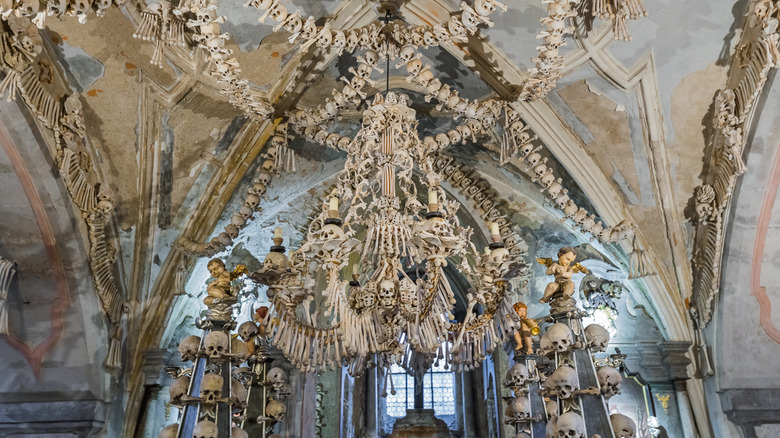
While the capital of Prague looms large in the minds of most people who visit the Czech Republic, thanks to its inherent safety, fairy-tale castles, and friendly locals, the rest of the country has plenty to offer, too. Take Kutná Hora, for example: a small village about 50 miles east of the capital. Quaint and blessed with a UNESCO World Heritage-listed town center, it is also home to one of the creepiest places on the planet. The Sedlec Ossuary is a church adorned with the bones of thousands of victims of the plague.
For a place that is host to 40,000 corpses, it is surprisingly beautiful. In 1278, legend has it that an abbot returned from the Holy Land with soil he collected from Jerusalem and scattered it over the present-day site of the church; it soon became a much-desired place to bury loved ones. By the 14th century, a church had also been constructed there, but successive waves of disease and the ravages of the Hussite Wars (1419–1434) overwhelmed the cemetery to the point where bodies had to be exhumed.
The celebrated architect Jan Santini-Aichel seems to have been the first to repurpose the bones of the long-deceased as decorations, but a simple carpenter named František Rint created most of the sculptures on display today. There are archways adorned with the calcified remains of the dead, chandeliers of bone, and entire walls filled with the lifeless gaze of a thousand skulls. Such finishes are the very definition of macabre, but this is a holy place, and there is no hint of any haunting. Still, the sense of foreboding is palpable, and all the more so as Halloween night draws in.
Hellfire Caves, Buckinghamshire, England, United Kingdom
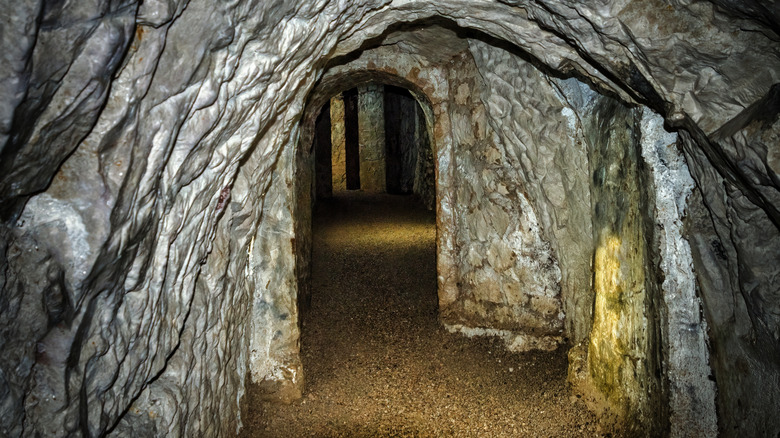
Buckinghamshire, England, lies just a few miles east of Oxford and is a place of market towns filled with shops, parks, and Victorian manors, and rolling hills, separated by fields of wildflowers and wetlands. But dug deep into the chalky underbelly of the village of West Wycombe lies a much darker history. You'll find the one-time meeting place of the notorious Hellfire Club.
The very first Hellfire Club was based in London and founded in 1718 by a close friend of King George I, Philip, Duke of Wharton. The most notorious chapter of the society, however, came into existence in 1740. Its founder, Francis Dashwood, commissioned the excavation of the caves and began using them as a meeting place for an organization he called the Knights of St. Francis: the Hellfire sobriquet came later. During such gatherings, pretty much anything was permissible, and rumors of black magic, satanic rituals, and other more licentious activities proliferate even to this very day. Benjamin Franklin was a member, although the specifics of what he got up to are unknown,
Visiting the caves today is a one-of-a-kind experience. The passages are dimly lit, and ceilings are low, and yet they open up in places into magnificent chambers. It is possible to hire the space for late-night dinners or fully catered parties, but the best time to visit is unquestionably during the night of Halloween. Mood lighting and deliberate round-the-corner scares make it an adult-only affair, and as for actual hauntings, the caves have them covered also. Late-night ghost walks take place at least a couple of times a year and are, by all accounts, hair-raising experiences.
Island of the Dead Dolls, Mexico
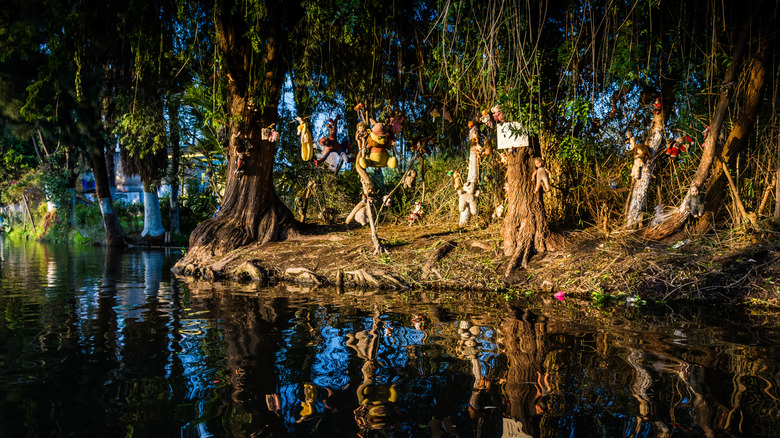
Venice isn't the only place in the world where an entire island has been cursed with tales of supernatural beings. Mexico City is home to some 9 million people, and scattered across the sprawling metropolis are leafy suburbs with bohemian beach vibes, enclaves of Michelin-rated street food, and a nightlife scene of near-legendary status. And tucked away in the wetlands south of the center, you'll find a truly arresting site: an abandoned island that stares back at you via thousands of lifeless eyes.
That the eyes belong to plastic dolls is the first clue that this is a creepy place. Even those of us who only feel a passing sense of dread towards said children's toys might want to pause for thought. Dolls in varying states of decay hang from every fence, tree, and structure. Some reach out at visitors with genuine earnestness. Others are missing limbs or stare out from weathered sockets with a hideous refrain. Some say that the dolls whisper amongst themselves as you walk by. Others claim that they turn their heads towards you as you approach.
The collection was started by a man called Don Julian Santana Barrera, who is said to have been haunted by the spirit of a drowned girl. He became the island's sole occupant and festooned every surface with the dolls he found discarded in the local canals. He passed away in 2001 after having spent most of his life completing his homage to the forlorn spirit that so tortured his soul. Such is the island's reputation that most ferries avoid it altogether, but some will make a special trip out there upon request.
Bhangarh Fort, Rajasthan, India
The most populated nation on the planet is around a third the size of the United States of America and yet somehow manages to contain four times as many people. It is a place where one can add picturesque island exploration to an overflowing itinerary, organize treks through fields of mountain flowers, and visit a genuine wonder of the modern world within the space of one vacation. India is awash with mystic traditions, and although All Hallows' Eve is not recognized in any official capacity, across the subcontinent, ceremonies in remembrance of the dead proliferate. And everywhere, ghost stories weave themselves into the very fabric of life.
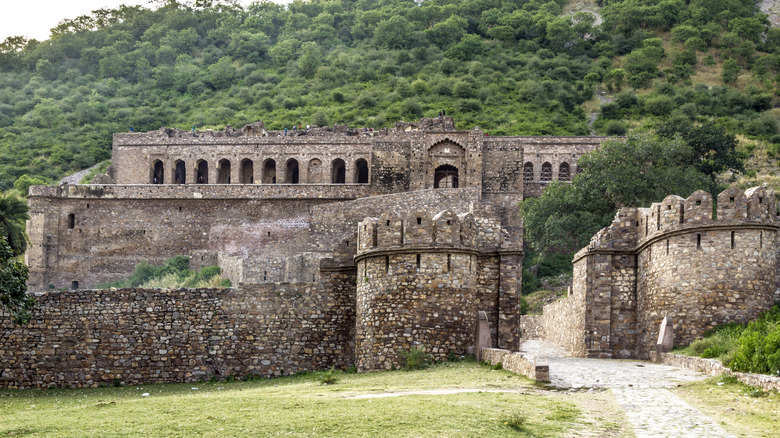
In a country as large and varied as India, finding the most haunted locale is a tall order indeed. Still, there is little question that Bhangarh Fort, found some 50 miles east of the pink-hued city of Jaipur, is a definite contender. Built in the late 17th century, it was abandoned during the 19th century for one of two alleged reasons. The first claim is that the king agreed not to build its walls so high that they cast shade upon a local holy man's favorite meditation spot. His grandson reneged on the promise, and the entire place fell under the baba's curse. Another tale speaks of a wizard who fell in love with a princess who rejected his advances. Regardless of the truth, such is the belief that spirits roam freely within its ruined — yet still magnificent walls — that it is forbidden to enter the place after the sun has set.
Hoia Forest, Cluj-Napoca, Transylvania, Romania
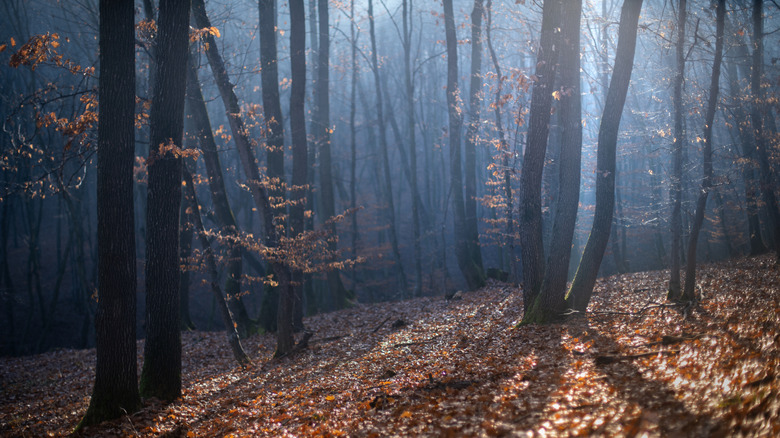
If the thought of ancient woodland filled with twisted trees that seem to writhe like demonic tentacles gives you goosebumps, then you could do worse than booking yourself on a vacation to Romania's most haunted patch of forest. You'll find it near the city of Cluj-Napoca, one of the best places in Europe for a scenic fall vacation, but although the woodland lies hundreds of miles north of Bran Castle, its reputation as a place of supernatural activity carries similar cultural weight.
To start with, the place is known as the Bermuda Triangle of Transylvania and has a reputation for electrical failures, UFO sightings, and cult activities. The site has been occupied since Neolithic times and was once home to some of the earliest European farmers. Today it resembles little more than typical ancient European Forests save for a couple of reasons.
Firstly, the trees are warped tin ways that seems to defy logic: at night, a walk amongst their boughs throws shadows that can quicken the pulse of the most rational of us. Secondly, tales of paranormal activity are ubiquitous. Reports of sudden rashes, feelings of nausea, and the presence of strange lights and voices calling through the mist keep most locals away from the forest's heart. Which is just as well, really; at the very center of the forest is a perfectly round clearing where absolutely nothing grows. Nobody seems to know why, and it would take a brave soul indeed to attempt to find out on Halloween.
Chillingham Castle, Northumberland, England, United Kingdom
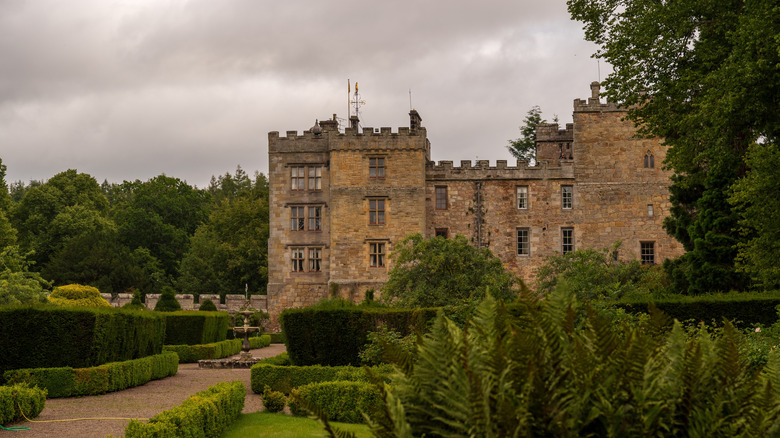
The United Kingdom is home to some 1,500 castles, many little better than ruins, but Chillingham Castle in England is remarkably well-preserved. Located just 20 miles south of the Scottish border, it is of 12th-century pedigree, although its original purpose was that of a monastery rather than a fortification. It also just so happens to be one of the most haunted places in the whole of the U.K.
The weight of the ages certainly lies heavily upon the place. In 1298, King Edward I paused at Chillingham before marching north to face William Wallace in battle. It was the site of a 16th century armed rebellion against King Henry VIII, known as the Pilgrimage of Grace. Charles I cowered here for three nights before he was captured, taken back to London, and subsequently beheaded. Little wonder the place is so full of ghosts.
Those entering the so-called pink room at midnight may spot a vision of a boy dressed in blue, which is scary enough in its own right, but during a period of reconstruction in the 1920s, the bones of a small boy were found behind one of the walls. His remains were covered in tattered blue fabric. There's the rustle of Lady Mary Berkley's skirts to listen out for, as she wanders the halls lamenting her wayward husband. Down in the torture chambers, the spirit of John Sage, a man who strangled his wife to death, is said to lurk. And everywhere there are reports of swinging chandeliers, strange noises, and the feeling that something otherworldly just brushed up against you. If that doesn't get you in the mood for Halloween, nothing will.
The Stanley Hotel, Estes Park, Colorado, U.S.
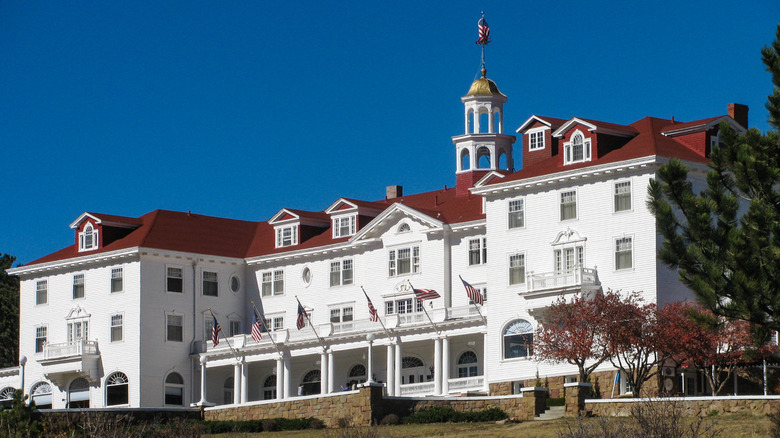
If there is such a thing as a bonus pick in a list such as this, then the Stanley Hotel is surely it. Stephen King stayed in the hotel in 1974, in room 217, no less, and after suffering a nightmare about his son being strangled by a fire hose, he settled down to write one of his most chilling novels: "The Shining."
The hotel was constructed in 1909 and is perched high among the Rocky Mountain peaks about an hour and a half's drive from Denver. Constructed in the colonial revival style, the building's elegance is undeniable, but so too is its literary provenance. It might very well be the most famous hotel in the world.
Whether the place is actually haunted or not is something of a moot point. Over the years, staff have complained about hearing strange voices coming at them from the ether, and the sensation of being touched by something that simply is not there. But it is its connection to the famous novel that is the real draw. Each year they hold an annual Shining Ball on the first Saturday before Halloween, and it is then that the true spirit of the annual holiday takes shape. Costumes, dancing, and generic revelry are an absolute given, but so too is the possibility of a photo opportunity or two outside of room 217.