
Essential Stops For Driving Kansas' Flint Hills Scenic Byway: A Classic Midwestern Road Trip
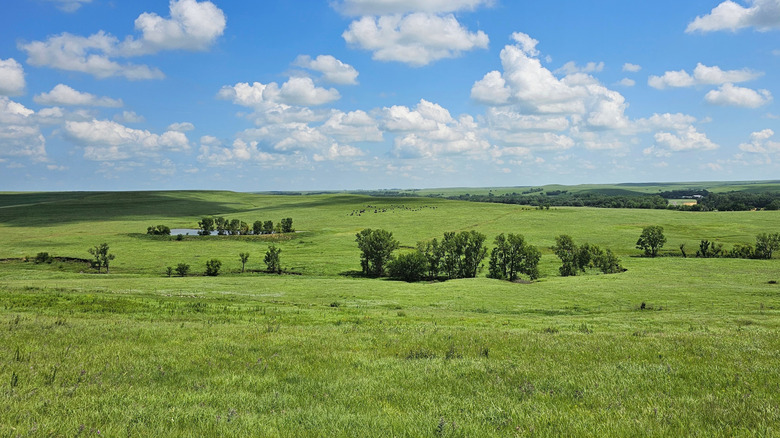
The Flint Hills National Scenic Byway is a short-and-sweet, 47-mile-long rural drive through the heart of a region boasting one of the world's last remaining tallgrass prairies. The two-lane highway follows Kansas Highway 177 (K-177) between the communities of Council Grove in the north and Cassoday in the south, where it's easy to hop onto Interstate 35 toward either Wichita or Topeka. The route's primary appeal is its rolling prairie, where travelers glimpse what tens of millions of acres of the Great Plains used to look like before settlers brought urban development and agriculture.
The Flint Hills Scenic Byway is where "ancient Kansas" thrives, winding through the rural heart of The Sunflower State. Depending on how many stops you plan to make and how much time you have to spend, the opening times of certain attractions, such as state historical sites, may influence your timeline. To give yourself enough time to enjoy unique landmarks, local businesses, and walking trails, give yourself a day and a half to explore. At fewer than 50 miles, the drive can be completed in about an hour without stops. To make the most of the trek, though, there are some essential stops to add to your itinerary.
Below, explore seven spots worth a visit along the scenic byway, from interpretive sites to charming Midwest towns to seasonal events. To compile this list, we've consulted a handful of resources, including Travel Kansas, Kansas Byways, Kansas Historical Society, the National Park Service, and the National Scenic Byway Association. We've also consulted the route on Google Maps, referenced an itinerary published in the online travel journal Ayushjeevan, and considered visitor reviews for specific attractions and destinations on Tripadvisor and Google.
Kaw Mission State Historic Site, Council Grove
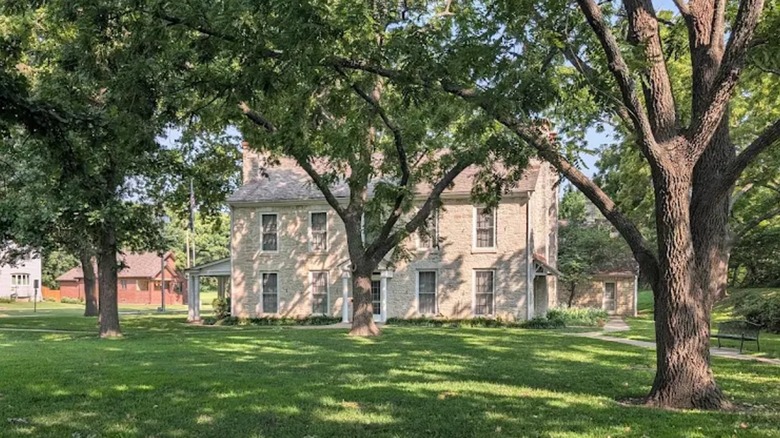
Council Grove has a quaint downtown — more on that next — and the official Flint Hills National Scenic Byway begins from the center of town. But before we hit the road, it's worth enjoying some of this charming town just south of Council Grove Lake's camping, fishing, and beach. On the north edge of town is the beautiful Kaw Mission State Historic Site, which has an important story to tell about how settlers in the mid-19th century made their mark on a region inhabited for centuries by Native American tribes like the Kanza and Osage.
The central stone building was designed as a boarding school for Indigenous Kanza boys, today often referred to as Kaw, who were moved to a small reservation here in 1846 by the U.S. government. The building, which housed students, teachers, missionaries, and farmers, was built in 1851 for use as a manual training school but was only in use until 1854. In the early 1870s, they were forcibly removed to Oklahoma, where the tribe is based today.
Beautiful, mature trees dot the Kaw Mission's small property. The site is open from Wednesday to Sunday all year round, from 9 a.m. to 5 p.m. (1 p.m. to 5 p.m. on Sundays). Spaces contain interpretive exhibits and archival objects, and visitors are welcome to explore additional rooms on the second story of the main building. Adjacent to that is also one of 138 government houses that once occupied the Kanza reservation, where visitors can learn more about how the Kanza way of life was indelibly changed. Admission is free, and you can also peruse a small museum shop.
Downtown Council Grove
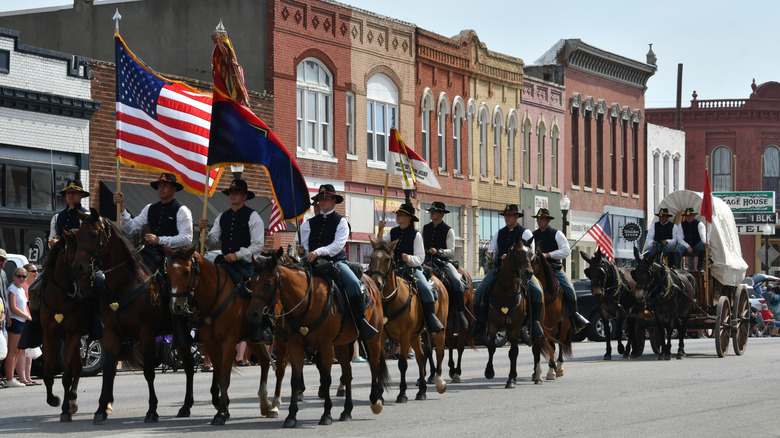
Council Grove's quaint downtown brims with Midwest charm, complete with historic brick facades and even the oldest restaurant west of the Mississippi River. That distinction goes to Hays House, which opened its doors for the first time in 1857. The restaurant and tavern have the unmistakable look of a 19th-century inn or saloon with a second-level mezzanine, and the menu is chock full of comfort food favorites. History buffs will also like a glimpse of the Last Chance Store on West Main Street, which also dates to 1857 and, at the time, was the final opportunity that westbound traders on the Santa Fe Trail had to stock up for the trek — hence the name. The Kansas Historical Society oversees the store, and tours may be available if you get in touch in advance with staff at Kaw Mission State Historic Site.
Council Grove marks the crossroads of the byway and the historic Santa Fe National Historic Trail, a 19th-century trade route stretching between Missouri and Santa Fe, New Mexico. The small city has styled itself the "Main Street of the Flint Hills," where you'll find boutiques and more quaint eateries like Trail Days Cafe & Museum, which sits inside the beautiful Rawlinson-Terwilliger Home. Peruse antiques at The Dustie Shelf, where you can grab a root beer float at its throwback soda fountain, browse apparel at Weathered Wood Home, or grab some reading for the road at Flint Hills Books. On a nice day, stroll along the Neosho Riverwalk, which will bring you to several sites, including the Kaw Mission State Historic Site, a couple of commemorative statues, and the trailhead for the Flint Hills Trail, which in its entirety stretches for 118 miles westward from Osawatomie, through Council Grove, and onward to Herington.
Tallgrass Prairie National Preserve
Seventeen miles south of downtown Council Grove is a beautiful, rare, rural destination where bison roam wild amid fishing spots and scenic trails. At nearly 11,000 acres, Tallgrass Prairie National Preserve conserves a tiny slice of a biodiverse ecosystem, where Native Americans have lived for thousands of years. The prairie used to cover one-third of North America — around 170 million acres — but has become scarce following centuries of agricultural and urban development. The preserve is home to more than 500 species of plants, nearly 150 species of birds, and dozens of different types of reptiles, amphibians, and mammals.
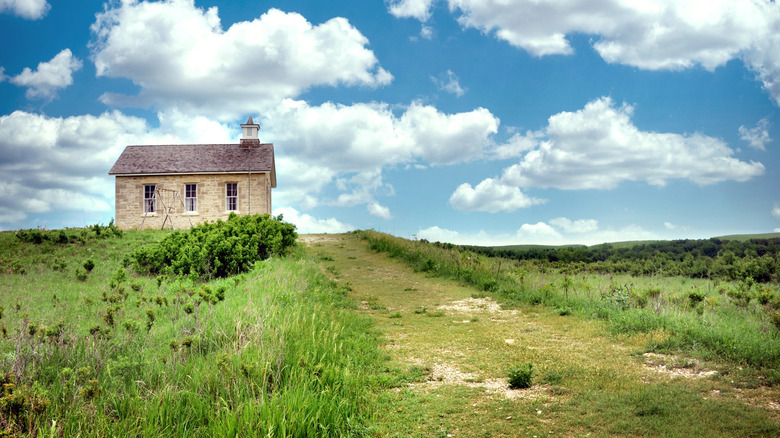
Here in the Flint Hills, visitors have the opportunity to hike, picnic, and glimpse what the Great Plains looked like before settlers arrived. There are vestiges of the region's homesteading past, though, in photogenic historic sites like the Lower Fox Creek Schoolhouse and the stately Spring Hill Farm and Stock Ranch's home and large barn. The prairie still supports cattle grazing as part of an active ranching operation. The visitor center is also located adjacent to the house and barn, from where the Southwind Nature Trail stretches for 1.9 miles.
If you have more time, more remote trails like the Scenic Overlook Trail, Ranch Legacy Trail, and Crusher Hill Loop offer expansive views, and only hikers are allowed — no bikes or horses. Just keep the time of year in mind when it comes to the height of the grass: It's short and green in the spring, then it gets "tall in the fall" and eventually turns brown. Overnight stays aren't permitted at the preserve, but campgrounds aren't too far at Swope Park in Cottonwood Falls (five miles south) or Chase State Fishing Lake (eight miles south).
Strong City
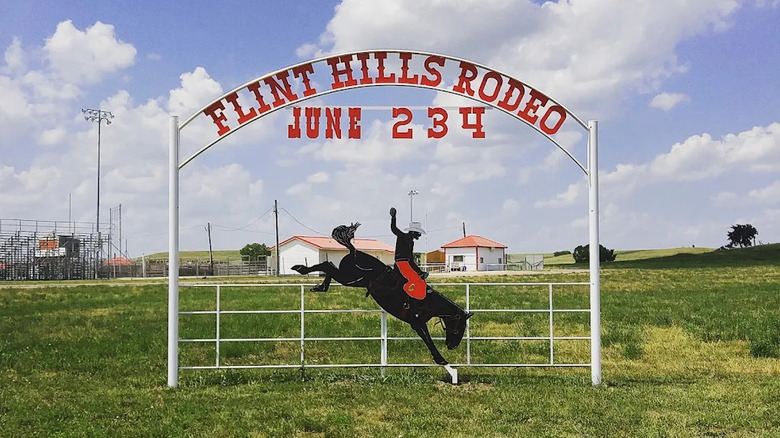
Strong City is located 20 miles south of Council Grove and just about three miles south of Tallgrass Prairie National Preserve. It's a small town that nevertheless makes a great pit stop for lunch if you've been outside exploring. If you're looking for a sit-down lunch with a hint of local history, head to the end of Church Street, which stretches a little more than three blocks east of the byway. If you're here on a Sunday at lunchtime, you'll enjoy the charming Chef Stan's Place, which has transformed the street's small namesake church and school into a restaurant featuring American cuisine. Alternatively, head toward the northeast edge of town for tacos and then some at Jacalito Family Restaurant.
Strong City is famous for its historic Flint Hills Rodeo, which celebrated its 88th season in 2026 and claims to have been running continuously longer than any other rodeo in the state. Throughout a three-day weekend in late May or early June, the town brims with energy around this time-honored tradition, and professional rodeo contestants travel from all over the country to compete. Saturday afternoon during rodeo weekend is also a family-friendly opportunity to take in the Flint Hills Rodeo Parade, which stretches from Swope Park in Cottonwood Falls, 2.5 miles south of Strong City, up to the rodeo grounds. Even if you're not in town for the big event, Strong City is worth a quick stroll through its small downtown, where the architecture is eclectic and historic. Stop by Kelly's Bees on S. Cottonwood Street to grab a jar of local honey, which you can also scout out at the local hardware shop, Clark Farm & Home Store.
Cottonwood Falls
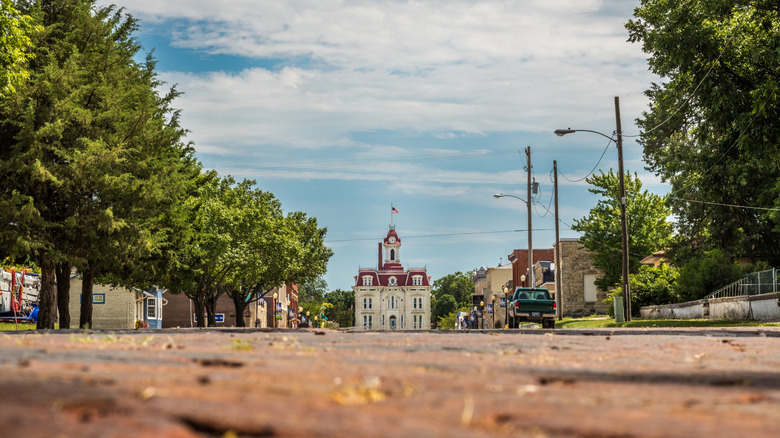
Just two miles south of Strong City is the slightly larger rural hub of Cottonwood Falls, a small Kansas city with peaceful prairie scenery and a delightful downtown. The beautiful Cottonwood River flows north of town, and visitors can walk across a historic bridge that's been turned into a pedestrian-only crossing to view the namesake cascade. One of the community's most well-known features is the ornate Chase County Courthouse. Its red roof and bright limestone have made it a prominent feature since it was completed in 1873, and it holds the distinction of being the oldest courthouse still used in Kansas.
Cottonwood Falls is a great option for an overnight stay if you stretch your Flint Hills Scenic Byway itinerary across a couple of days. If the weather is agreeable, Chase State Fishing Lake is just three miles west. Here, you can cast a line in the afternoon for crappie, bluegill, channel catfish, and more. Back in town, The Lark Inn manages a number of guesthouses ranging in size, age, and style, including the 1879 Stone House and a revitalized 1890s prairie house on Main Street. Downtown, you'll also find the quaint Grand Central Hotel in the tradition of late 19th-century ranch town inns, which also features the Grand Grill for lunch and dinner, plus the Buffalo Bar.
Downtown is small and walkable, with the courthouse as its centerpiece. You'll find espresso drinks and freshly baked pastries at HeBrews CoffeeHouse, after which you can head to Tallgrass Antiques (open Friday through Sunday) to browse a wide range of vintage objects and architectural salvage. Stop into the Flint Hills Gallery to see the beautiful landscape paintings of local artist Jessica Bell, and peruse local heritage at the Chase County Historical Museum.
Schrumpf Hill Scenic Overlook/Kansas Scenic View
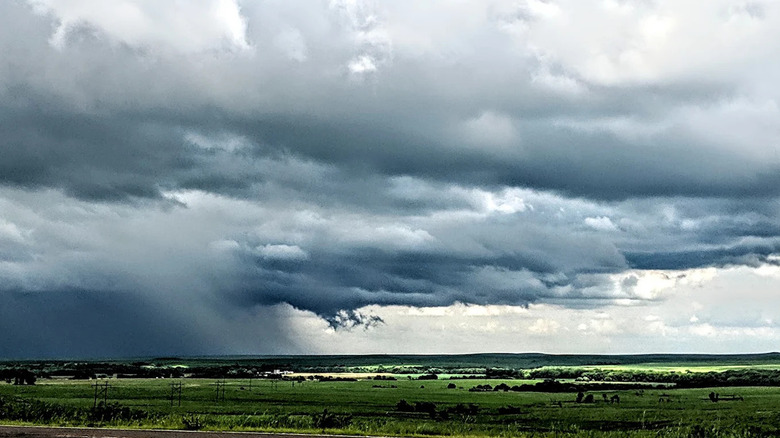
About three miles south of the southern edge of Cottonwood Falls, a very easy-to-access turnout right on the byway provides some of the route's best views. The expansive landscape here feels virtually uninterrupted, providing an experience that feels worlds apart from the rest of the area's cities, suburbs, and farmlands. If you're navigating using Google Maps, the site is marked simply "Kansas Scenic View," but it's also known as the Schrumpf Hill Scenic Overlook. Although there's no cover, a few small benches provide a great spot to stop for a snack on a nice day. And while there are a lot of opportunities for interesting photos along K-177, especially if you have an eye for eclectic rural towns, this is one of the best places to capture images of the sprawling grasslands as they would have looked centuries ago.
Parking is very easy to access via a short exit from the highway that is marked simply with a blue sign reading "scenic view." A short walk along a paved path leads you to an elevated vantage point over the prairie, along with interpretive panels describing the many animals and plants the Flint Hills are home to.
Cassoday
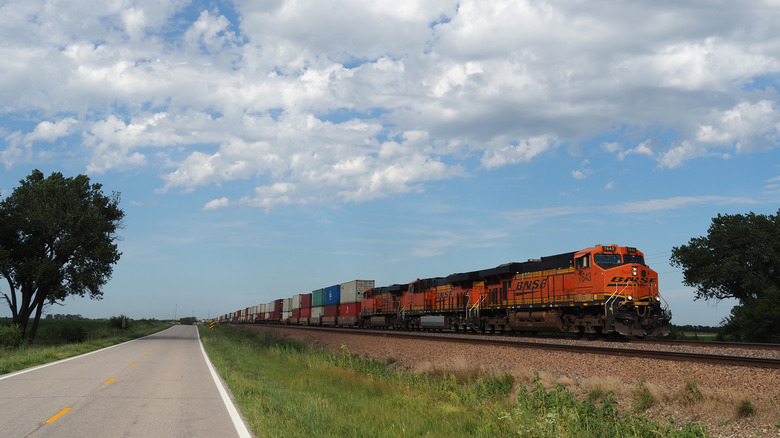
The final notable stop on the Flint Hills National Scenic Byway is the town of Cassoday, known as the "prairie chicken capital of the world." The town's nickname nods to its location within the vast prairie that these fascinating, colorful, chicken-sized birds inhabit, and it's located about 22 miles south of the Schrumpf Hill Scenic Overlook. While Cassoday is a quiet town without a lot of amenities, the community still marks the formal end of the byway and is worth a peek before heading onward on K-177 or hopping on I-35 to your next destination.
Cassoday is the gateway to another ecologically valuable area known as the Flint Hills Tallgrass Prairie Preserve, managed by The Nature Conservancy, which is about six miles due east of Cassoday proper. Although it's been around since the mid-1970s, its trails only opened to the public in 2023. The preserve protects a wide range of native grasses and animals like bobcats, sparrows, deer, and — surprise, surprise! — prairie chickens across nearly 2,200 acres.
If you want to add one more remote yet stunning vantage point to your list before heading on your way, continue eastward on 300th Street/Teterhill Road for another six and a half miles, and you won't miss Teter Rock, a limestone monolith that sits atop the highest hill in the area. Although it's a replacement from the 1950s, the original one stood in the late 19th century as a waymarker for westbound homesteaders. It's a great spot to observe where your next leg of the journey will take you.