
The Best Ways To Use Credit Card Points To Travel The World For Free, According To A Points Expert

Credit card points and miles remain some of the most misunderstood aspects of the travel world. Built to be complicated, those who know how to wield them effectively seem to be on a never-ending carousel of business class flights and luxury hotels, while others remain convinced they're almost a scam.
The hard truth for those in the latter group is that they just don't know how they work. Credit cards promise the world, but hide the best redemptions behind a slew of complex transfers and a paywall-like learning curve. I've experienced this first-hand, and have spent the last six years battling my way to the top of that hill as I traveled the world full-time.
Since my first few misfired redemptions, I've managed to take control of my points strategy, saving upwards of $10,000 a year on travel, writing about points and miles extensively, and even launching a course on the subject. If you're unsure if air miles are actually worth the hassle, I'm here to show you they are, and these are some of the best ways to earn and use them to travel the world essentially for free.
The difference between airline/hotel points and credit card points
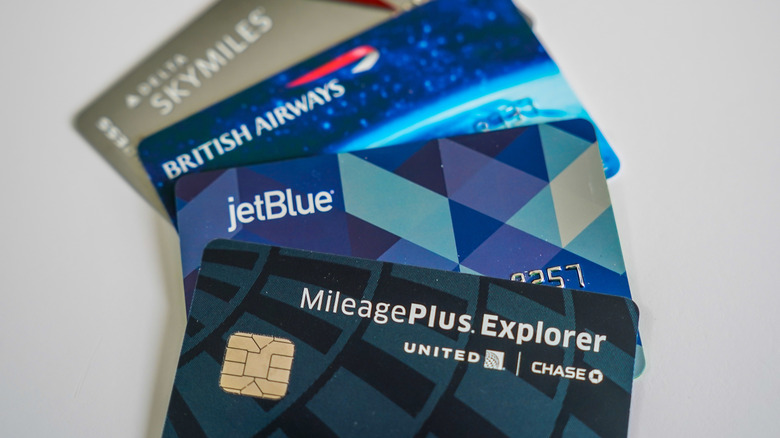
Before getting into the nitty-gritty, it's important to distinguish between the types of points. This is a constant source of confusion and one of the biggest pitfalls hopeful travelers are susceptible to. Grasping the difference is vital.
Airline and hotel points are redeemable currencies attached to the loyalty program of any given carrier or accommodation brand. They can (generally) only be used within that ecosystem. For example, Delta SkyMiles can only be used on Delta's booking portal, and Hilton Honors Points can only be used on Hilton's. You can earn these by using the associated brand or opening a co-branded credit card.
General credit cards, on the other hand, like American Express, Citi, Capital One, and Chase, earn their own points. These, unlike airline miles, can be transferred to a range of designated transfer partners. For example, Amex points can be transferred to KLM, British Airways, Air Canada, Hilton, and a number of other airlines. This makes them immensely valuable, and I'll explain why in the next few sections. Some airlines, like Alaska Airlines, the best domestic frequent flyer program in the U.S., are harder to transfer to and can be worth saving separately. It's also worth highlighting that while frequent flyer status can make or break your in-flight experience, it's your points that get you free flights.
Earning points: Analyze your spending with a clear goal

Before you do anything else, it's imperative that you take inventory and build a clear goal. Many people open a card without any real thought, and find themselves frustrated or feeling conned when the free travel they hoped to cover just isn't possible. When setting a goal, start with identifying whether you want to fly business class once a year, cover multiple trips for as little as possible, or supplement some travel you're already paying for. This sets the standard for the volume of points you'll need and how soon you'll need them. Without knowing this information, you can't open the right cards. This isn't an exciting part of the process, but it's one that'll pay dividends in the long run.
For example, while traveling full-time, my goal wasn't business class flights. I was set on paying as little as possible for as long as possible. This meant I was less focused on having enormous volumes of points and more focused on steady earning.
You'll also need to analyze your spending habits to ensure you open cards that work with you, not against you. Note how much you spend on average each month, and where. Do you eat out a lot? Is gas a huge bill? Maybe travel expenses are high? This will dictate your next move.
Earning: Open cards that complement your lifestyle

Credit cards are your principal tool when it comes to earning points and miles. Unless you're flying regularly, there's simply no way to earn as much, but your card choice can make or break your success. The right arsenal of products can help you earn on autopilot. Remember, credit card points are, at their core, marketing tactics for the banks. They want you to open the one that sounds the best, even just the one that looks shiny and impressive, so fighting that impulse and selecting one based on your own situation is a win in itself. Just remember, the best credit card for you often isn't the one you'd expect.
Use the information you've gathered about yourself to pick a card (or cards). Finding products with high earning rates in your big-spend categories sets you up for day-to-day success, while opting for introductory offers with spending thresholds well within your monthly budget constraints can gift huge volumes of points.
If two cards have similar rates, but one offers more perks, then go for that one. Just don't be lured in by things like lounge access if the fee is too high and the card doesn't offer anything beyond that. In even a year's time, you'll be happier knowing your flight is paid for rather than getting into a lounge.
Earning: Earn a variety of points
As mentioned before, there's a difference between general credit card points and airline or hotel points. It's natural for people to lean towards an airline they like. For example, you may opt for Delta whenever you fly and assume it makes the most sense to open a Delta credit card. However, the reality is that Delta Skymiles are some of the hardest miles to gain value from. It's actually better value to book a Delta flight using another airline like Virgin or KLM, which is considered the world's best airline points program for 2025.
Instead, make general credit cards the core of your strategy and supplement with specific brand points. This allows you the maximum scope in any situation, whether you're looking for a cheap domestic flight or heading on a round-the-world jaunt.
Opting to earn transferable points like Amex, Chase, Citi, Capital One, and Bilt is the best way to have the most power in your wallet. It provides flexibility and maximum value in almost every scenario. It doesn't hurt to have the extra specific points on hand, but they shouldn't be the focal point.
Earning: Open cards for the intro bonuses

This is where the real strategy starts to come in. Once you've built a good picture of your finances, goals, and cards that would match your lifestyle, you need to start opening them. Aim for cards that offer introductory bonuses. These offers generally gift new cardholders large sums of points and miles for hitting a specific spending threshold. For example, a card could offer 60,000 or even 75,000 miles after spending $4,000 within three months of opening it.
While the prospect of spending $4,000 may seem intimidating, it works out well when you break it up by the average spend per month. Without a bonus, that $4,000 would only earn you between 4,000 and 12,000 points on their own, assuming the card earns one to three points per dollar — that's how valuable these bonuses are.
Many points and miles enthusiasts actively open multiple cards a year just for these bonuses. In some years, I've managed to earn well over 200,000 points without spending beyond my means. That's a huge number that could take me a long way with flights. Of course, you must be careful here, as it's a risky game opening up so many cards. You need discipline to ensure you're not overspending, and even more to guarantee you pay all the cards off every month, lest you accrue some interest. Free travel isn't free if you're in debt.
Earning: Take advantage of your big purchases

Using the same tactics of honing in on big introductory offers, big purchases can be a game-changer. Obviously, some come out of the blue, like a broken washing machine, but others, like a new laptop or TV, can be planned ahead. If you know you have a significant purchase on the way, look at some cards with bonuses that match the rough amount of spend.
A few years ago, I opened a Hilton card on top of some of the other cards I'd already been using for day-to-day things, to purchase my new laptop. The 150,000 points I earned on a $2,000 purchase allowed me to grab five nights in London that would have cost $1,000. That's an incredible 50% return on my purchase. I repeated the feat a year later with a new MacBook for my girlfriend, and that one scored us a similar five nights in Paris.
At the start of the year, take inventory and think about whether you'll have any big buys coming up later on. This can help you plan and time the opening of a good card. Big holidays and vacations are also a good time to consider opening one. The extra travel, presents, hosting, and sales are all triggers for bigger spending that can be capitalized on.
Earning: Use 'two-player mode'

If you're lucky enough to have a fiscally responsible significant other in your life, it's time to ramp things up a little. Affectionately named "two-player mode" in the points world, this tactic involves doubling down on points and miles by using two people to maximize earnings. Working in pairs means you can attack each and every card twice, sometimes in quick succession. It also means you can open multiple cards that tick different boxes. For example, one of you can open a more expensive premium card that offers lounge access for the two of you, while the other hones in on high-earners.
Naturally, this requires a lot of trust. If you're married, it's likely your finances are already intertwined, so it shouldn't be too much of a difference. For newer couples who maybe aren't as tied to each other's money, there might be an acclimation period. I've worked with my partner for the past six years on this, and it's taken a lot of tough conversations and honesty to ensure we stay on track. It's by no means easy, but it's what allows us to save over $10,000 a year on our travels.
Redeeming: (Almost) always transfer points

Let's get to the really complex part: Redeeming your hard-earned points for free travel. Thousands of credit card holders go abysmally wrong at this point, and it's not really their fault. Airlines don't really make their money from flights anymore: It's credit cards that are driving profit. As such, the credit card companies have built so many ways to redeem points and miles that we often default to the most obvious option.
In this case, that obvious option is credit card travel portals. These function like traditional travel aggregators like SkyScanner or Expedia, but are only accessible to cardholders of the specific issuer. Generally, you search for a flight or hotel, you find one you like, and you're given the option to book with cash or points. Points are typically given a value of one cent each on these portals — so, if a flight costs $500, it'll require 50,000 points, and so on. The only problem is that a one-cent valuation is terrible compared to what you can get by transferring points. Each issuer has a list of airline and hotel partners that allow you to move your general credit card points into specific loyalty programs. From there, you can book flights and stays for far higher value, like three or four cents per point, and sometimes as high as 10 cents per point.
Consider a 75,000-point introductory offer. If you spend $4,000 to earn it, you'd get $750 back in travel on a portal. But if you could transfer the same 75,000 points to a strong partner and get three cents per point, you'd have grabbed over $2,000 in value. That's a huge difference. Of course, if you have points in an account with a strong redemption, you don't need to transfer.
Redeeming: Aim for high value

Yet again (spot the pattern), it's not always as simple as transferring to any old airline or hotel program. Each program has its own strengths, making it easier or harder to maximize the value of your points. These valuations can fluctuate aggressively, so it takes a little research on your part to make sure it's a good deal. It's vital to do these calculations on a flight before you move points, as, once they're gone, they're gone.
To calculate the value of an award redemption, take the cash price of the flight, subtract the taxes and fees on the award redemption, divide by the number of points, then multiply times 100 to get the cash value per point. For example, let's say you find an award redemption with United Airlines that costs 40,000 miles plus $5.60 in taxes. Then, you search for the same flight in cash and find out it costs $600. So, subtract $5.60 from $600, then divide that by 40,000. That comes to about 0.015 (rounding up), and multiplied times 100 equals about 1.5 cents per point. It's not amazing, but it's better than one cent per point.
Taxes and fees are important here. United's are usually pretty low, but other airlines opt to pass fees on from other airlines or airports. Sometimes this can be hundreds or even thousands of dollars, but it's still possible to get a good deal. Do the calculation to see if you're on track, and if it falls below one cent per point, don't do it. A good way to pad this value is to use transfer bonuses. These are limited-time offers that allow you to transfer points from your credit card to an airline or hotel with a bonus — sometimes as high as 70%.
Redeeming: Hone in on the award charts

Each airline and hotel has its own way of dictating award rates. Recent years have seen a huge swing towards dynamic pricing, meaning the program can raise and lower rates to match cash prices or demand, or just because they feel like it. This is bad for consumers, as it makes things unpredictable and hard to maximize value. But some have clung to the old concepts of award charts.
Award charts are where we can find the best value because rates are set by predetermined variables. For example, Air Canada's partner award chart sets rates based on four distinct geographical regions and the distance flown. To calculate the award rate with Air Canada, you'd check the region you're flying from and to, then see how far the flight is. A flight from New York to Paris means you're flying from the North American region to the Atlantic region, and the distance of the flight falls under 4,000 miles, so you'd always be paying 35,000 points for an economy flight. If you go above 4,000, it would rise to 40,000, and so on. It doesn't matter what the cash price is; you'll get the same points rate.
This is where real value starts to appear. If that Paris flight costs $500 one day and $900 the next, you're still paying the same points rate. You'd be getting 2.5 cents per point for the $900 flight and 1.3 cents per point for the $500. Other programs like ANA, British Airways, American Airlines (for partner flights), and Hyatt all have excellent award charts to take advantage of. These should be your first searches in any travel planning.
Redeeming: Learn the sweet spots

"Sweet spots" are reliable redemptions within programs with outweighed value. Most of these are found within award charts, because of the reasons mentioned earlier, but there are a few exceptions. While sweet spots could take an entire article in themselves, it's worth pointing out a few.
In the hotel scene, pretty much the entire World of Hyatt program is a sweet spot. Its award chart is the most generous in the travel industry and offers customers the chance to book immensely expensive and luxurious properties for almost nothing, or book weeks of nights in cheaper hotels. It achieves this by setting each of its properties in a category between one and eight (eight being the most luxurious). Each category is then assigned a nightly rate at off-peak, peak, and regular times. A category eight property, which can often cost well over $1,000 a night, costs just 35,000 points at off-peak times. That's almost three cents per point for that redemption.
Elsewhere, Virgin Atlantic offers transatlantic flights for just 6,000 points plus $75 in fees, while Turkish Airlines has flights with United between New York and Hawaii for as little as 12,000 miles. These are all remarkable redemptions that guarantee a strong return. And, like I said, you don't need to open a card from these airlines. Capital One transfers to Virgin and Turkish Airlines, while Chase transfers to World of Hyatt. One 75,000-point bonus with Chase could get you almost a month in a Category One hotel with Hyatt.
Methodology

I've been writing about and using points and miles for the last six years, and know these systems like the back of my hand. While I have linked to external pieces of my own from The Daily Navigator, my knowledge is backed up by first-hand experience as well as other well-known and trustworthy points and miles outlets such as NerdWallet and The Points Guy. All information is up to date as of November 2025. Since the world of travel points can largely depend on the person using them, some of the advice hinges on opinion or hypothetical examples, but the bulk of it is well-accepted tactics within the points and miles community.