
The 5 Best Abandoned Ghost Towns To Visit In The Pacific Northwest, According To Reddit
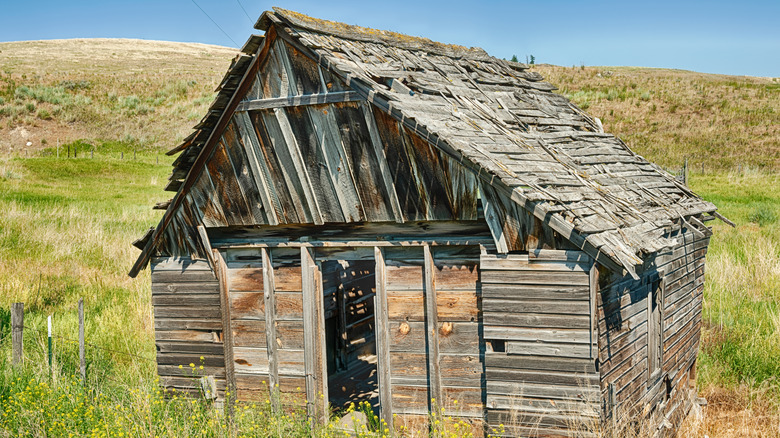
Pick any state in the U.S., and you'll find a ghost town — the sometimes spooky, always evocative remnants of a place that once was. Ghost towns are often a result of a once-booming industry that fell into decline (like mining), natural disasters, and economic hardships. While it's said that Texas has the highest number of abandoned towns, the Pacific Northwest is also a hotbed of ghost towns, primarily linked to the region's natural resources, which led to a boom in mining and logging towns during the 19th century.
There are several types of ghost towns, according to Travel Oregon. "True ghost towns" no longer have any residents, "partial ghost towns" have a much smaller population than before, and "tourist ghost towns" have been repurposed for visitors, like Oregon's Shaniko, a once-abandoned ghost town that's getting a second life. Remember to be respectful and leave no trace when visiting one, as it's important to leave everything as preserved as possible.
You'll find especially well-preserved sites in the desert regions of the Pacific Northwest, as the arid climate better preserves these structures. Although it's nearly impossible to whittle down so many options to just five, this list focuses exclusively on true ghost towns with well-preserved structures highlighted on Reddit.
Bayhorse, Idaho
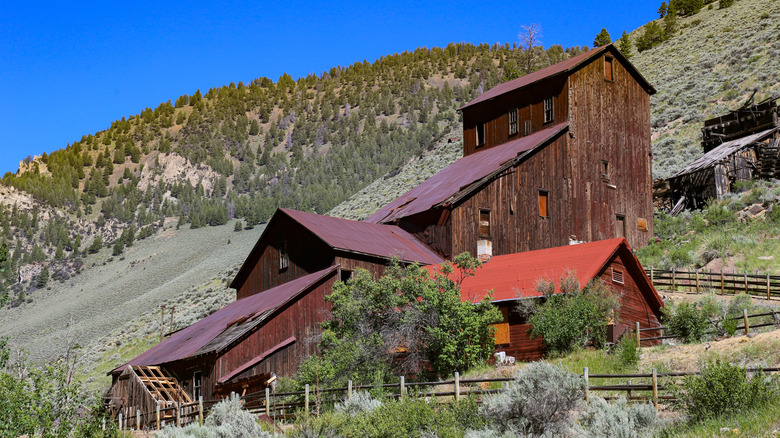
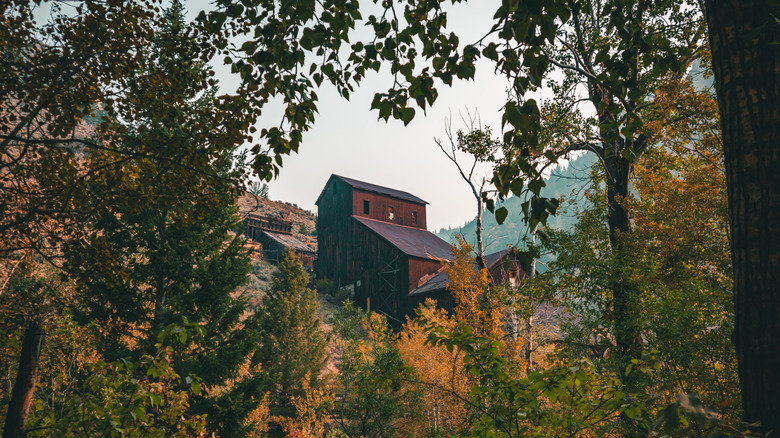
Located in the Gem State, Bayhorse, Idaho, was a silver mining town that sprang up in the 1870s. Its origins date back to 1864, when a prospector found silver and lead deposits in the nearby Salmon River. The area was named after his two bay horses, known for their distinctive coloring. The town had one of the richest silver and lead discoveries in Idaho, and at its peak, had about 300 residents.
Bayhorse was home to a post office, hotels, boarding houses, and a brothel — the typical businesses you would find in a mining town — and its stacked architecture uniquely follows the shape of the mountains around them. A fire wreaked havoc on Bayhorse in 1889, and things took a turn for the worse when a water shortage slowed mining efforts. The high altitude — over 6,000 feet — didn't help make life easier in this remote location, and by 1925, Bayhorse had emptied out and become a ghost town. Today, you'll find 19th-century structures like the stamp mill and charcoal kilns, slowly decaying against a magnificent backdrop of forested mountains, which is perhaps why several users recommend it on a Reddit thread looking for "more off the grid" ghost towns.
Bayhorse is about a 20-minute drive from Challis, a hidden gem on the road to Yellowstone, tucked inside Yankee Fork State Park. Ghost-town enthusiasts can explore the entire state park, which also has the Old West-style ghost town of Custer and Bonanza within its limits. These two sister towns were also mining hubs, but were both abandoned by 1911 when the mines ran out. Check out the Yankee Fork Gold Dredge, a massive 988-ton machine that canvassed the Yankee Fork in search of gold until 1952.
Burke, Idaho
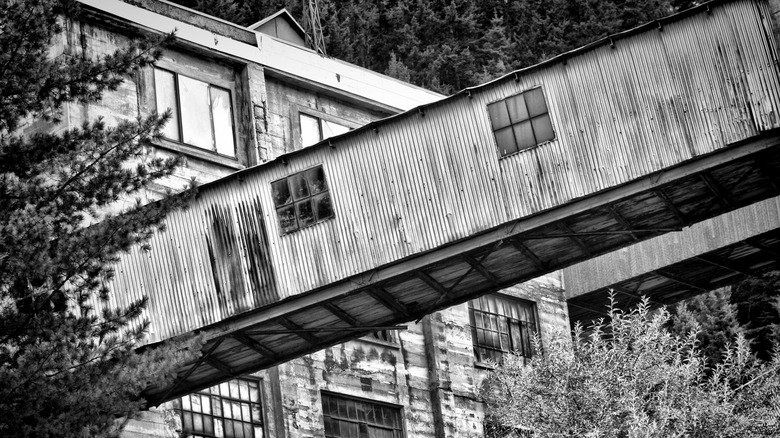
One of the strangest ghost towns — architecturally speaking — is Burke, a fascinating site in northeast Idaho that's just a few miles from the border of Montana. This abandoned mining town, filled with yesteryear charm, was constructed in a canyon so narrow that the architecture had to adapt to it. Burke was built in 1884, when silver ore was discovered in the area. A drawback to this location? The canyon is only 300 feet wide at its narrowest point. Not a problem for the residents of Burke, who simply made their main street the railroad tracks running through the town, which meant cars had to pull over when the train came.
The Tiger Hotel, the town's commercial hub, served 1,200 meals each day, while the town had about 1,400 residents at its peak. The hotel was built across the stream in the canyon, straddling the main street, connected by a covered walkway. That's right: The Tiger Hotel was constructed over the train tracks, perhaps the only hotel in the country that had trains running through its lobby. Burke's precarious location 3,700 feet up in the Coeur d'Alene Mountains made it susceptible to the elements, and the town suffered a series of deadly avalanches, plus floods and fires.
The last mine closed in 1991, and now Burke is an empty ghost town, filled with decaying buildings clustered around the old train track. Unfortunately, the unique Tiger Hotel was torn down in 1954, but you can still see several abandoned buildings and the holes in the cliffs where some built their homes. Be aware that these days, parts of the town are fenced off or on private property, but there's enough to see from the outside to make several folks recommend it on Reddit.
Golden, Oregon
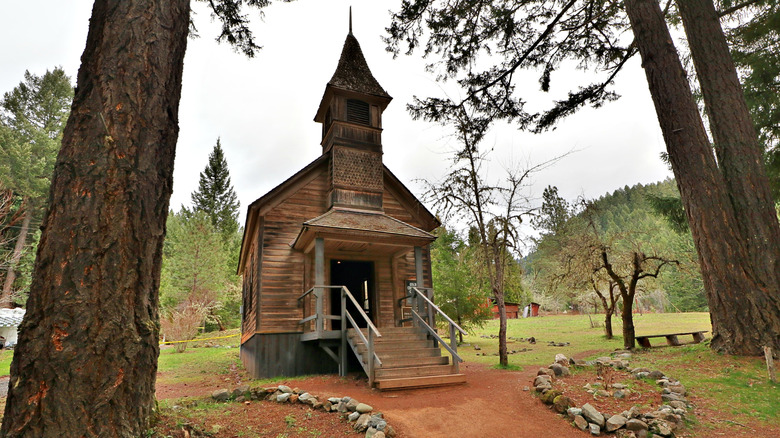
Although Oregon has a high number of ghost towns, like Granite, hidden in one of Oregon's smallest cities, it doesn't have many "true" ghost towns. This is one reason why the town of Golden is so popular. Hidden among the forest of the Golden State Heritage Site, several things set this mining town apart. Unlike most ghost towns, you won't find a saloon. Reverend William Ruble settled this dry town in the 1890s, building a religious community of about 100 people who adhered to strict rules that included no drinking, gambling, or dancing.
There were two churches — one of which still stands today. As with most gold-mining towns, Golden dried up when the gold did, and after the post office closed in 1920, it was only a few years before the rest of the town did, too. Now, just four buildings remain: a church, a residence, a shed, and the general store (that was also the post office).
Maybe more surprising than the lack of a saloon is, according to some, the presence of something else: ghosts. Several people have reported strange happenings and unsettling feelings while visiting the town. The church was rebuilt in 1950, and some believe the ghost of the reverend still haunts it, while others say the spirit of the shopkeeper's wife, who disappeared in 1901, still calls the general store home. This Golden State Heritage Site is just a 30-minute drive from Grants Pass, Oregon, and is tucked near the parking area. It's a family-friendly site — assuming your family is okay with ghost stories — so see for yourself why it made it onto a Reddit thread of people's "favorite and most interesting" ghost towns.
Molson, Washington

Perched high in the Okanogan Highlands near the Washington-Canadian border is Molson, an abandoned town bursting with history. A spectacular drive leads through a remote landscape peppered with abandoned buildings and mining equipment, making Molson a great stop while exploring Central Washington. Molson was founded in 1898 by George Meacham and Canadian brewing heir John W. Molson after gold was discovered in the area in 1896. About 300 people lived here initially, with even more arriving once the town was added to the Great Northern Railroad route in 1905.
Things began to take a turn when Molson failed to register the land title. A man named MacDonald put the deed in his name and forced everyone to leave, claiming they were now on his private property. The residents built a new Molson half a mile away, but they didn't go quietly, stealing the post office and bank. The railroad took Molson off its route in the mid-1930s, following the depletion of the mines.
These days, you can find the old schoolhouse and bank still standing, along with about a dozen other buildings. Admission is free, and you can visit the well-preserved town during daylight hours. For more history, head to the Molson Schoolhouse Museum, located in the brick schoolhouse that closed in 1969. The museum is also free to visit and open from Memorial Day through Labor Day from 10 a.m. to 5 p.m. One Reddit user drove six hours just to see Molson, which wound up being their favorite ghost town that they saw, while on another thread, u/Dogprestidigitator calls it a "cool ghost tow[n] you can drive into."
Monte Cristo, Washington
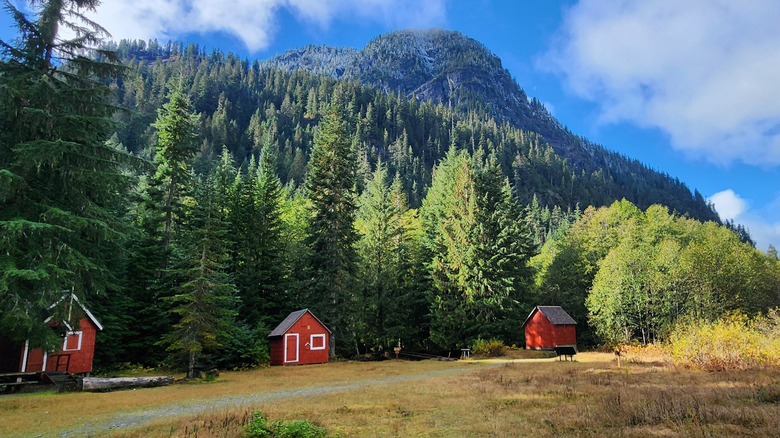
If you're looking for a half- or full-day ghost town experience, lace up your hiking boots and head to Monte Cristo, Washington, located on one of Washington's most underrated drives. A near-flat 8.7-mile out-and-back path beginning at the Barlow Pass Trailhead leads you through the dramatic peaks of the Mount Baker-Snoqualmie National Forest to this 19th-century mining town that may be the most famous ghost town in the state.
Hidden among the mountains is a small abandoned town named after Alexandre Dumas' "The Count of Monte Cristo." Two prospectors discovered Monte Cristo in 1889, and within a few years, John D. Rockefeller decided to invest in the town's gold, silver, lead, zinc, and copper mines and fund the railroad linking it to Everett. This led Frederick Trump — the paternal grandfather of Donald Trump — to stake a claim in this small town and build a hotel on land that he didn't even own. Monte Cristo was thriving with a population of about 2,000 people, eight mines, and hotels and saloons.
A few different elements brought about Monte Cristo's decline. Its location made it susceptible to avalanches and floods that damaged the mines and railroad, and Rockefeller started pulling his investment in 1894. The town was abandoned by the 1930s, and, despite attempts to make it a tourist attraction, its vulnerability to the weather has kept it empty, which is perhaps why users on several different Reddit threads have recommended it to those looking for abandoned towns in Washington.
Methodology
Picking just five ghost towns out of hundreds was not an easy task, so a few different criteria were used to create this list. One of the main ones was focusing only on true ghost towns, which no longer have any residents. That's why you won't see Idaho's wild west escape of Silver City on here, since it's not fully abandoned. Islands then looked at Reddit, travel blogs, newspapers, and online publications like Atlas Obscura, Only In Your State, and MSN to see what names popped up repeatedly across different websites. Reddit was used to condense the list because it's often much more locally oriented.
This research helped determine both the state of the buildings (how well-preserved they are) and the accessibility of these sites. We also wanted a mix of places that visitors can reach either by driving or hiking. Finally, since many ghost towns in the Pacific Northwest followed similar trajectories — springing up with the discovery of resources and then being abandoned when they ran out — Islands sought to include places that had either an interesting history or an architectural style that makes them stand out.