
New Mexico's 5 Once-Thriving Locales That Are Now Abandoned Ghost Towns
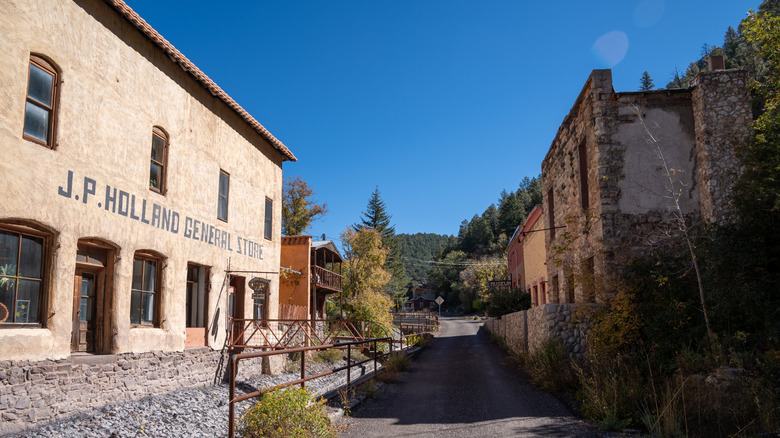
Few other states can rival New Mexico when it comes to abandoned places. For one thing, there are hundreds of abandoned settlements across the state (more than 400, according to the official New Mexico Tourism Department estimates). They're also often better preserved than ghost towns elsewhere, thanks to a combination of low humidity and a sparse population in the areas around many old settlements, leaving them surprisingly intact.
Not all of the ghost towns in New Mexico are abandoned. Many are still occupied, if by a much smaller population than in their heyday, like the gold-rush settlement of Hillsboro, which in 1907 was home to more than 1,200 people but today is a tranquil village of about 100. Others have come back from the dead, like Madrid, a Turquoise Trail town between Albuquerque and Santa Fe that boasts Mexican charm, art, and cuisine.
For those who are seeking traditional ghost towns, where you can explore empty streets and structures that make you feel like you're stepping back in time, there are plenty of spots in New Mexico where you can get that experience. Some have been fully abandoned, while others are preserved as historical landmarks and have a small "population" made up of caretakers and workers. Here are five of the state's best ghost towns that are worth traveling to see. In narrowing down candidates for this list, we focused on a specific category of ghost town: those with zero full-time inhabitants beyond those whose sole purpose is the upkeep of the town. We also made sure to include ghost towns home to enough standing structures or landmarks to make a visit significantly worthwhile and interesting. Head to the end of the article for more details on how we curated this list.
Glenrio
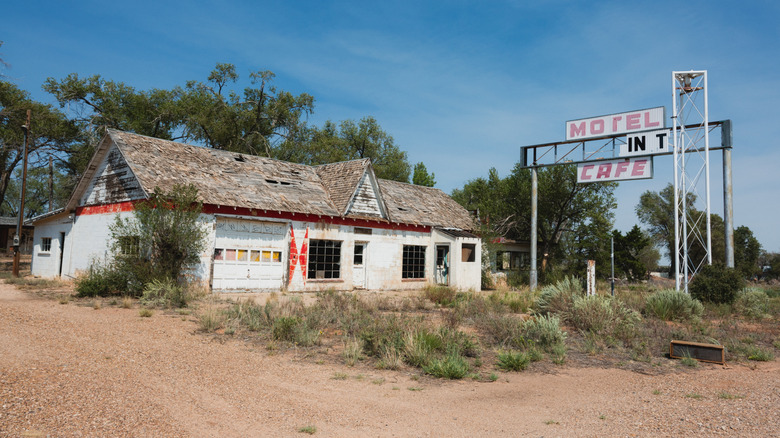
Travelers interested in Route 66 will want to pay a visit to Glenrio, a well-preserved abandoned border town that is now a historic snapshot of the Mother Road. The town was founded in 1905 as a railroad stop along the tracks of the Rock Island Railroad. In 1913, the Ozark Trail Association started promoting highways to cater to the new trend of automobile travel. This trail became part of the new Route 66 in 1926, and the town thrived until the construction of Interstate 40 in the 1970s. By the turn of the new millennium, the population had shrunk to just five people.
Glenrio was listed on the National Register of Historic Places in 2007, creating a historic district that includes 17 still-standing abandoned structures as well as the old Route 66 roadbed. It straddles the New Mexico-Texas border, and the preserved buildings reflect how this dual-state identity shaped Glenrio's construction. The Texas side was in a dry county, so all of the bars were built in New Mexico. Conversely, New Mexico's gas tax was higher, so service stations were built in Texas. There are abandoned structures on both sides of the border, including the State Line Motel and Cafe and a Texaco station, the Longhorn Motel, and the Little Juarez Diner on the Texas side.
The best way to reach Glenrio is via I-40. It's roughly a 3-hour drive from Albuquerque and an hour west of Amarillo. The ghost town is about a mile from the Exit 0 off-ramp. If you want to explore more Route 66 history, you can continue about 80 miles west on I-40 to Cuervo, another once-thriving community along the famous highway that was officially abandoned in 2011.
Mogollon
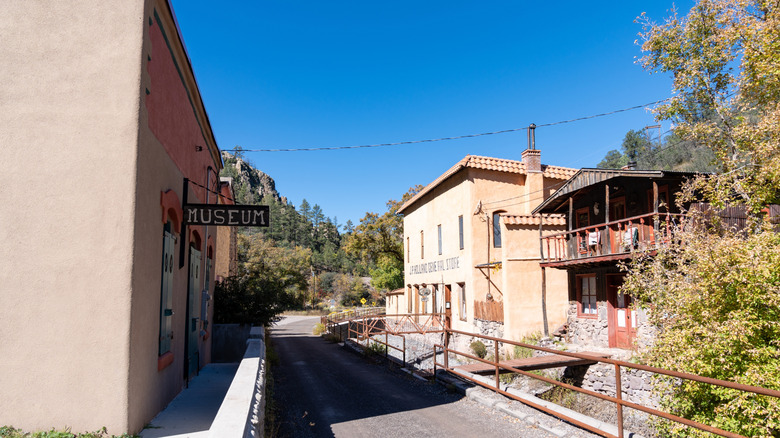
Most people think of California when they hear the phrase "gold rush," but fewer know that New Mexico started the mining boom about two decades before the Forty-niners flooded the West Coast. Gold was first discovered in the Oritz Mountains in 1827, prompting a string of mining camps to spring up across the state in the decades that followed. Some of these are still functional communities, like the near ghost town of Cerillos. Others have disappeared or become historic relics like the well-preserved ghost town of Mogollon, located deep in the Gila National Forest.
Mogollon started in 1876, when retired Army Sergeant James C. Cooney started mining gold and silver he'd spotted during a scouting expedition a few years earlier. By the early 20th century, Mogollon had a population of up to 6,000 people, along with several businesses, including five saloons and several red-light districts. Its mines were some of the most valuable in the U.S. until the Little Fannie Mine shut down in 1942. The town had already been shrinking, and the mine's closure sent most of the remaining residents elsewhere in search of work.
Though not entirely abandoned, the 15 people living in Mogollon today are caretakers tasked with preserving the historic site, a designation made official in 1987. There are nearly 100 historic structures to explore. To reach Mogollon, you can take Bursum Road (also known as NM 159) from U.S. Highway 180. The area is fairly secluded — the closest large cities are Tucson (roughly 4 hours southwest) and Albuquerque (about the same distance to the northeast). It's best to visit on weekends between May and October, when businesses like the Purple Onion Cafe and Silver Creek Inn are open for visitors.
Shakespeare
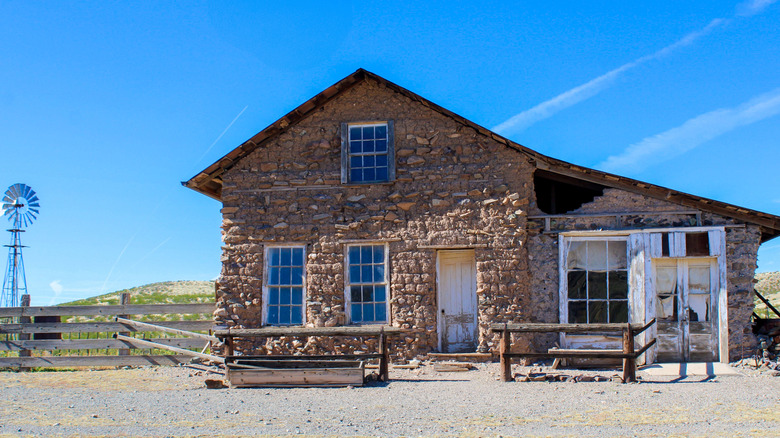
Another of New Mexico's one-time mining boom towns, Shakespeare's origin story starts in the 1850s, when the town was known as Mexican Springs and served as a stop for the Butterfield Overland Stage line. Prospectors passing through the station discovered silver in the surrounding hills in 1870. By the time the town was officially named Shakespeare in 1879, it had a population of around 3,000 people.
That boom was short-lived, though. Most people left when the mines closed in 1893. The opening of a copper mine nearby in 1907 spurred a brief revival, but by 1935, the land was purchased by ranchers who preserved the remaining buildings, securing an official historic designation for the remains of Shakespeare in 1970.
Shakespeare is in southwestern New Mexico, about 2.5 hours east of Tucson and 3 miles south of Lordsburg, an underrated small town brimming with outdoor recreation and Southwestern charm. Since it's located on private property, the only way to explore it is with a guided tour, which is offered three times daily for $15 a person (tours must pass a $30 minimum threshold). Along with preserved buildings like the Stratford Hotel, Grant House, and blacksmith shop, the town puts on historical re-enactments several times a year. In addition to its mining history, Shakespeare was known as a regular stop for outlaws, including infamous figures like Billy the Kid. Some of those outlaws met their end in Shakespeare, like Sandy King and his friend William "Russian Bill" Tattenbaum, who were hanged at the Grant House in 1881.
Lake Valley

Lake Valley is in southwest New Mexico, about an hour's drive south of Truth or Consequences, an underrated resort city known for its wellness tourism. This silver-mining town was first founded in 1878 then moved to its current site in 1882 after the discovery of the Bridal Chamber Mine.
At its height, it was a bustling railroad and stage stop home to about 4,000 people, while the nearby mine produced 2.5 million ounces of remarkably pure silver ore. But like with Shakespeare, those boom years didn't last long. The twin blows of the 1893 silver panic and a 1895 fire reduced Lake Valley to a shadow of its former self. It had a brief resurgence as a manganese mining town that ended in the 1950s, but its post office closed in 1954, and its last residents moved to the nearby town of Deming in 1994, officially turning it into a ghost town.
The Lake Valley site is always accessible for self-guided tours, but the best days to visit are Thursday through Sunday, when a docent is on-site to open up the schoolhouse and chapel, which have been restored by the Bureau of Land Management. There are a few homes and other structures still standing in Lake Valley, too, which you can learn about from the Historic Townsite Self-Guided Walking Tour brochure that you can access online or find at the schoolhouse. Just make sure that you stay on the designated paths while you're exploring since the area is known territory for rattlesnakes (and, while pets are welcome, you should keep them on a leash for the same reason).
Loma Parda
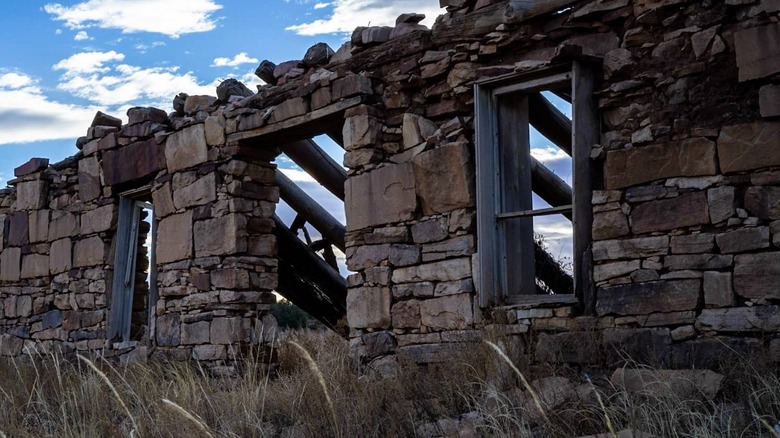
In the 1830s, a stretch of the Mora River was settled and given the descriptive name of Loma Parda ("Gray Hill"). It existed as a quiet farming village until 1851, when Fort Union opened about 4 miles away. After this, it turned into a "blow off" town, where soldiers went to drink, gamble, and patronize the prostitutes operating out of the town and caves in the surrounding cliffs. This reputation for vice earned it the nickname "Sodom on the Mora" and prompted its growth to a bustling town of about 400 people, many of whom worked in its pool halls, dance halls, saloons, and brothels.
Fort Union closed down in 1891, and with it went Loma Parda's main reason for existing. It reverted to its former identity as a farming village for a few decades, but it was abandoned entirely in the 1940s. In 1948, the only bridge to Loma Parda washed away and was never replaced, though there's a small footbridge that provides access for visitors today. Loma Parda is said to be a ghost town in the supernatural sense, as well. Violence was common during its debauchery era, and some of the souls who lost their lives in the village are still said to haunt the ruins.
Loma Parda is about 90 minutes north-east of Santa Fe, near the Rio Mora National Wildlife Refuge. Visitors can explore a few roofless and deteriorating structures along what used to be Loma Parda's Main Street, including the remains of Julian Baca's dance hall, where soldiers could find entertainment. While you're in the area, you can also visit the Fort Union National Monument, where you can see the ruins of the fort that once provided Loma Parda with its customers.
Methodology
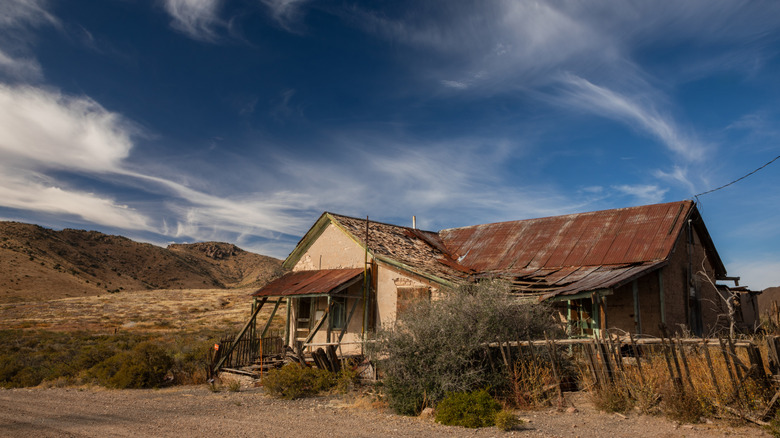
Ghost Town USA defines five categories of ghost towns, ranging from completely barren sites with no standing buildings (Class A) to historic communities that are still occupied but with a much smaller population than at their peak (Class E). Our list focuses on sites in Class C, which are what the average person likely envisions of a "classic ghost town. These sites still have standing structures but no resident population, or they serve as homes to caretakers who live there to preserve the site and run activities for visitors or seasonal businesses (usually including museums, souvenir shops, and the like).
There are far more than five ghost towns in New Mexico that fit this categorization. To narrow our list down further, we considered two main factors. First, whether there are sufficient buildings or other landmarks still standing to make them worth traveling to visit. From there, we evaluated the history of each site, aiming to include towns with a variety of backstories and from various regions across New Mexico.