
We Ranked The 5 Weirdest American Traffic Laws You May Encounter While Traveling

Traffic laws are pretty simple, right? Stop when the light is red. Go when it turns green. Mind the speed limit. If you've earned your driver's license, you know the relevant traffic rules to follow. But not all traffic rules are straightforward. Some rules you may encounter on your road trip across the U.S. are downright bizarre, and so out of left field that you just have to wonder, "What on earth happened to make THAT a law?"
Some of these laws are only tangentially related to driving. For example, you're not allowed to drive with an animal attached to your car in Anchorage, Alaska — which has less to do with road safety and far more to do with preventing animal cruelty. Similarly, Massachusetts prohibits anyone from transporting dangerous animals like bears without properly secured cages to prevent them from escaping and attacking someone. For the most part, laws like these aren't ever going to affect you. However, there are some obscure rules in different states that you may unwittingly come across while taking the ultimate historic road trip from Los Angeles to Virginia.
Because almost every state has laws ranging from slightly concerning all the way to hilarious, it was hard to figure out which ones would make the cut for this exclusive list. So we narrowed it down to two main qualities. First, the law has to be weird, unusual, or highly specific. Second, it has to be something that visitors to the state might actually run afoul of. While laws like the ones mentioned above are funny to discuss, most out-of-state drivers probably won't ever have to worry about them. But if you're on the most scenic road trip American that crosses five states, these strange laws are the ones you may actually encounter.
Thou shalt not startle horses on public roads in Connecticut

Picture this: You're driving down a scenic Connecticut road between quaint New England towns, on either side of you lies a thick grove of trees, draped in classic fall colors. As you wind your way through the state, you notice a horse and its owner ambling along, blocking the road. Irritated, you press the horn or yell to signal to the owner that he needs to move his horse. And just like that, you've broken the law in Connecticut — as a dirt bike rider in Newtown did in September 2025 when he deliberately revved his engine at a horse and rider (via News Times).
According to Section 14-293-b of the Connecticut Agencies Regulations (passed in 1986), "No operator of a vehicle in the vicinity of an equestrian and horse may blow a horn, or cause loud or unusual noises, in a manner to startle or frighten the horse" (via Cornell Law School). While this law seems a bit unusual in the modern day, it actually makes sense for Connecticut. While it's by no means the state with the most horses (that honor goes to Texas, home to the largest horse-breeding ranch in the U.S.), Connecticut still has an impressive 43,000 horses.
So, if you do get stuck behind a horse in Connecticut, what should you do? Well, the law covers that too. According to part (a), drivers approaching a person on a horse should slow down or stop to avoid scaring the horse. While the law doesn't explicitly state the penalty for an infraction, you may be charged with animal cruelty and causing bodily harm if you spook the horse, who then in turn causes the rider to suffer an injury. That Newtown biker? He's facing charges because his actions allegedly resulted in the horse throwing its rider, who consequently breaking her neck.
Thou shalt not change your clothes inside a car in Delaware

Ever watch that 2008 rom-com 27 Dresses? The main character of the movie, Jane (played by Katherine Heigl), is a bridesmaid in multiple weddings, two of which happen on the same day. In one montage, she switches outfits rapidly inside a cab — attending to her duties at one wedding before jumping back into the cab to change into the next outfit. It's a good thing this scene took place in New York, because Jane would have been in serious trouble if she tried to do the same in Fenwick Island, Delaware.
Technically, there are two laws in Fenwick Island that prohibit changing clothes inside a vehicle. The first is Section 77-3 "Disrobing in Public" of Article 2 of the Town Code, which covers public exposure. The second is a 1965 law — Section 116-5 "Activities inside vehicles prohibited" of Article 1, which lays out general rules for camping, beaches, public parks, and vehicles. These laws also explicitly forbid anyone from cooking and living inside their cars. In both cases, the laws exist to prevent indecent exposure and include disrobing in other public, non-enclosed spaces.
So, what does that mean for you? Well, Fenwick Island is an absolutely delightful coastal haven, which means most visitors go there to enjoy beachside camping or swimming. However, if you plan to drive there and change into your swimsuit in or beside your car before hitting the waves, think again! You could face a $250 dollar fine, with the amount increasing to $500 with every subsequent violation. Instead, change into your swimsuit before leaving your hotel, and wear a shirt or a wrap-up on top that you can easily remove when you get to the beach.
Thou shalt not curse on or near a public road in Maryland
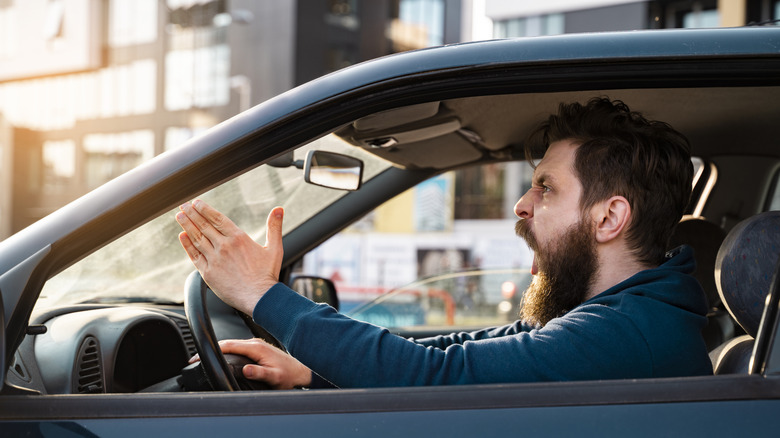
Confession time: I have succumbed to road rage on occasion. I'm sure the feeling of your blood boiling as you witness another fool cut across the lanes to make an illegal U-turn is familiar to most of us. But if you're in Rockville, Maryland, you'll need to keep your temper in check to avoid running afoul of a very specific, very bizarre rule.
According to Section 13-53-a of the Rockville Municipal Code, it is illegal for anyone to use profanity or obscene language on or near any public street, sidewalk, or highway within another person's hearing. In simple terms: No swearing on public roads where people can hear you. The wording of the law is a little confusing and vague, though. It doesn't explicitly mention drivers within their vehicles, but it doesn't explicitly exclude them either, creating a shady grey area. It also generally applies to vulgar language that could incite violence, but is rarely enforced otherwise. So, you may be able to get away with an angry swear in a general sense, but you should hold back on insulting anyone else.
A violation of this law is considered a misdemeanor, which usually results in a fine of up to $100. But, you could also end up spending up to 90 days in jail (yikes!) if the offence is deemed serious enough. Remember that the next time someone cuts you off in Rockville, filling you with the urge to seek immediate verbal revenge.
Thou shalt not honk at political rallies in California

In 2017, Susan Porter was passing by a rally held outside her local congressman's house. To show her support for the rally, she honked a total of 14 times — a method passing drivers have used to show support for their political parties for years. However, Porter was almost immediately pulled over by a San Diego County sheriff's deputy, Kelly Martinez, who ticketed her for "illegal use of horn' (via USA Today). Porter eventually sued the state, claiming the law was a violation of her First Amendment rights.
According to Section 27001 of the California Vehicle Code, it's illegal to use your horn in California for any reason other than a warning to other drivers or pedestrians, or as a theft alarm. While similar "no disruptive honking" laws exist in other states, they usually include time and location restrictions that aim to prevent noise in residential areas, school districts, or late at night. California's law, on the other hand, can be applied at anytime and anywhere, which is why it's considered a bizarre law to have on the books in 2026. That's why it came as a shock when Porter v Martinez concluded with the Supreme Court upholding the archaic law in 2024.
So, if you should happen to pass a political rally on your perfect road trip to all of California's national parks, keep your hand off the horn, lest you incur a $238 fine. Just carefully, quietly, cruise away — or maybe show a thumbs up while passing by. Don't let a 1959 law derail your modern California vacation.
Thou shalt not pump your own gas in New Jersey

What happens when you realize you're running out of gas while driving? You search for the nearest gas station, get out of your car, pay with your card, fill up your tank, and leave. Right? Not in New Jersey, you don't.
According to the New Jersey Retail Gasoline Dispensing Safety Act and Regulations of 1949, it's illegal for anyone who is not a trained attendant to fill up a fuel tank. Even if you do it in the presence of an attendant. While people have asked for more self-service stations, citing convenience and lower costs, New Jersey stubbornly refuses. Officially, the reason for the law is to prevent fire hazards and keep people safe from gasoline-powered explosions.
Oregon had a similar law on the books until 2023, when it was repealed to allow a mix of full-service and self-service stations. However, New Jersey is still holding out, and as of February 2026, the law preventing people from pumping their own gas still stands. Violators can face fines of up to $250 for a first offence, and $500 for every subsequent one. So, if you ever find yourself running low on gas while enjoying the views along New Jersey's scenic coastal byway, you'll just have to pull into a station and wait for an attendant to get to you.
Methodology

There are a lot of really weird traffic laws still on the books across the U.S. We first looked through articles and videos to get an idea of each state's strangest laws, then cross-referenced them with official sources to confirm the laws actually exist as of 2026 and aren't just urban legends. Almost every state has at least one law that could be considered 'weird,' so we couldn't include all of them. Instead, we chose the laws to feature in this article based on two parameters.
First, the law has to be weird, restricted to one state or town, or highly specific. For example, some sources mention University City, Missouri's rule prohibiting you from leaving your keys in a car. But many other states and municipalities have similar laws, so this specific Missouri law doesn't make the cut for this list. However, the California "no honking for reasons other than warnings to other drivers" rule makes the cut for one simple reason: Other states have similar laws, but those laws only apply during specific times of the day (late night, for example) or in specific areas, while California's law applies at anywhere, anytime. You could be stuck in a traffic jam on a busy highway in the middle of the day and honk from frustration, and technically, an officer could cite you for it.
Second, the law has to be something visitors to the state might reasonably come across. Most people will not run afoul of Montana's restrictions on transporting sheep without a license or Alaska's restrictions on tying an animal to your car roof for transport. But you could, theoretically, break the "no startling horses" rule in Connecticut, even if by accident. Or you could be fined for changing into your swimsuit in your car at the beaches of Fenwick Island.
We also looked through news sources to find instances of people facing fines or charges under these laws and prioritized the ones that have been enforced in the last 10 years. The ones that weren't enforced recently were still included if they were sufficiently 'weird' per the above criteria.