
Common Clothing Mistakes To Avoid At An All-Inclusive Resort
All-inclusive resorts are like miniature worlds. The heavenly properties contain everything you could ever want to enjoy an escape. From morning to night, multiple restaurants serving different cuisines provide all the meals and snacks you could ever need. Throughout the day, entertainment calendars invite you to enjoy live music, water sports, golf, and other fun experiences. There's also on-site medical attention, shops, spas, and more. If the resorts are microcosms of the wider world, it goes without saying that they have rules and expectations. Things like tipping, alcohol consumption, and what's included in the all-inclusive rate all have rules. But the ones around clothing can be the most confusing.
Dress codes can apply to any area of the resort. But they especially affect restaurants, so mistakes around them can really spoil a vacation. Whether you're planning a romantic escape to one of the Caribbean's amazing adults-only all-inclusives or have your eyes on one of Europe's affordable all-inclusive resorts, you'll want to know what these rules are so you can avoid infringements where you can. You'll also want to avoid a few common missteps anyone could make when packing for an all-inclusive vacation.
I spent more than half my life living in the Caribbean, where all-inclusive resorts are the norm. During that time, I enjoyed my fair share of the resorts and have a tip or two on dressing faux pas you'll want to avoid, and what to do instead. When I lived in New York City, my family also spent winter vacations at an all-inclusive resort in Pennsylvania's Pocono Mountains, so expect tips that go beyond beach escapes.
Disregarding dress codes

You plan an all-inclusive vacation so you don't have to worry about planning meals, outside activities, or organizing transportation outside the resort. To meet your expectations, the best resorts offer a stacked calendar with events and dining into the night. These evening events and restaurants usually require a completely different dress code than what is accepted during the daytime. But with one resort sometimes having multiple evening dress codes and names that offer little guidance, it's easy to misunderstand what attire is acceptable and what is not, and end up under- or overdressed.
To illustrate, Jewel Dunn's River, one of Jamaica's popular all-inclusives, has 11 eateries, and three of these are specialty restaurants that serve dinner only. Instead of one evening dress code for all three, the resort has two different ones called "resort evening casual" and "resort elegant." On their own, these names offer little help — resort elegant doesn't mean formal dresses or anything close. If you checked Jewel's website, you would see that it means no jeans, shorts, T-shirts, or caps.
In my experience, having a mental "uniform" of sorts can help when an all-inclusive has varying dress codes. Regardless of what the code is called, men who wear long pants and dress shirts while dining in specialty restaurants or enjoying an evening activity are usually safe. Women can't go wrong in a nice dress or a dressy top and a nice skirt or pants. For more guidance, it's best to check the resort's website or app. If you navigate to the dining section on the app, each restaurant usually has its dress code listed. If what you find is suggested and not mandatory, as in the case of Club Med, packing the suggested attire is still a good idea so you don't stand out.
Wearing the wrong footwear
If you're planning a beach vacation, you may be looking forward to the freedom of wearing flip-flops everywhere. But if you're thinking of staying at an all-inclusive, you would be committing a serious faux pas that may cost you your dinner reservation. Many all-inclusive resorts are serious about footwear. They may allow flip flops or barefoot bliss in their cafes and more casual eateries — think beach bars and poolside grills. But as you move from the beach to other areas on the property, you'll find your footwear under scrutiny.
Some hotels have a wholesale ban on flip-flops in all restaurants during dinner. Others have strict rules that go beyond flip-flops, banning other types of shoes in their more upscale specialty restaurants. If you check the website for Moon Palace in Cancun, you'll see that the all-inclusive resort has a strict policy against sneakers, flip flops, and water shoes in its fancier specialty restaurants. Sandals Grenada has a similar policy at its upscale eateries, Le Jardiniere and Butch's Chophouse. Both restaurants require evening attire, which excludes sneakers, flip-flops, and slippers.
But don't be too quick to leave those sneakers and slippers at home. While you'll want to check the resort's dress codes to see what kind of shoes are allowed into the restaurants and events you plan on attending, you'll also want to consider any off-resort plans you may have. If you plan to go on excursions that require lots of walking, you'll still want to pack those sneakers so you can walk comfortably for long distances. And if your travel plans include a tropical destination, you may be visiting a slippery waterfall or rocky beach where you'll need to wear water shoes.
Wearing a swimsuit cove-up everywhere
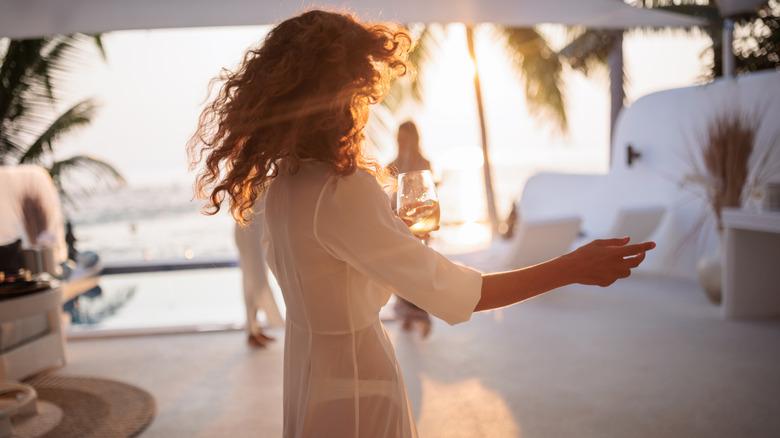
Today's swimsuit cover-ups are so fashionable and diverse that it can be tempting to wear them as your outfit for the day. You can hop out of the pool, grab your cover-up, and go about your day without worrying about going back up to your hotel room to change. But given that the handy bathing suit accessories are designed to be lightweight and breathable enough to feel comfortable during hot summer days, many are made from sheer materials that all-inclusive resorts frown upon in some establishments.
This doesn't mean that sheer swimsuit cover-ups can't be worn around the resort. On our last trip to an all-inclusive, the kids wore bathing suits to a grill next to the onsite water park, and the adults all wore sheer cover-ups that weren't a problem. It's when you try to venture into some of the indoor areas that issues may arise. And this is true even in more casual spaces. For instance, if you booked a stay at the Moon Palace resort, more elegant eateries like Sundeck would not allow beach attire and see-through clothing. But even the casual eateries like Boulangerie and Jerk Hut, which both serve snacks and pastries, also have policies that do not allow guests in beachwear or sheer cover-ups inside.
It's easy to avoid making this mistake. With a bit of digging into fabric type, you should be able to find cover-ups made from thicker materials that make them seem like regular dresses. What's important is that the cover-up doesn't look like beachwear, so in addition to choosing an opaque material, choose a style that looks dressier instead of casual. Long maxi dress cover-ups are one option to explore.
Not packing appropriate clothing for all activities

From themed parties to water sports, all-inclusives are designed to give you all the enjoyment you need inside their walls. Some resorts offer racquet sports like pickleball and tennis. Others are known for offering complimentary scuba diving and snorkeling. And yet others have scenic golf courses, horseback riding, hiking, and biking to consider. With such a wide variety of exciting activities and limited luggage space, it can be easy to show up for your vacation without the proper clothing for an activity you want to try. But with some research, you may be able to pack less than you think you need and still have fun.
For example, if you plan on scuba diving, some resorts include complimentary equipment and will rent dive suits if you don't want to pack your own. Similarly, some all-inclusives with golf courses may have spikeless golf shoes for rent, so you'll only have to pack golf shirts or whatever attire is comfortable for the sport. As you do your homework, you'll figure out what can be rented and what needs to be packed.
While planning, other things to consider include any special experiences your resort is known for. For instance, if your escape is to an outdoorsy all-inclusive like the charming Blackberry Farm on the edge of the Great Smoky Mountains, hiking will be a major activity, so proper hiking shoes will be needed. Or your resort may be known for themed events like all-white parties that you'll want to pack suitable outfits for. If space is a concern, limiting your shoes is one of the best ways to pack a suitcase as efficiently as possible so you don't end up with overweight fees.
Choosing the wrong fabrics

Wearing uncomfortable clothing can ruin a good day anywhere. When it happens on vacation, it's even more distressing, as once vacation days are gone, they never come back. To avoid this, pay attention to the fabrics of the clothing you plan to carry on your trip. If your all-inclusive is in a tropical climate, heavy knits and thicker fabrics that trap heat will make a hot day unbearable. Even thinner clothing that felt comfortable in warm weather back at home can suddenly feel stifling in tropical destinations with more humidity. A temperature of 85 degrees Fahrenheit feels completely different in a dry city without humidity than it does in high-humidity destinations like the Caribbean or Honolulu.
If your vacation is to a colder European or North American destination, you'll have similar considerations. Extremely cold weather may require undergarments and socks made from thermal fabrics. If you don't live in a cold city or have never visited a cold destination, you'll also need thick scarves, gloves, a winter hat, and outerwear made from appropriate fabrics.
Generally, winter jackets and accessories are made to be warm regardless of material, but if your destination is extremely cold, jackets made from down provide better warmth. Scarves and winter hats made from thicker knits, wool, and cashmere provide the best warmth. For humid, tropical destinations, choose moisture-wicking nylons and polyester, or merino wool, linen, and bamboo. If your vacation includes hiking, color is also important, so opt for clothing in white, which is one of the colors you should always wear while hiking in hot weather.
Forgetting accessories

All-inclusive resorts are popular around the Caribbean and Mexico, where white sands and bright sunny days pull travelers escaping the cold of winter. This sunny weather can come with a painful cost if you forget the right protective accessories. Other accessories don't offer protection but can elevate an all-inclusive vacation, and are worth packing just for the memories they can make.
If you plan on spending most of your days on a beach, the most important accessories you'll want to pack are good sunglasses, a wide-brimmed hat, and possibly a protective cover-up. UV-blocking sunglasses keep harmful UV light from your eyes, while a wide hat offers additional protection for your nose and cheeks. If you like to spend hours on the beach, you may also want to consider packing a cover-up with built-in sun protection along with your regular ones. Although not clothing, a good beach bag makes it easy to carry enough water for the day, snacks, sunscreen, and all your other necessities, so a sturdy one should also be packed.
If you're planning a romantic escape to an adults-only all-inclusive, you may also want to remember to pack the accessories you know would elevate your aesthetic. This could be a nice belt to cinch your waist or the perfect piece of jewelry to highlight your neckline. Whatever it is, it can be easy to leave behind, as these accessories are usually small pieces that are often overlooked until you arrive and realize your outfit is missing that special touch. While packing your outfits, think of any accessories you would normally wear with them and be sure to throw them in.
Not checking dress codes for sister properties

Many all-inclusives add variety by allowing guests to visit sister properties where additional restaurants, pools, and experiences can make a trip more interesting. Think of it as your opportunity to have two or more very different experiences for the price of one. These properties with "stay at one, play at two" policies sometimes belong to the same chain and have similar dress codes that will make planning a breeze. Others have arrangements with properties outside the chain that may have very different dress codes that you'll want to be acquainted with, so you don't lose access to the amenities you want to use.
For instance, Secrets has two all-inclusive resorts in Montego Bay, Jamaica: Secrets St. James and Secrets Wild Orchid. Both are sister properties that offer guests staying at one access to the other. Some guests also get access to a third resort called Breathless Montego Bay. Breathless Montego Bay enforces dress codes that guests who take up the offer to play there would want to check before showing up. These range from extremely laid-back (beach casual), which allows bathing suits and flip-flops, to casual elegance, where men are required to wear long pants. If your booking allows you to play at other resorts, it's simple to check what's allowed or disallowed at the other resort by looking at their website before you show up.
Not packing for changing weather
From destinations that have scorching daytime weather and cool nights to places where rain happens on a whim, traveling can come with fickle weather that you'll need to pack appropriately for. Warm destinations like the Caribbean have a reputation for being warm during the day, then getting significantly cooler at night. Popular destinations like Bali and Malaysia can have weather that swings between rainy and sunny if you visit during the monsoon season.
In my experience, the different indoor areas around a resort itself can also have inconsistent air conditioning that may require additional layers. For example, one restaurant may be the perfect temperature for a sleeveless dress while the air conditioning in another may consistently feel too cool to enjoy comfortably without a light jacket.
Whether it's the weather that happens to change drastically, or the inconsistent temperature around different sections of your all-inclusive, you'll want to pack extra layers like a light jacket or light scarf so you can enjoy your vacation comfortably. If you're visiting a destination where it may rain on a whim, it's a good idea to pack a rain jacket you can wear between your room and other areas of the resort you may need to walk to. In the excitement of the moment, I find that it can be easy to forget to bring these extra layers on excursions outside of the resort, so a tactic to help you remember to carry them is also worth implementing.
Wearing culturally inappropriate clothing

While on your all-inclusive vacation, wearing clothing the locals find inoffensive will be important, at the resort itself, but more so on any excursions you take outside. Countries with more conservative cultures will find clothing that reveals too much skin offensive. Short shorts and tank tops may have people staring at you in popular destinations like Morocco, Saudi Arabia, and the United Arab Emirates, although they are welcoming of Western visitors. Sometimes the fix is as simple as a long-sleeve top and a modest bottom. Even if you don't mind being stared at, you'll want to dress modestly when you visit sacred places like temples and mosques, as these religious places sometimes have rules requiring certain attire.
If you're traveling to a Western country with a more familiar culture, cultural differences can still make some clothing choices inappropriate. Major European cities like Paris and Rome frown on ultra-casual looks. These destinations may not have clothing rules, but they do have social norms you'll want to follow so you respect their culture. Opt for smart-looking casuals that are comfortable while being polished. Stay away from anything that looks like beachwear unless you're actually on a beach. Europe is only one example. Many other destinations that are known to welcome Western travelers have different dress norms. Do some research, if there's even a chance your destination may have a different approach to clothing.