
Unwritten Rules You Should Know Before Visiting Houston
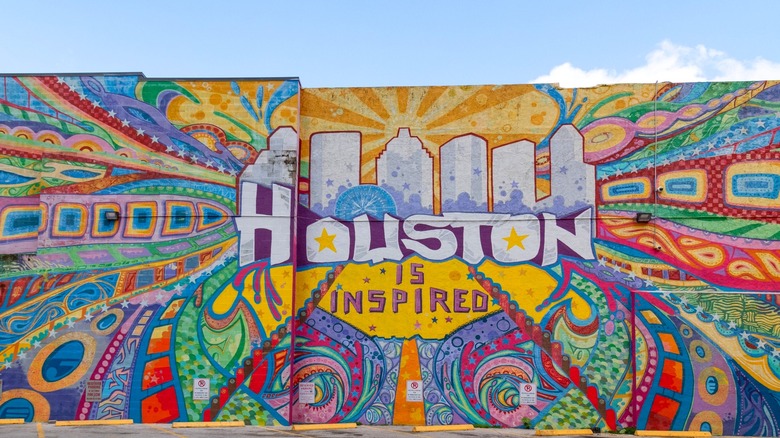
Houston is one of the most popular cities in Texas — and for good reason. The multi-faceted destination has been nicknamed both "The Energy Capital of The World" because of its large energy sector. Some call it "Space City" in ode to its longtime association with NASA and the Apollo space missions. And, of course, it has a renowned art and museum scene that rivals New York City, expansive green spaces, and plenty of things to do. Whether your upcoming trip is for business or pleasure, you'll find whatever you're looking in Houston.
While navigating the city, you'll find that your adventures can come with unexpected side effects. The abundance of green spaces can painfully affect some visitors. If you hop on the highway for a day trip, you may find yourself subject to the ire of locals if you don't respect some of the unofficial rules of the road. And forget public transportation, that will only work in a few circumstances.
That said, those travel hiccups are certainly worth it — and can be avoided with a little preparation. Houston also has much to like! After all, it's one of America's most diverse cities, offering plenty of free things to do (even those renowned museums, if you visit at the right time) as well as delightful cuisine that goes beyond Tex-Mex. We consulted local news sources and official tourism boards, as well as advice from locals on Reddit, in order to round up these unwritten rules you'll want to know before your trip to Houston. Here's the scoop on what to expect.
Learn 'Houston speak'
Houston is a cosmopolitan city, and therefore the stereotypical "Texas twang" isn't as common. While there isn't a particular Houston accent, there are still turns of phrase that seem specific to the city. Locals can use words to mean totally different things than what you may expect, make up brand new terms that you've never heard before, or use unfamiliar pronunciations. Before visiting, it's a good idea to get acquainted with some of the more common terms in the city's nomenclature so you don't feel clueless.
For example, say you're shopping for sneakers in the city. You may notice the retail clerk calling them "tennis shoes" instead of "sneakers." This is because many locals call athletic shoes tennis shoes, regardless of the type. Variations like "tennies" and "ten-e-shoes" are also common, according to some local Redditors. Take the shopping example further: If the retail clerk says something like, "I'm going to get a size 8 right quick," they're simply telling you they'll get you the shoes quickly. And if you happen to be shopping on San Felipe Street, you would pronounce it, "san fuh-leep-ay," according to a Houstonian on Reddit.
Names of other places may also be new to you. If a local mentions going to a beer barn, they're referring to a drive-through beer store. If you're directed to take a "feeder road," that's a Houstonian term for a service road or a frontage road (the road that runs parallel to a highway, offering easier access to local destinations).
Don't depend on public transportation
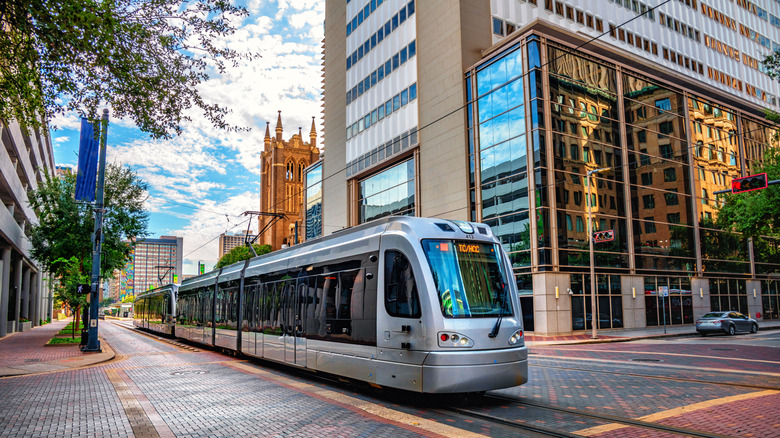
Houston is the fourth most populous city in the U.S., but you wouldn't know it from its public transit system. You would expect to have an efficient network of trains and buses at your disposal in such a big city. Instead, what you'll find is a rather lackluster system that ranked 40th in an AllTransit study on the commuter networks of major U.S. cities, so don't go expecting Houston's public transit system to compare with other cities you may have visited.
The light rail system consists of three lines (red, green, and purple), which only service the downtown area. The bus is more extensive, totaling 80 routes. However, many of these routes focus on one area — The Loop, which includes downtown, the nearby museum district, Midtown, and a few residential neighborhoods. If you have plans outside this core area and hope to find efficient public transit options to get around, you might be disappointed. And seeing that Houston's attractions are sprawled across the city, it's very likely your itinerary will include spots outside the main downtown area.
For example, the city's top attraction (according to Tripadvisor), Space Center Houston, is outside The Loop, as are both Asiatown and the popular National Museum of Funeral History. While you may be able to reach some of these places by public transit, you'll likely waste a lot of time doing so. For example, a car drive from a hotel downtown to Space Center Houston, would take about 35 minutes, depending on traffic. On the bus, it would be around two to three hours, according to local Redditors. We can only recommend public transportation if you plan on only doing the museums and other attractions that are close to downtown.
Do try the Indian food

You simply can't go to Houston and not try the food. Of course, your itinerary probably includes a few Tex-Mex spots, but as you eat your way through the city, be sure to also try some Indian eateries. Houston is regarded as one of the top U.S. cities for the South Asian cuisine. The Michelin Guide to Indian restaurants named two of the city's eateries among some of the best in the U.S. And it's been called "America's Indian food capital" by Houstonia Magazine.
The reason for the popularity of the cuisine is simple. Houston boasts a sizable group of Indian immigrants who moved to Houston for work in the 1980s. Today, Houston is among the top U.S. cities with the largest Indian population, and, unsurprisingly, the community brought their delicious cuisine with them. When you visit, you'll find everything from food trucks to fine dining establishments serving the spicy fare.
Kiran's, located in the Upper Kirby neighborhood, is Houston's number one Indian restaurant according to Tripadvisor, so head there if you're looking for the best of the best. Houston is also home to the original Musafeer, and the Michelin-starred eatery sits in The Galleria shopping center. While The Galleria is considered one of Houston's most over-hyped tourist attractions, the restaurant itself is a consistent favorite in Houston's restaurant scene. Little India, also called the Mahatma Gandhi District, is a good place for everything from Indian grocery stores selling traditional cookies to eateries serving North Indian cuisine.
Don't say 'Houston, we have a problem'
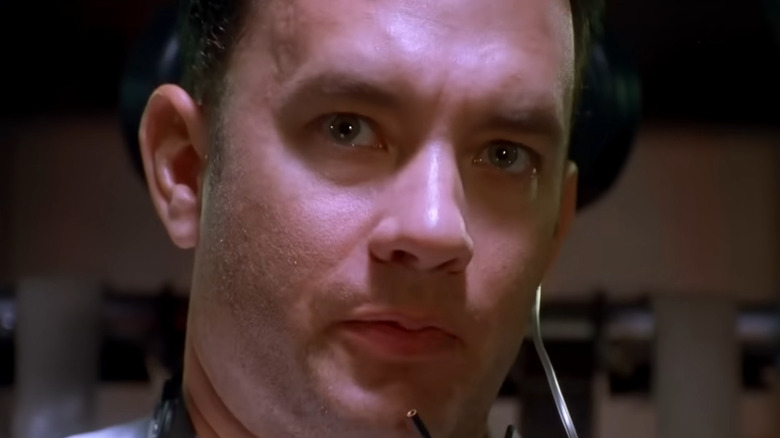
Many cities have phrases locals would rather not hear. Sometimes that's because they're cliché and corny, and other times they're just downright annoying. For instance, one of the rules you should know when visiting Chicago is not calling it "Chi-City." And it's well established that one of the unsaid rules to follow in Nashville is never yelling "woo" at the locals. Similarly, you'll want to stay away from saying, "Houston we've got a problem," on your trip to Houston. Yes, it has a nice ring to it. And whether you first heard it in Tom Hank's 1995 hit movie, "Apollo 13," or in another context, we realize that it's become one of those iconic sayings you can't easily forget — and an easy joke to make off the cuff.
But put yourself in the shoes of a Houstonian. You go to a local baseball game, the announcer uses the phrase at the slightest hint of a loss. You try to catch up on the news, and the term shows up more often than you care to read — in around 12,000 news broadcasts and articles since 1982, according to the Wall Street Journal. And more often than not, when it does, it's being used in relation to something negative. Wouldn't you get annoyed after hearing the clichéd term all your life? That's exactly how locals feel.
Do check the weather forecast every day
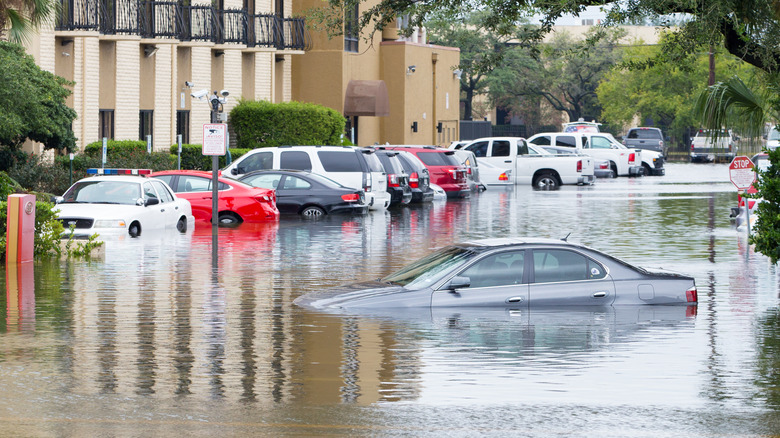
Yes, checking the weather is a routine part of traveling. But in Houston's case, it really is important to give serious consideration to the weather while planning your trip and after arriving. Thanks to the commercial development of wetlands that could soak up excess water, flat terrain, and the city's clay soil (which doesn't absorb water well), wet weather frequently causes flooding. Dangerous wind storms called "derechos" are also not unheard of. And to make matters worse, extreme weather can strike in almost any month of the year.
In May 2024, stormy winds ripped roofing from the Hyatt Regency hotel in downtown Houston, sending rain and debris into the lobby, according to CNN. And in July of that same year, Chron reported that Hurricane Beryl flooded and closed off The Rothko Chapel and a few other museums. Previously, in September 2019, Tropical Storm Imelda shuttered Houston's airports (via CBS News) and closed down the Houston Zoo (via Fox 26 Houston). And according to the Houston Press, the situation turned dangerous when the Omni Hotel Houston flooded in both August 2017 (Hurricane Harvey) and May 2015 (Memorial Day Weekend Flood).
While you may not be able to always predict extreme events, you can check to make sure your Airbnb or hotel is outside a flood zone before booking. Importantly, once you're in Houston, check the forecast daily. Forecasted weather can change swiftly or not match what you actually wake up to. One Redditor complained: "What weather forecasting apps do y'all use?... the app I'm using does not coincide with the actual weather. It's frustrating when trying to plan my days." He was overwhelmingly recommended the Space City weather app, so consider downloading that as your best source for Houston's ever-changing weather.
Don't visit in spring if you have allergies (seriously)
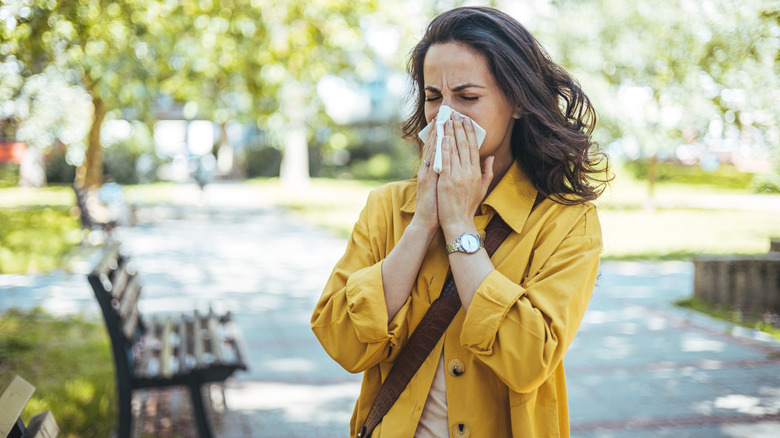
Houston gets so much pollen in spring that it's often called "snow." Come spring, it's common for visible dustings of pollen to cover cars, outdoor furniture, sidewalks, and just about any outdoor object with space for the sneeze-inducing culprits to accumulate. While the problem is more marked in the northeastern parts of the city, air can carry the stuff to other parts of Houston as well, so people can expect heightened allergy symptoms anywhere. One local said on Reddit, "Everyone is sick right now, with runny noses, headaches, sore throats, etc. I assumed it was allergy season because the wild flowers are blooming, but its spreading?"
The responses were very telling. "The entire air supply is yellow. That's called pollen," said one Redditor. Sadly, this is just a fact of life in the city. Houston is not a great place for allergy sufferers in the U.S., ranking 26th on the Asthma and Allergy Foundation of America's (AAFA) 2025 Allergy Capitals study, reporting worse than average pollen counts. Many areas have large tree populations, and the types of trees present happen to be species known to produce heavy pollen. The city's warm weather also means spring sometimes arrives a little earlier and stays longer than in other parts of the country.
If you react badly to pollen, incessant sneezing and congestion may squeeze all the enjoyment out of your trip if you visit during spring. If at all possible, we recommend arranging your trip for one of the other seasons.
Do take advantage of free days at the museums
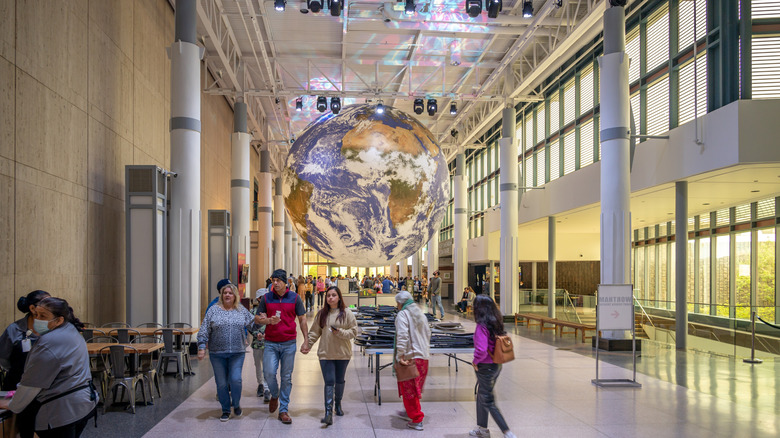
With around 115 museums — including the Menil Collection, one of Houston's' most underrated destinations — chances are high that if you're visiting the Greater Houston area, you have at least one museum on your itinerary. Whether your plans include one of the 19 more popular museums in the district or a lesser-known gem, we have good news. You can visit many of the city's galleries and exhibitions free of charge on some days — or all the time!
Thursdays are especially good for museums as you won't have to pay for many of the popular destinations in the museum district on that day. With art collections spanning 5,000 years, the Museum of Fine Arts, Houston is the perfect destination for art lovers and is free to visit all day on Thursdays. Ranked one of the best Children's Museums in the U.S. between 2020 and 2022 by USA Today Reader's Choice Awards, The Children's Museum, Houston, also allows gratis entry from 5 p.m. to 8 p.m. You can also visit the Buffalo Soldiers National Museum, The Health Museum, and a few others free of charge.
The excellent Houston Museum of Natural Science, also in the district, is free on Tuesdays from 5 p.m. to 8 p.m., with one caveat: the highly regarded butterfly garden and planetarium will still incur fees. If you're looking for options that allow entry without charge everyday, Menil Collection, the Contemporary Arts Museum Houston, and Houston Museum of African American Culture are some of your choices but there are many others. It's also recommended to check with the museums you want to visit to see when they offer free days and build your itinerary around that.
Don't go slow in the fast lane
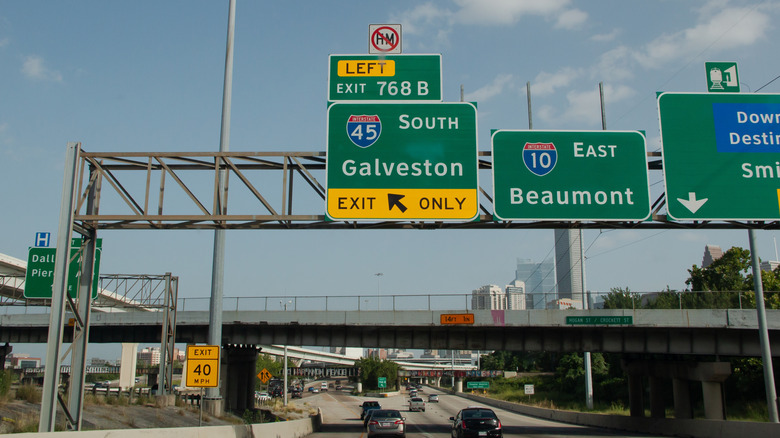
Not going slow in the left lane is actually a written law in Texas. It's nicknamed the "slowpoke law," and although exceptions for bad weather and the like exist, an officer can ticket those they deem to be slowing down traffic (and endangering others as a result).
And, yes, Houstonians have an intense dislike of slow drivers, but the frustration with slow drivers in the left lane isn't confined to the locals. No matter where you are, the practice can lead to a constant weaving in and out of traffic that can cause accidents as well as lead to congestion. That can be annoying, whether you're a New Yorker or Alaskan. There have also been a number of road rage incidents that have been caused by slow drivers, and those who respond by weaving in and out of traffic can certainly cause their own problems. "My commute takes me down 45 from Clear Lake down to La Marque. The speed limit's 55 and I'm constantly pushed to go 75 or more ... Outside of Dallas I've never seen worse, more aggressive and reckless drivers than here," vented a Houstonian on Reddit.
If you plan on driving while in the city, take this advice from a disgruntled local, who was quoted in a Click2Houston article giving pointers to new Houston transplants. "The far left lane is for "real" speeding ... not 70 mph more like 90 mph," they explained. "Stay out of the left lane if you're not driving 90 mph. If someone drives up fast behind you, YOU get over to the right and let them pass."
Don't expect to get anywhere fast
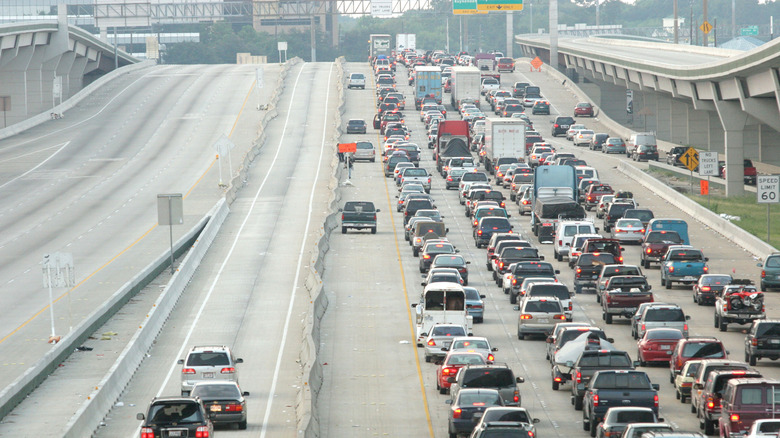
As we've mentioned, Houston and traffic nightmares practically go hand in hand. After all, 90% of Houstonians own their own cars (especially since public transportation options are limited). But the traffic problem is somewhat nuanced. Houston is a fast-growing city that attracts thousands of new residents every year. With no other good options, many of these residents have to drive, causing an ever-growing number of cars to use the roadways. There's also the issue of the city's design. Instead of being centralized, Houston is sprawled over a large area, demanding that residents drive far distances to and from work and other destinations. With all this, it isn't surprising that the city has ranked among the top 10 cities in the U.S. for worst traffic by U.S. News & World Report.
It also isn't strange that frustrated locals take to Reddit to vent sometimes: "I can handle the heat and humidity, the occasional tropical storm or hurricane, the occasional massive power outage, the pancake flat terrain, and soulless suburban sprawl, but I just hate the traffic," said one resident."It isn't just rush hour ... It's just about all the time."
You can expect much the same on your trip. But with a little planning, you can make your life just a tiny bit easier. The main thing to do is to budget extra time for getting around, a trick many locals employ. If you absolutely hate traffic, you can also book a hotel downtown and plan an itinerary that solely focuses on nearby attractions that are accessibly by light rail system or a cheap Uber. Remember that places outside The Loop will be almost impossible to reach on public transportation so this only works if you stick downtown.