
8 Lifeguard Tips You Might Not Already Know For Staying Safe At A Water Park
You'll find plenty to enjoy on your next water park trip, whether you're planning an adults-only excursion or a family trip. If you're headed to an indoor one during winter, most are decorated with tropical decor and bright colors that will chase away those winter blues. And in summer, they're a sure way to make lifelong memories that the little ones won't soon forget. While you're planning, there's one less-upbeat fact to consider. Drowning is the leading cause of accidental death among children aged 1 to 4. That's why it's a good idea to include a strategy for safeguarding your family in your preparations.
The National Drowning Prevention Alliance advises that families have a water safety plan before visiting water-filled destinations. Among other things, families should know how to respond in an emergency, children should be closely supervised by an adult, and both adults and kids should take swimming lessons to build their skills in the water. Apart from these general practices, it's worth implementing some water park-specific tips. And where better to get them than from lifeguards who've seen it all?
We looked to Reddit and other sources to find some of the best advice from lifeguards and other water safety professionals. From the surprising reason you don't want to strike up a conversation with your lifeguard, to the most dangerous part of a water slide and how to safely maneuver it, these tips may be surprising. They'll come in handy, whether you're headed to Orlando, home to some of the absolutely best water parks, or the Midwest, where reviewers say you'll also find some good options. While most are for kids, a few are designed to keep the adults in the family safe too.
Be extra careful in water slide pools (use a life jacket if necessary)

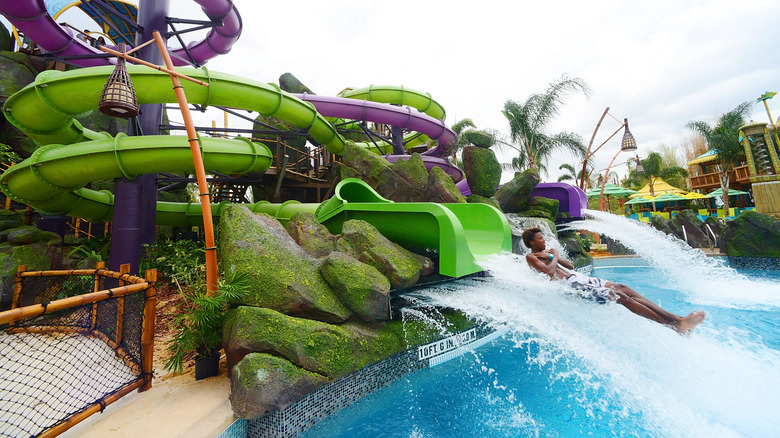
Whether your plans include the whimsical sights and water slides at Ocean Breeze, Virginia Beach's only water park, or going down a slide through a shark tank in Golden Nugget Casino's unique attraction, riding the twisty contraptions can be exhilarating. But at times, the landing pool at the end of a water slide can pose its own risks. You might not expect it, but this can happen in both shallow and deep water.
One lifeguard on Reddit mentioned that even when the pool is shallow, strong currents can form where the slide enters, making it difficult for some kids to regain their footing. U/Haunting -Ad-8029 explained: "Was a lifeguard at a major water park. I think my total saves for the season was 38 ... Oddly, quite a few were in 3 foot deep pools at the bottom of slides." And u/Key-Imagination-1808 said: "I work at a water park with two water slides that have drops at the end into deep water (7ft and 9ft respectively) .... there's an average of about 4-5 saves a day for that zone."
With these risks in mind, WaterWiseKids warns that the landing area at the bottom of a water slide deserves particular attention. You can reduce these risks with a little extra attention. Always follow height restrictions, as children under recommended heights may find themselves in a pool that's too deep for them. Weak swimmers should stick to slides specifically designated for their swimming ability and follow all posted life-jacket and rider rules. And if you're an adult, stay away from alcohol as it may affect your coordination and leave you disoriented as you splash down. Lastly, u/Fritztoof, a lifeguard speaking specifically about the slides at Canada's West Edmonton Mall World Waterpark, gave this advice: "There are also life jackets ... a tube is no replacement for non/weak swimmers!"
Don't have long conversations with the lifeguards
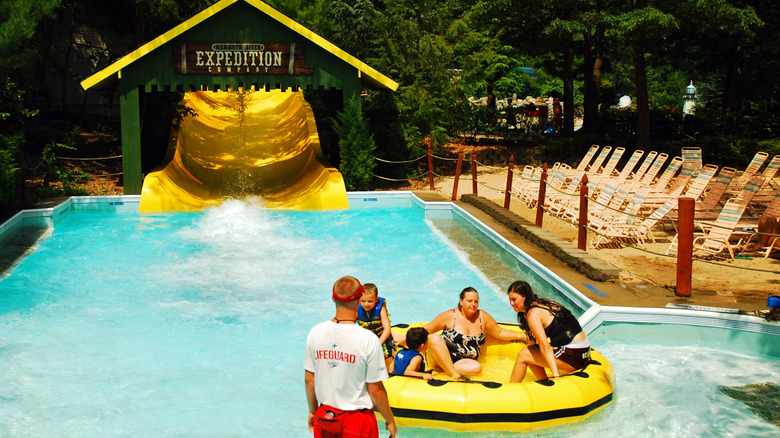
You may think stopping to have a chat with your lifeguard is a nice gesture. But unless you're asking a question related to safety, it isn't advisable because unnecessary conversation can distract lifeguards from watching swimmers. Swim coach Damon Allen explained it like this on Quora: "Lifeguards shouldn't be talking to swimmers whilst on duty ... Lifeguards have a duty to keep everyone using the pool safe. They cannot be distracted by friendly conversations."
To successfully do their job, lifeguards have processes they need to follow. One important part of the job is continuously scanning their assigned area for signs of trouble. Keeping track of everything and accounting for every person in their zone demands precise attention. If you stop by with small talk or try to engage them in other unnecessary conversations, you may interrupt their concentration. And if you keep up the conversation, you can inadvertently distract them from watching their assigned area.
With this in mind, reconsider approaching your lifeguard if you don't have a serious issue like a missing child or another safety concern. You can always find another park employee to help.
Have designated watchers so kids are always supervised
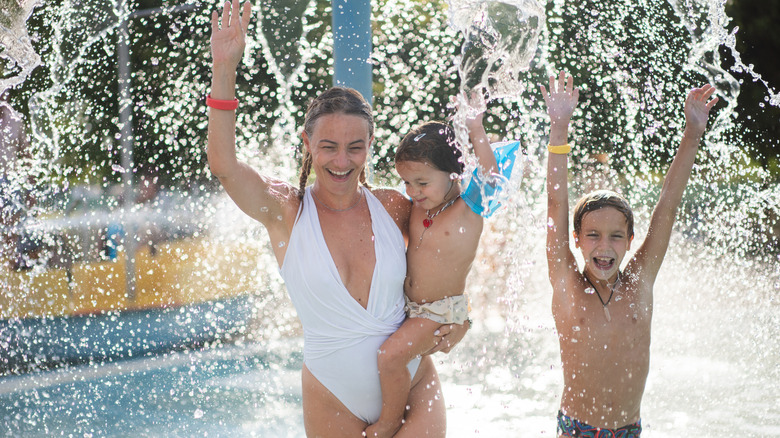
It's easy to assume that someone is watching the kids when you're traveling as part of a group with many adults. But without a plan, there is no guarantee. "When it comes to water – if everybody is watching the kids, nobody is watching the kids," explained one Redditor. When you consider how distracting a water park can be, it's easy to see how these kinds of oversights can arise. There's organizing food for the kids, the back-and-forth conversations with the other grownups, and the sheer effort involved in navigating a massive water park — if you've ever been to Calibunga, a Northern California giant paradise of slides and lazy rivers, you know how colossal they can be.
Even with all the distractions, leaving kids unsupervised is one mistake you don't want to make. "Parents are the first line of defense in keeping kids safe in the water. Never leave children unattended ... not even for a minute," explained Aleatha Ezra, the director of park member development at World Waterpark Association, in an interview on Poolsafely.org.
One way to go about this is to designate water watchers. For infants, toddlers, and other young children, the supervising adult should stay in the water and within arm's reach. If several adults are present, consider rotating water-watcher duties every 15 minutes so one person can remain fully focused on supervision. It's also important to consider the number and swimming ability of the children each adult is supervising. Some aquatic facilities set specific adult-to-child ratios for younger swimmers, so check the rules at the water park you're visiting.
Take a family photo in your swimsuits

Having a kid go missing may be the last thing you want to plan for. While it's rare, the worst-case scenario can happen at water parks. Knowing exactly how your kids look and what swimsuit they're wearing can help a lifeguard find (and help) them quickly.
"Parents would say they lost their kid and the only description I could get out of them is they have brown hair, are about 8, and are wearing blue ... then in reality the child is found only to be wearing a white rash guard and green shorts," explained Natalie Livingston, a water park operator and water safety expert, in an interview with Alive Solutions. "Take a photo in your phone (I wear mine in a waterproof case) for quick reference." When you think about it, this is a common-sense suggestion, even if it's not something most people would think of. It only takes a few seconds, so it's easy to do.
In fact, it mirrors guidelines from the National Center for Missing and Exploited Children. In addition to recommending that parents be ready to fully describe a missing child's appearance and clothing, the organization advises having a recent photograph available. Knowing how a missing child looks and what they're wearing makes it easier for officials to find them — whether that's a lifeguard or law enforcement. It's especially helpful in a crowded water park, where quickly identifying a missing child can be critical if they're in or near the water. Take a moment to snap a quick family photo. You may never need it, but if you do, it could help responders identify your child more quickly.
Don't depend on water wings or other non-Coast-Guard-approved flotation devices
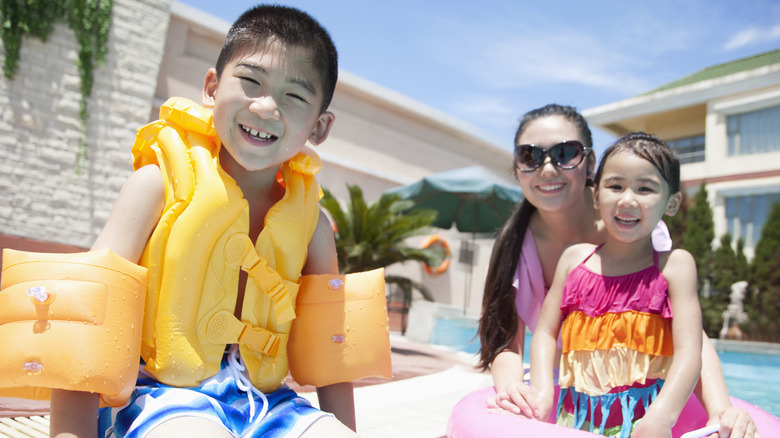
They may have become something of a requirement for pool days, but some flotation devices can give a false sense of security. A 2023 poll conducted by the Pool & Hot Tub Alliance (PHTA) and its Step Into Swim initiative found that 66% of parents mistakenly believe that floaties and water wings keep children safe in water. In the case of water wings, also called inflatable arm bands, this false sense of security can make constant supervision seem less necessary.
This can be a dangerous mistake, as arm bands are not meant to prevent drownings. They are not approved by the U.S. Coast Guard, and according to YMCA lifeguard Nicole Bizuga, "any safety flotation device should be coast guard-approved." Because they aren't designed as safety devices, they can slip off, deflate, or fail unexpectedly.
The good news is that you can get a U.S. Coast Guard-approved life jacket to fit your child or the other weak swimmers in your family. Choose the correct size and make sure the life jacket fits snugly according to the label instructions. Some are colorful and come in playful designs, so they're also kid-approved.
Test the wave pool when the waves are on
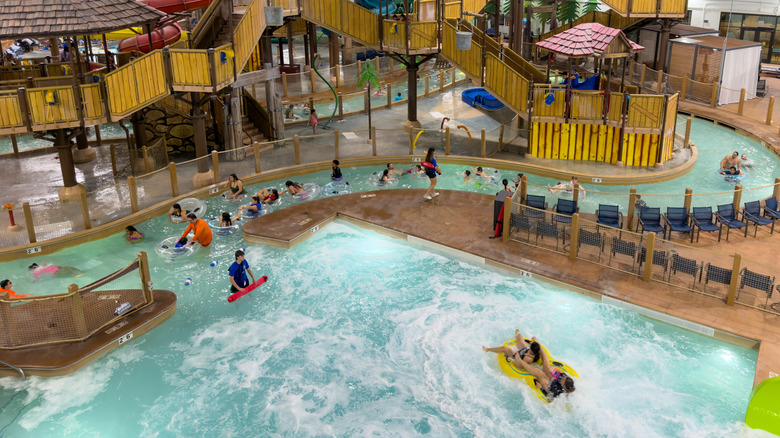
Thanks to their exhilarating waves, wave pools are often considered the perfect alternative to the ocean. Although exciting, wave pools are among the riskiest areas in a water park. Lifeguard u/Thicken94 gave this perspective: "Worked at an indoor waterpark for 3 years and I only jumped in for two very small kids ... worked on the wave pool at an outdoor water park for 4 months with 6-8 other guards on the same pool at the same time. We had roughly 3-10 rescues per week."
Quite a lot has been written about avoiding the risks associated with wave pools. This description of a common danger from lifeguard u/Pterodxctyl illustrates one precaution you can take. "People who were clinging onto the side of the pool while the waves were off were often not equipped to tread in deep water when the waves turned on." Assess your child's swimming ability before entering the wave pool and follow any posted swimmer or life-jacket requirements.
If you decide that your kids are up to the task, bear in mind that wave pools pose the highest drowning risk among water park attractions, particularly for younger children and weak swimmers, according to HealthyChildren.org. You can mitigate this risk with some precautions. Keep young children and weak swimmers within arm's reach, as waves can knock them off their feet or separate them from supervising adults. It's also important that they don't dive or hold their breath underwater, and that they stay away from the bottom near the wave wall where currents are strongest. Have them take regular breaks and ensure weaker swimmers wear a properly fitted U.S. Coast Guard-approved life jacket.
Follow all written and verbal rules (even ones that dampen the fun)
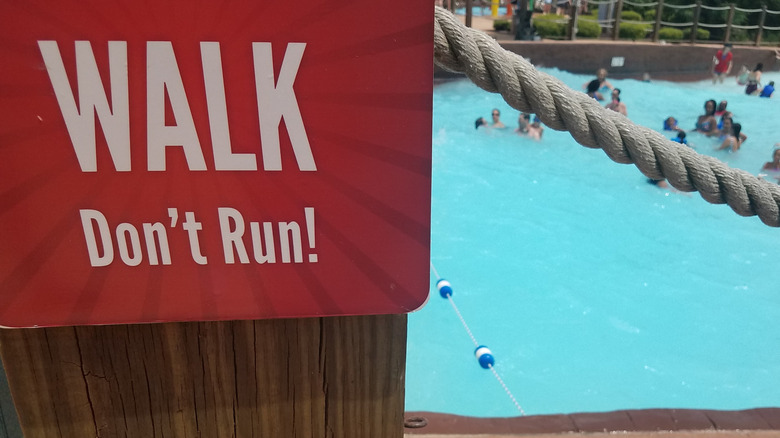
Your kids may think the many rules around a water park are there to put a damper on the fun. That's quite understandable when you consider the main ones. "No running on the pool deck – this one is a given," said lifeguard u/Ruleshorror in a Reddit thread specifically about pools. "Riders of all slides must go down feet first and on their backs," explained another lifeguard in a safety video for Harper's Ferry Water Park on YouTube. In the video, she also made it clear that all posted rules and lifeguard instructions should be followed for safety reasons.
These regulations may seem like buzzkills to your kids, especially if they're eager to try one of the longest water slides in the world. But behind these rules is a strategy that you'll appreciate. Lifeguards take a multi-pronged approach to safety. A major part of that strategy is prevention. The goal is to prevent dangerous situations before they escalate into emergencies that require a rescue. The reasoning is that it's better to prevent an accident before it happens and avoid requiring a lifeguard to jump into the water.
A big part of prevention in aquatic facilities is bringing safety rules to patrons' attention and enforcing them when necessary. Pools, spas, and beaches all have these rules. And your water park visit won't be any different. Read and explain the rules to your kids if needed. Also remind them to follow all instructions given by lifeguards. When you consider what's at risk, this is a worthwhile conversation to have before the fun begins.
Stay away from crowds in narrow areas
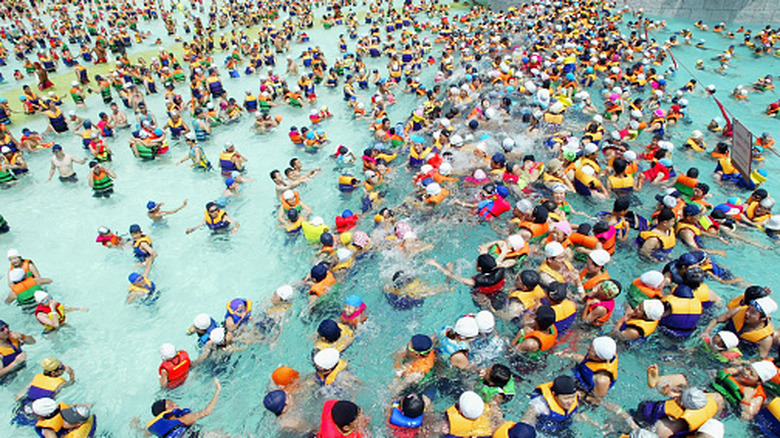
Your trip to a water park is — at least partially — for socializing. The bigger your group the more fun you may plan on having as one big happy family. One thing you might not know is that crowding together in the water can make it harder for lifeguards to see everyone clearly. Lifeguard u/Fragrant_Mine_177 explained why this is so on Reddit. "Another issue I had is when people would get extremely close together in narrow parts of the water park, making it harder to scan and see everyone."
Because scanning is such a crucial part of effective lifeguarding, anything that obstructs a guard's view can make it harder to spot a hazard or swimmer in distress. One 2020 Australian study, conducted by Life Saving Victoria and Swinburne University, found that higher numbers of swimmers made it harder for lifeguards to quickly detect someone in distress. To help, pools and water parks use capacity limits and other crowd-control measures to reduce overcrowding. These measures help keep swimmer numbers manageable within each lifeguard's surveillance zone, but visitors can still help by avoiding unnecessary crowding in narrow areas. If you're in a narrow area of the water park, this small action can be especially helpful.