
America's National Forests With The Most Uniquely Beautiful Trees
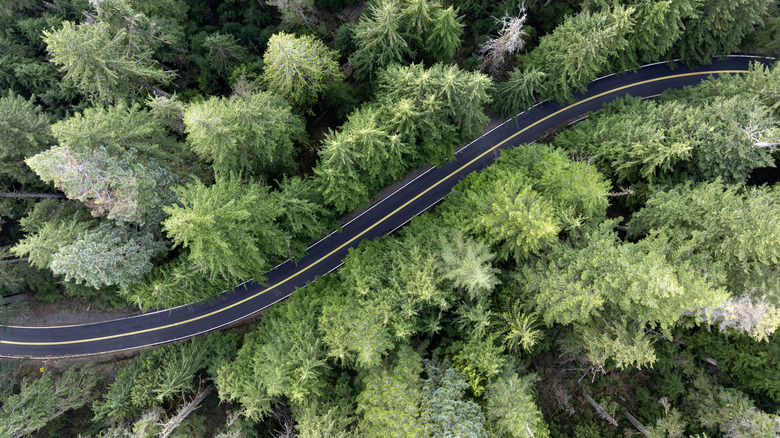
The national forests in the United States span an extraordinary range of landscapes. Desert peaks, swampy coastlines, and even a tropical rainforest all fall under the authority of the U.S. Forest Service. Since its creation in 1905, the system has grown to 154 forests across an astonishing 193 million acres, and many are home to trees of extraordinary beauty. Some of these trees have adapted to their specific environments in remarkable ways, clinging to windswept mountaintops, standing tall in waterlogged swamps, or even enduring months buried under heavy snow. Some are incredibly old, with some even surviving for thousands of years. Others are giants that soar so high you can't see their tops as they blend into the canopy or disappear through mist.
But there's a lot more to beautiful trees than just age and size. The seasons bring their own unique character; Spring is the time of explosive blooms of color, while summer deepens canopies into dense shades of green. In the fall, many forests ignite into scarlet and gold, while needles drop to create soft carpets across forest floors. If you can brave the cold, winter transforms many forests into silent wonderlands of snow-laden branches. Most of America's national forests sit within an easy drive of towns and cities. You can even pitch a tent or park your RV in many of them, and they are fantastic places to stroll, hike, and explore for the day or even a weekend. If you want to pick a forest with the most uniquely beautiful trees, here are 10 of the best that will satisfy your needs.
Sequoia National Forest, California
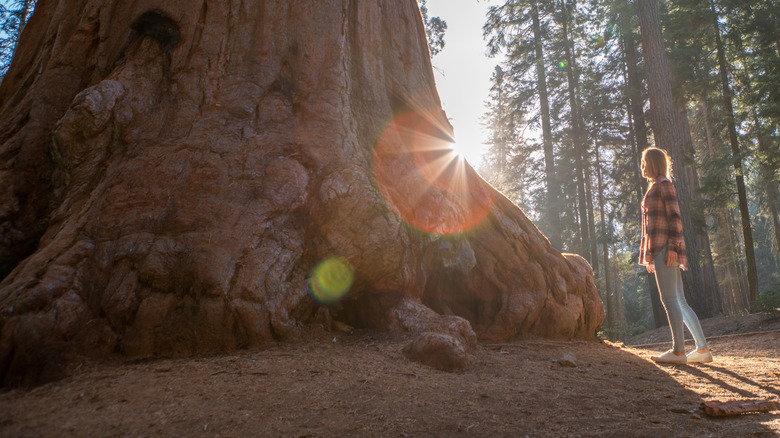
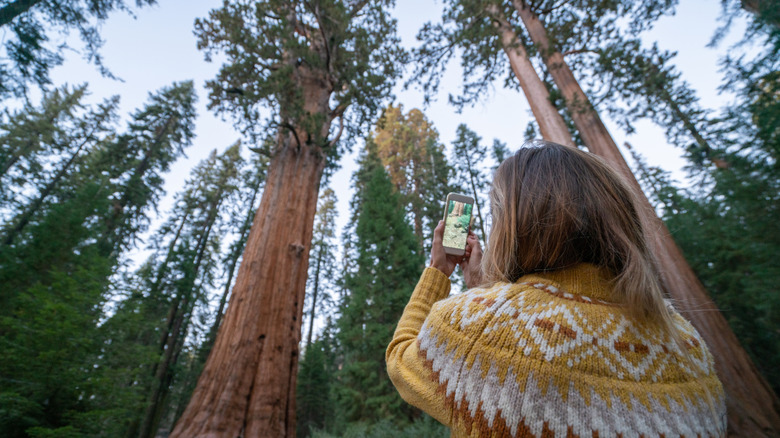
California is the U.S. state with the most national forests, and the most famous is Sequoia National Forest. It is situated in east-central California in the southern Sierra Nevada, and is a sweeping woodland that blankets slopes and valleys across 1.1 million acres. And, of course, it's home to 38 groves of the world's largest tree by volume — the giant sequoia. Their distinctive rust-colored bark feels oddly spongy and tears away in fibrous shreds when disturbed, while rounded, prickly needles and strangely small cones also distinguish them from other conifers.
But it's their colossal forms, standing sentinel like grand monuments, that are the fascination for visitors. You can crane your neck toward the heavens while following the Trail of 100 Giants — the most convenient route to witness them. It's a 1.3-mile wheelchair-accessible paved path with interpretive signage explaining everything you need to know about these amazing trees. Elsewhere in the forest, you'll find the Boole Tree — an absolute behemoth that stands tall as the sixth-largest tree on the planet. Most of the sequoias are protected by the 328,000-acre Giant Sequoia National Monument, which is essentially a second layer of protected land ensuring the trees remain preserved for future generations.
However, they aren't the only botanical standouts you'll find in this forest. You'll also see the world's largest pine species, the sugar pine. Its spectacular cones measure up to 22 inches, the longest pine cones you'll ever see. Jeffrey pines offer another unique sensory experience with their vanilla-scented bark. You'll find both of these species throughout the mid-elevation zones, while at higher elevations you'll see the red fir, one of the world's largest fir trees, with its reddish bark and barrel-shaped cones.
Six Rivers National Forest, California
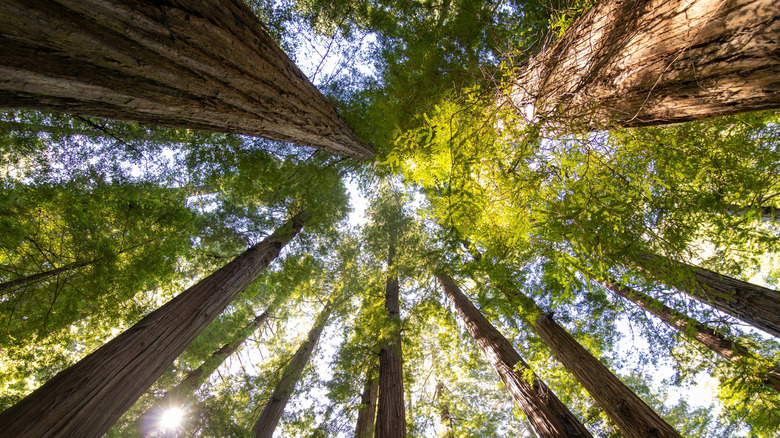
Named after the rivers that flow through its protected wilderness, the Six Rivers National Forest extends for 140 miles from the Oregon border through northwestern California. It's a broad expanse of conifers spread across mountainous terrain that climbs from sea level to just about 7,000 feet. This diverse landscape shelters several distinctly beautiful tree species, including the tallest organism in the world, the coast redwood, as well as the Pacific madrone, bigleaf maple, and Pacific dogwood.
So, if you're visiting the Bigfoot Capital of the World, stop off at the forest to witness some real giants. The cathedral-like groves of redwoods along the coast are simply awe-inducing. Their trunks form huge living columns that can shoot skyward beyond 320 feet. It's the cinnamon-red bark that gives this species its name. It's textured like shredded rope and loaded with protective tannins to ward off invading insects and fungi. This bark grows thick — up to 12 inches — and forms an insulation dense enough to protect the wood underneath whenever fire tears through the forest.
The Pacific madrone also captivates visitors with its peeling bark of cinnamon-colored strips. Underneath is a smooth green skin that darkens over time into a deep crimson. These evergreens grow up to 80 feet and hang fragrant clusters of white urn-shaped flowers that grow into red berries in fall. Another beautiful tree that the sea to the west lends its name to is the Pacific dogwood. They are small at 30 feet, but they show off white flower bracts in spring and leaves that turn a vivid red when autumn arrives. Then there's the bigleaf maple, which grows the largest maple leaves in North America — sorry, Canada. They measure 12 inches across on branches as high as 100 feet.
Inyo National Forest, California
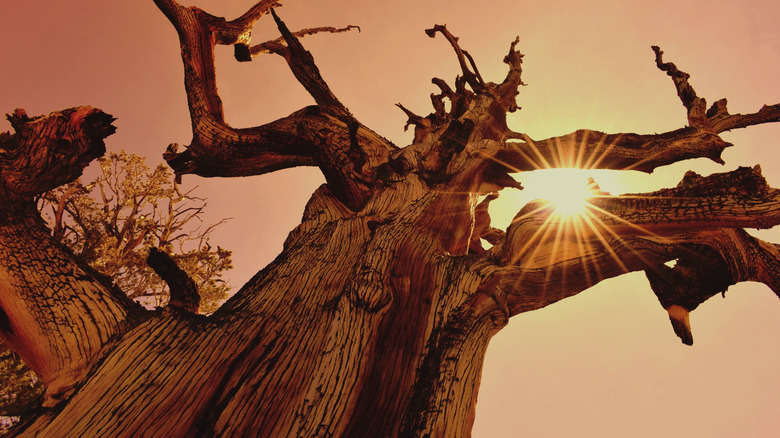
The world's oldest trees hide in a forest high in California's White Mountains. Native Americans named the region "Inyo," which translates to "dwelling of the great spirit." It is a fitting name; with the crisp mountain air and wide-open skies over alpine lakes and soaring peaks, it is indeed a spiritual landscape. The Inyo National Forest rolls across 2 million acres and is home to landmarks like Mount Whitney, Mono Lake, and the Ancient Bristlecone Pine Forest. It's the latter that stands out for its unique and beautiful trees, with a grove of Great Basin bristlecone pines where extreme conditions have sculpted their distinctive, gnarled appearance.
This species can survive for millennia, with the eldest twisted, wind-sculpted specimen in the forest confirmed to be almost 5,000 years old — about the same age as the pyramids of Giza! The exact whereabouts of this tree, named Methuselah, is kept secret by the U.S. Forest Service, which has given the tree a legendary aura, but these ancient conifers are all in a class of their own. Not only do they look incredible and rank among the oldest on the planet, but they have also achieved significance in the field of science.
The cold, dry White Mountain air has long prevented dead bristlecone wood from rotting. In fact, it has preserved much of it for thousands of years. Scientists were able to use this ancient wood to fix errors in their radiocarbon dating methods, which eventually earned the species recognition as "the trees that rewrote history." But they're not the only beautiful trees in the area. Jeffrey and lodgepole pines populate the forest's lower elevations, but these younger species still pale in comparison to the bristlecones.
San Bernardino National Forest, California
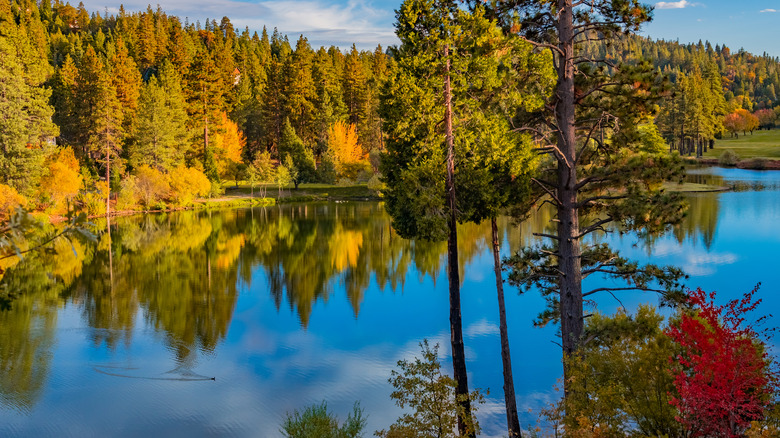
With remnants of ancient footpaths and old mining sites, the San Bernardino National Forest has a historic landscape. It shifts dramatically across Southern California for 1,287 square miles, from scorching desert valleys to alpine summits at 3,500 meters. And, within the San Gorgonio Wilderness, one of the forest's five protected areas, grows the southernmost quaking aspen grove in the state — a rare treasure in the Californian climate.
These deciduous trees, with their slender trunks wrapped in smooth bark of dark lenticels on a milky white canvas, grow up to 82 feet tall. In summer, their glossy green leaves shimmer and sway in the mountain breeze. Come late September, the fall magic begins to unfold. The leaves transform into brilliant swaths of gold and yellow, peaking in the first weeks of October. Several other species join in on this autumnal show, including bigleaf maples, willows, and western sycamores — but it's always the aspens that steal the show.
The forest is home to impressive conifers, too. Among them are the Jeffrey and ponderosa pines with their sweet-smelling bark, sugar pines with their massive cones, and Pacific dogwoods with their spring-blooming snow-white flowers and crimson fall foliage. Elsewhere, the forest's dominant oak species — the black oak with its deeply lobed leaves and the canyon live oak with its evergreen cover — produce an abundance of acorns that nourish wildlife throughout the mountains.
Tongass National Forest, Alaska
At nearly 17 million acres, Tongass is the largest national forest in the United States, as well as the world's largest remaining intact coastal temperate rainforest, and it's a landscape that's dominated by ancient trees. It was the Tongass Clan of the Tlingit people who named the forest. They, the Haida, and the Tsimshian peoples called this place home thousands of years before any of the forest's current trees had even taken root.
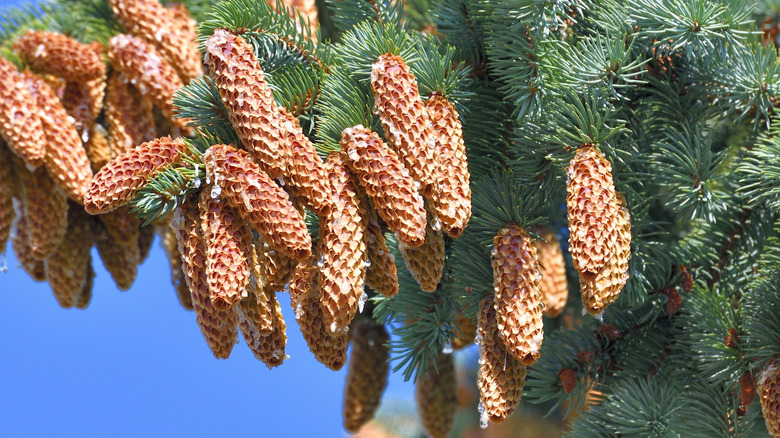
The old growth here is dominated by the Sitka spruce and the western hemlock. The former is the official state tree and can live for up to 700 years, reaching the dizzying heights of 225 feet. Their diameters are generally between 5 and 8 feet, but it's how their needles attach that differentiates them from other conifers. They grow to around an inch long and spiral around the branches. Higher up in the tree, tawny-brown cones droop downward, their thin, delicate scales eventually dropping seeds to the moss and ferns blanketing the forest floor below. When young, Sitka spruces have smooth, silvery-gray bark, but as the centuries pass, it thickens and becomes scaly, darkening to a deep purplish-brown.
The other dominant species in the forest — the western hemlock — is recognizable by its graceful nodding branch tips. Then there are the cedars. You can recognize the red cedar by its cinnamon-red bark that grays with age, while the yellow cedar, also called the Alaska cedar, has ash-gray bark and gets its name from the bright yellow wood underneath. Both have pleasant aromas and braided needles, and together they represent some of the most distinctive trees of the Tongass.
Coconino National Forest, Arizona
With landscapes shifting from desert red rocks up to high alpine tundra, Coconino National Forest is one of America's most diverse. It's a high-altitude forest with lava fields, icy trails, and stunning summit views, and you'll find it just south of the college town of Flagstaff. The San Francisco Peaks rise to 12,633 feet — the highest point in the state and hallowed ground for the local Native people. But it's not the only natural highlight the forest holds in its 1.8 million acres. You'll also find Mormon Lake, the largest in the state, where you'll see bald eagles hunting high above herds of elk.
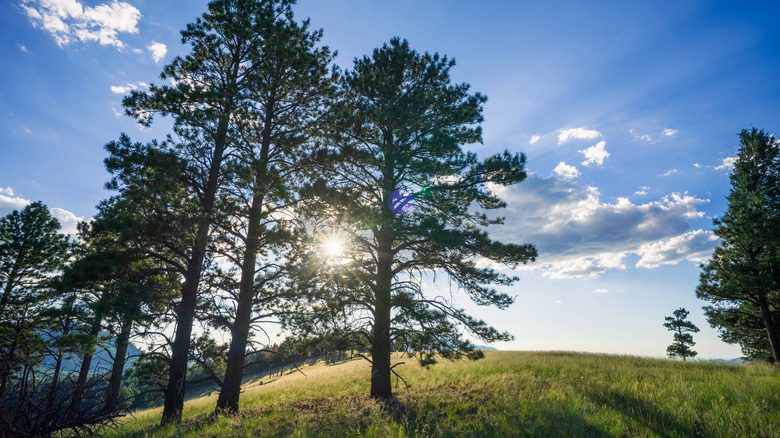
At the forest's higher elevations, you'll find ponderosa pines. You'll notice them from afar with their butterscotch-brown bark. These giants naturally grow scattered across grassland similar to park-like woodlands rather than dense forests. Dappled sunlight reaches the ground, but they still provide shade and feed woodland animals like deer and elk, and the forest's countless bird species. At even higher elevations, quaking aspens transform the mountainsides into golden blankets every fall. In summer, they cover the slopes in green, but what makes this species so unique is that they clone themselves through underground root systems, creating entire groves that share a single genetic identity.
Other trees in the forest include the Douglas fir, which grows in cool, damp zones and provides wildlife habitat. Gambel oaks scattered across the forest also drop their acorns and nourish wildlife, while the aptly named alligator juniper has a bark reminiscent of reptilian scales. In recent decades, white firs have spread throughout the forest, while maples display their brilliant reds and oranges in fall along the Mogollon Rim.
Fishlake National Forest, Utah
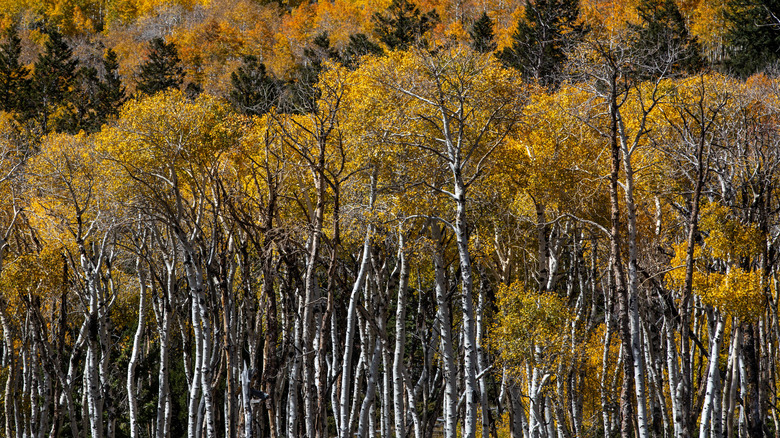
Did you know that aspens clone themselves through networks of underground roots? In Fishlake National Forest, this is taken to the extreme with Pando — the name given to a massive "clonal colony" of quaking aspens that the forest is famous for. What looks like thousands of beautiful aspen trees waving together in golden fall splendor is in fact a single organism spread over 106 acres. The name even comes from the Latin for "I spread." It's a majestic natural marvel with vibrant color, and it's estimated to have lived since the tail end of the last ice age. This makes Pando one of the oldest known living things on our planet. It's also thought to be the heaviest at 13 million pounds. That vast system of underground roots constantly sends up new stems, but the individual trunks only survive for 75 to 100 years before they die, and constant replenishment is key to surviving for millennia.
However, Pando is in crisis. Thanks to hunters killing off predators that once controlled deer populations, mule deer and cattle now devour new shoots faster than the regeneration process can handle. This means that there are just a few younger stems remaining. Pando now consists predominantly of elderly trees, but restoration projects are underway, and conservationists have erected fencing to protect this grove from grazing animals. So if you come here to view the golden stems that are affectionately known as the "Trembling Giant," make sure to close the gate on your way in and out.
Pisgah National Forest, North Carolina
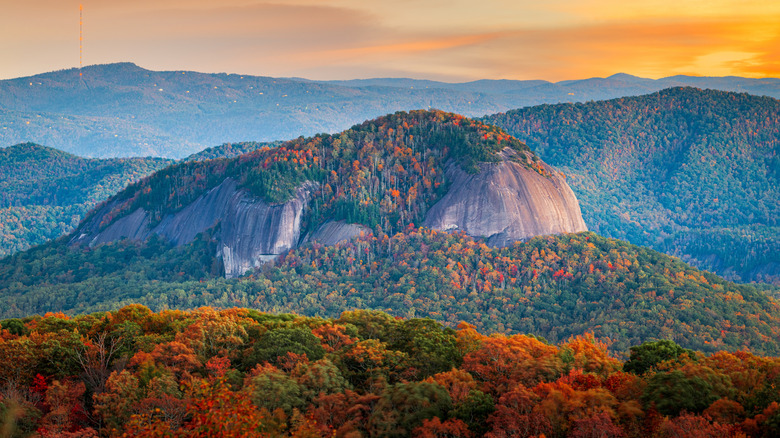
Pisgah National Forest is comparatively small at half a million acres, but it's a place where peaks rise above cascading waterfalls and thick hardwood slopes. It's a place with Appalachian views just like the Great Smoky Mountains, but without the crowds. Eastern white pines tower above in certain areas, with their dramatic silhouettes standing out against the ever-shifting mountain skies. Fraser firs also grow at these higher elevations, with their distinctive pyramid shape and silver-green needles. This is the most popular fir species used as Christmas trees in North Carolina. The red spruce also grows up there, surviving for centuries in the harsh alpine climate.
Down below, the American sycamore grows along streams and rivers, its peeling bark revealing mottled patterns of white, tan, and gray, like a camouflaged soldier. Come spring, the tulip poplars burst into the stunning bright yellow-green blooms that give the trees their name, while their enormous leaves provide plenty of shade for the animals below. Sourwood trees produce white bell-shaped flowers, and their sweet smell is irresistible for bees and butterflies, while chestnut oaks provide the acorns that countless animals in the forest depend on. By fall, the slopes are ablaze with radiant red maples that paint the landscape in a vivid scarlet, making it the perfect time to come for a hike or a woodland stroll.
Ocala National Forest, Florida
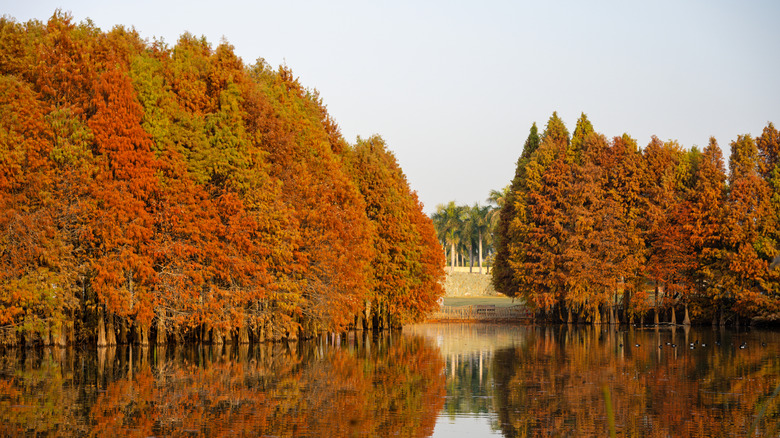
North of the city of Orlando is the Ocala National Forest, the most southerly forest in the continental United States. It's an underrated national forest of endless recreation and was one of the earliest protected woodland areas in that part of the country. At 383,000 acres, it doesn't come close to being America's biggest, but it does contain the largest unbroken stretch of sand pine scrubland on the planet. They fill it by the thousands, but you won't find anything particularly majestic there. These trees twist and branch unpredictably in gnarled shapes, though some people do appreciate their rugged, wind-shaped character.
Sand live oaks also pepper the scrubland. They are small evergreens with thick leaves that curl inward like ladles. In the swamps, the iconic bald cypress, with its knobby "knees," an instant identifier, dominates many of the forest's wettest areas. In the fall, their brilliant orange needles rain down and carpet the ground or float in the water before sinking. But it's the tall, elegant longleaf pine that is most iconic to Florida. They can live for centuries, with some specimens in the forest having survived for around 450 years. Their needles grow longer than any other pine species — sometimes reaching as much as a foot — and their massive cones can measure 6 to 8 inches in length.
Bonus: El Yunque National Forest, Puerto Rico
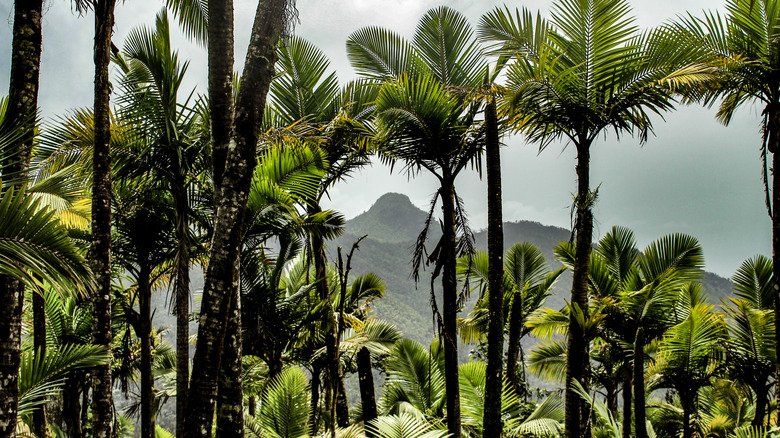
The only tropical rainforest in the U.S. National Forest system is in Puerto Rico. El Yunque draws in around 600,000 visitors every year and gives Americans the chance to experience a Costa Rica-like vacation without leaving U.S. soil. At just 28,000 acres, it's the smallest forest on this list, but there are dozens of excellent hiking trails that wind their way through the island's eastern mountains. Some lead to waterfalls where you can swim in natural pools, while others climb up to dwarf forests where clouds and winds have stunted tree growth.
These tropical wilds hum with the gentle whistles of the iconic coquí frog, and you might spot rare birds like the endangered Puerto Rican parrot. It's also a chance to experience ecosystems that are found nowhere else in the U.S. National Forest System. The Luquillo Mountains' steep slopes create multiple of them, from steamy lowland jungles to cloud-shrouded peaks — and despite its compact size, El Yunque is home to some extraordinary biodiversity, with over 240 tree species, 23 of which are endemic to the island.
Tabonuco trees dominate the mature rainforest like towering monarchs. They can push past 100 feet into the canopy, where their sprawling crowns claim a third of the territory. They provide food for the island's endangered parrot, which feeds on its large seeds. Along the steep mountainsides, slender sierra palms thrust their silver trunks skyward, while down in the lower forests, yagrumo trees will catch your eye — especially when the wind picks up. At this time, their enormous hand-shaped leaves flip to reveal silver undersides, and many locals even use this distant display to predict if a storm is on its way.
Methodology
We looked to reputable and authoritative sources for each forest, primarily U.S. Forest Service pages, conservation organizations, tourism boards, scientific documents, and species checklists, to identify unique and beautiful tree species in each forest. It's impossible to include everything distinctive and unique, but the trees and forests aren't going anywhere soon — so don't just read about them; pack your hiking boots and go enjoy them.