
10 Unwritten Rules You Should Know Before Visiting Canada

A visit to Canada can take many different forms. There are scenic riverside parks blessed with beaches, camping, and trails to explore, excursions to the far north in search of wildlife, aurora borealis, and a seemingly endless number of ski resorts filled with laid-back vibes and mountain views. Canada is a place of city breaks, camping trips, and unique adventures. And while it is easy to think of the Great White North as a wintery extension of the North American continent, it's its own place; fiercely independent, proud, and in possession of a whole slew of idiosyncrasies, cultural taboos, and hidden rules. Navigating them takes practice.
Some differences from the U.S. are obvious. Canada has a distinct political system, it uses a different currency, and the accent — which, to many Europeans, sounds indistinguishable from their neighbors to the south — is, upon closer inspection, markedly unique. Still, the melting pot metaphor of America is, in Canada, an official policy of multiculturalism, which from the ground level appears to amount to pretty much the same thing. Close to the border, U.S. dollars are traded freely, the weather is quintessentially North American, and culture in the form of music, film, and literature passes freely across the national boundaries.
What is less obvious are the subtle differences between Canadian culture and the outside world. Canada likes to define itself by what it isn't. The quietude of the Canadian people is a deliberate choice that has its origins in shared history and a sense of collective exclusivity that is rarely found elsewhere. Years spent living in Ontario helped navigate this guide to Canadian life and culture, and that, with the aid of a little research thrown in for good measure, helped create something of a definitive guide.
Give personal space

To scientists, the concept of personal space is just as much about neuroscience as it is about cultural norms. It is, after all, a universal truth that some people are more comfortable in their skin than others. There are people who give out hugs at a drop of a hat, and then there are those who cringe at the notion. You can find individuals who are more than happy to scrunch up on a sofa to make room for one more person, whilst also meeting those who would rather stand in the corner than brush elbows with a stranger. Throw into the mix a few cultural biases and national quirks, and judging proper distance can easily turn into a social quagmire. Case in point: Anyone who has spent time in the Austrian Alps searching for Italian vibes without the crowds has probably experienced the tactile nature of the local population. Attempting the same level of touchy-feelies in the U.K., on the other hand, is a great way to promote awkward silences. Canadians seem to fall somewhere between those two extremes.
How close is too close is a matter of personal choice, but as far as most Canadians are concerned, keeping an arm's length between each other falls slap bang in the middle of their comfort zone. Once noted, it's hard not to see these two-to-three-foot gaps everywhere you look, especially at parties, when queuing up for food, or traveling on public transport — whenever possible. Such ideology extends to touching. Yes, close friends and relatives might be prone to offering each other bear hugs when greeting one another, but for everyone else, the non-tactile approach is the norm.
Listen and learn to love small talk

Here's the thing. Canadians are friendly people and are quick to strike up conversations with complete strangers. They love small talk, they love to talk about the weather, and they are always happy to lend a helping hand. What they don't love is sharing intimate details right from the get-go. Such an attitude makes a whole lot of sense. Any nation that prides itself on its ability to keep physical proximity to a minimum almost certainly maintains a similar policy when it comes to sharing private details. Psychologically, small talk allows individuals to meet on neutral ground, and size one another up without dipping into areas of potential conflict or controversy.
Indeed, when trying to make a connection with a Canadian, it's best to bear in mind that small talk is an integral part of the getting-to know-you phase. Yes, the country is filled with friendly, prairie cities, stunning vistas, and locals willing to lend a hand to wandering tourists, but they simply have their own way of doing things. By keeping your ears open and watching for pointed social cues, you're liable to have a better time of your trip.
On that note, an important part of small talk is also listening well so you can share and respond, which may not come naturally to everyone. It's not always a simple case of failing to take in the details of any given conversation. After all, who hasn't let their mind wander off from time to time? It's more that when it comes down to one side being more willing to share than the other, there is a risk that the entire exchange becomes a little too one-sided.
Yes and no don't always mean what you think

Speaking of social cues, even simple terms like yes and no can have different meanings in various places. Australians quite famously often use both words in conjunction, forming a "yes, no," addendum to sentences that can sound confusing to those unfamiliar with the concept. Linguistically, such a phenomenon is known as a discourse marker, and when it comes to the yes-no dichotomy, it's one Canadians share as well.
A discourse marker is a word used to keep the flow of discussion moving in its intended direction. The word "anyway," for example, might be used to let someone know that the conversation needs to come to a fairly rapid conclusion. "Okay," on the other hand, is often used as a way of indicating to someone that the discourse is going well, that you have been listening, and that both parties agree with one another. The Australian use of yes and no in conjunction with one another is something of a contextual mystery, but where Canadians are concerned, things are a little bit more straightforward.
When Canadians respond to a query with the term "yeah, no," they simply mean "no." Such a response to a question asking whether you are on the right platform for a train, for example, would mean that you most definitely are not. If, on the other hand, those words are flipped around to a "no-yeah" configuration, the meaning becomes wholly positive in nature. "No, yeah, this is the right platform," for instance. Lastly, the phrase "no, yeah for sure" is a strong indication of agreement that loosely translates as "absolutely." Helpfully, in each case, it is the last word in the chain that indicates its true meaning; it's probably unintentional, but it is a useful piece of information to grab hold of nonetheless.
Respect wildlife, even when snapping for Instagram
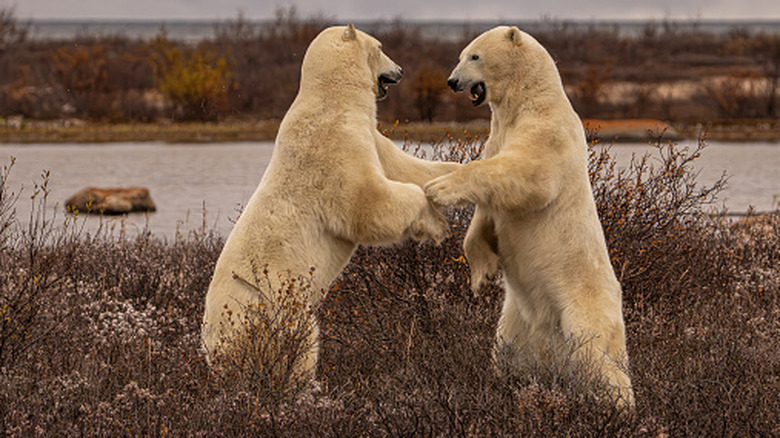
Canada is famous for its wilderness adventures. Canada is also home to multiple categories of animals that, while undeniably magnificent, nevertheless pose a legitimate danger to life. Adopting a cavalier approach to their presence is one of the best ways to ruin an otherwise tranquil vacation. The sheer number of bears of various hues roaming freely across the country immediately springs to mind. In addition, moose, wolves, boars, and a whole host of aquatic life and other large animals also call Canada's vast expanse home. Pro-tip: They are, for the most part, far less interested in posing for a photo opportunity than you might think.
Whether you are spending some time in a Canadian National Park filled with roaming bison, hiking trails, and camping spots, or just spending a little time in the great outdoors, it pays to be cautious. Trail etiquette is important to Canadians. Fire bans should be adhered to religiously, and bear-safe food storage protocols are as much about collective security as it is about your personal sense of responsibility. And then there are the geese. To us humans, the geese seem to think of themselves as Canada's very own air force — but keep your distance, seriously. Sure, they are crazy cute, but can also be a bit aggressive if you're not careful.
Holding the door open is a reflex action

Navigating your way through polite society is one of those things we learn as children, but adding an international aspect can throw a wrench into the works. In Thailand, for example, it is taboo to touch somebody's head. In Mongolia, indoor whistling is forbidden. The Japanese think service tips are rude, and in Mozambique, if someone offers you some food, you had best at least taste it. Canada has its own set of rules, of course, and being nice seems to be one of them. Their propensity to hold doors open for complete strangers is another.
Canada, like much of North America, was historically entwined with the geopolitical eddies of European culture. The United States, rather famously, severed ties with Great Britain in 1776, but Canada took a more leisurely approach to independence. Self-rule arrived in 1867, autonomy in 1931, and the Canada Act of 1982 ended British involvement in Canadian affairs for good. This slow divorce allowed Canada to adopt their own way of doing things, but one decidedly English trait seems to have resisted the tides of cultural drift. Canadians, like their British cousins, are polite to a fault.
In Canada, holding the door open for another person is considered a matter of simple courtesy. The mechanics of it all however are not as easy to define as you might think. There is an unwritten rule of proximity at play here; you certainly don't have to wait for someone across the street to arrive before letting a door close behind you. Holding it and allowing someone to enter or exit a building before you is also something of a judgment call. Making way for someone who is elderly, laden with bags, or managing a gaggle of young children is considered good form.
Tipping isn't as optional as you might think

When tipping fatigue gets too much, there are places where gratuities are not expected, but sadly, Canada is not one of them. To be clear, tipping is optional up in the Great White North, but said optionality is based on a technical point that does not gel so well with the reality of day-to-day life. So, no, there is no law that compels you to add a service charge to your bill, but yes, you really should leave one anyway because not doing so might be just plain rude.
For those traveling from south of the border, there is little fuss to manage. The tipping culture is more or less identical to that of the United States. In restaurants, tips fall between the 15% and 20% mark. Taxi drivers get a little less than that, and for other services, such as a concierge or hotel bellhop, a small denomination bill usually suffices. As always, common sense plays a part here. Exceptional service might earn a little extra on top of the base, but in cases where things are lacking, you might want to forego a tip altogether.
Apologizing is used as a social lubricant

Trying to discover which nation has the best manners is a tricky proposition. People in Japan are considered famously courteous and their language is practically built from the ground up to show respect to whoever you're with. In China, consideration for your elders is a social etiquette that can almost seem ritualistic to those not informed about the culture. Over in the U.K., it's important to thank people after pretty much each and every interaction. And Canadians? Well, Canadians tend to apologize for everything.
It's important to note that a Canadian apology is not necessarily an admission of wrongdoing. If you bump into a Canadian in the street, they will say sorry. If you come in from the cold, they will apologize for the weather. If you have to wait for a table to be cleaned before being seated, expect a whole host of requests for forgiveness. And, if, for some reason, a Canadian makes some kind of faux pas, such as forgetting or mispronouncing your name, you might think that they wish to throw themselves from the nearest window, considering how remorseful they become.
Exactly why Canadians love to say sorry is hard to pin down. As with the holding of doors, it is in some way related to their past associations with the British. But for the most part, perhaps it stems from the Canadian propensity to prefer diplomacy over conflict. Canadians enjoy quiet lives and have little interest in ruffling the feathers of those they interact with. By saying sorry, they indicate a level of humility that acts as a social lubricant.
Thank people for everything

The keen-eyed may have noticed that the flip side of apologizing for everything is to offer thanks in as prodigious quantities as possible. Verbal signals of gratitude are, of course, used worldwide, but two countries, the U.K. and the Canada, tend to take things to the next level. Indeed, whether you are planning a trip to a storybook village on Canada's Pacific coast, or planning a lakeside escape filled with beaches, mountain views, and stargazing, you'll find more than a few thanks heading your way.
In many corners of the world, appreciation is treated as an acknowledgment of kindness. In Canada, it's more about respecting basic humanity. Yes, the bus driver is being paid to do his job, but no, that does not mean his efforts should go unacknowledged. Serving staff should be thanked for bringing you the food you ordered: A door attendant holding open a door deserves a note of appreciation. It may very well be written into someone's contract to take your coat in a restaurant, but that is no reason to brush their effort aside without comment.
For visitors, it's best to adopt a "when in Rome" attitude to the proceedings. Few Canadians will act aghast at the sight of someone not offering their thanks — they are well-aware of their reputation for niceness — but doing so can help smooth things along. Fortuitously, there are no fixed rules to memorize. It's almost impossible to over-thank in Canada, and, generally speaking, if someone does anything for you whatsoever, throw a thanks their way and you'll be good.
Bragging is frowned upon

Canada has the longest coastline on the planet, it owns about a third of the world's stock of boreal forests, they produce most of the world's maple syrup, and you won't find anywhere else on earth quite so blessed with polar bears. Such lists of impressive details and superlatives can go on and on, but you are unlikely to hear any of them from card-carrying Maple Leaf citizens. Canadians, do not like to brag.
The humility associated with the constant thanks and apologies is at play here also. Canadians are well aware of their reputation as being something of a wallflower; they are not as loud as their neighbors to the south and seem to have little aspiration to become so. Those who take the effort to list their accomplishments in minute detail can come across as brash and perhaps even full of themselves. Canadians are no less proud of their nation than anyone else; it's just that they are quietly confident in their own greatness and do not feel the need to share it with others.
Respect the weather
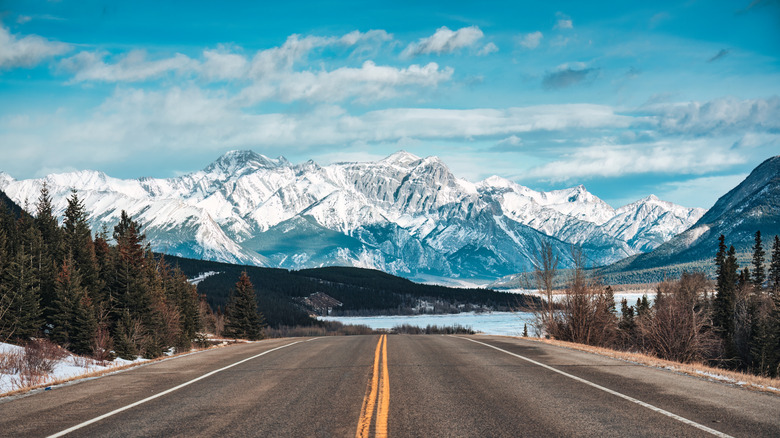
Canada is a vast country, and any discussion about its weather needs to consider its size. Most of the country falls into the category of subarctic: that means long and exceedingly cold winters, short summers, and little in the way of actual rain. Further north, you'll find the smaller but still significant Arctic lands, a place of permafrost, Inuit settlements, polar bears, and adventure holidays. Most Canadians, however — somewhere between 65% and 80% of them — live close to the border with the U.S., and it is there that you will find a temperate strip of land with sporting weather that is familiar to most North Americans.
But Canada is not a frozen wasteland. Coastal areas tend to be cooler, yes, but most major cities experience temperatures that edge towards the mid 80's degrees Fahrenheit during the summer months. Packing for frigid temperatures during those times is a rookie mistake. Still, anyone visiting laid-back mountain towns during the shoulder season or heading to any of the best places to view the Northern Lights would do well to keep an eye on weather warnings.
Because Canadian weather can be deadly, forward planning and even investment in specialist gear may be needed if you are going to attempt to navigate its extremes. The Meteorological Service of Canada is one of those resources most travelers should be aware of. They offer up-to-date forecasts, guides on how to deal with complications such as wind chill or avalanches, as well as a frank assessment of regional hot and cold spots. If they issue a weather alert that covers an area you are planning on visiting, it is always best to heed their advice.
Methodology

Despite growing up in the United Kingdom, this author spent several years living in Ontari, and exploring the absolute best that Canada has to offer, earning a familiarity with Canadian people and culture. Parallels with their British cousins definitely exist, but there is no question that the Canadian ways of doing things are very much their own thing. Experts who have spent some time exploring said differences were consulted during the writing of this article, and where fixed metrics were concerned — such as weather patterns, cultural norms, and population data — time was taken to pull numbers from official and expert sources.