
10 Biggest Things That Surprise Foreigners Visiting America, According To Reddit
Foreigners visiting the U.S. are often surprised as they go about their explorations. As you would expect, the main culprit is culture shock. While perfectly comfortable for us, common, everyday practices and our more extroverted behaviors can shock visitors from places with more reserved sensibilities. But culture is only part of the equation. From our geography to the design of our cities, other aspects of American life can be downright astounding. With Europe having all but one of the world's most walkable cities, our less-pedestrian-friendly streets are a surprise to many visitors from that continent. And the vast size of the U.S. coupled with our willingness to drive long distances can also be astonishing — you don't have to agree if you're gearing up for a long road trip on Route 66, America's most iconic highway!
Not all surprises are bad though. Some overseas visitors go giddy over the most unusual things: if you've never seen a yellow school bus through the eyes of a British visitor, you need to! And who knew some of the trusty establishments we take for granted would go viral for simply doing what they've always done. From the positive to the not-so-praiseworthy, we've compiled a list of many other things that surprise visitors, using Reddit as our main inspiration.
We started with threads that specifically asked about experiences that shocked or surprised foreigners visiting the U.S. To ensure we included the biggest surprises, only comments with hundreds or thousands of upvotes, and numerous responses were considered. Others that gave more context to those with wide consensus were sometimes included. We also consulted additional resources for insight into cultural norms and attitudes that contribute to some of the surprised reactions.
Public restroom toilet doors with gaps
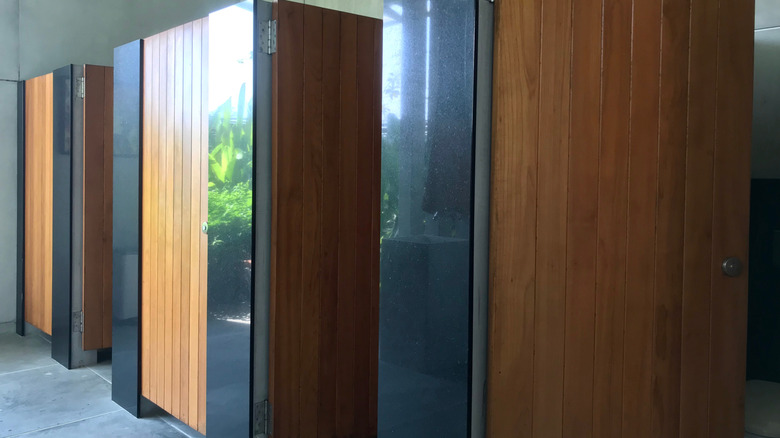
Using a public bathroom is uncomplicated for most Americans. We go in, close the door, do our business, and leave. We rarely think twice about the gaps on the sides or top and bottom of the toilet door. It's not as simple for Europeans visiting the U.S. They find toilet doors that don't provide complete privacy surprising as the doors they're used to back home are completely enclosed. In fact, hundreds of overseas visitors agreed with a Reddit comment calling the less-private doors a big surprise. "The toilets have big gaps either side of the door, and ENORMOUS gaps over the top and bottom of the door," explained a U.K. Redditor. "And the toilet itself is so full of water it looks blocked."
Apparently, unlike Americans, Europeans don't think it's okay to be able to see any part of a person while they're doing a very personal deed. And this is perfectly understandable. It does turn out that there are practical reasons for the gaps. Public toilet doors have gaps for reasons having to do with safety, sanitation, cost-control, and more.
Full-length doors are more expensive for obvious reasons. To keep costs low, corporations prefer to install shorter, cheaper versions. More importantly, the gaps can save the life of a user who's become incapacitated. The spaces below the door make it easy for emergency responders to quickly crawl in and help in these cases. The ease of cleaning they facilitate is another consideration. Sanitation employees can seamlessly push a mop through the gap to clean stalls without having to open each door individually. There is also the issue of airflow. Having gaps helps get fresh air in and odors out — a payoff many of us may think worth it!
Yellow school buses
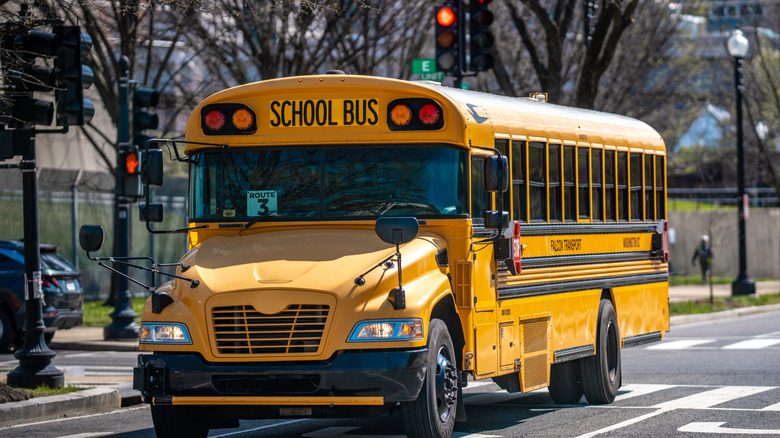
If you're an American, yellow school buses are a common sight, whether or not you have children. For much of the rest of the world, they're highly unusual as kids get to and from school using transportation without the vivid color or via other methods. Countries that have yellow school buses include Canada, parts of India, Malaysia, Vietnam, Italy, and some parts of Eastern Europe. For visitors from most of the other nations, the concept of a brightly colored school bus is a novel idea that's become something of an icon.
The reason for this is unexpected. Many first-time visitors from abroad learn much of what they know about the U.S. from TV shows and Hollywood movies. After seeing the buses in the media for so long, they came to be a wildly iconic symbol of American life. And we all know the shock you can feel when you see a "legendary" object for the first time. If you don't, one Redditor explained in this story: "All my friends were international students from Lebanon, UK, Hungary, etc. One day I was driving us to get food and they all started screaming 'OH SH** LOOK ITS A YELLOW BUS JUST LIKE IN THE MOVIES!' ... they were like 'They really exist?!'"
But perhaps, it's this Redditor who summed it up best: "It's fascinating to see things which you have seen in American films. Like steam coming from manhole covers in New York, yellow school buses ... I knew they were there, but seeing them was remarkable." Movies can turn even the most regular, everyday object into an icon!
Everybody asking 'How are you?'

For many of us, the greeting, "How are you?" is second nature. A waitress comes to our table, and we ask how they are before giving our order. When we go to conduct official business, we offer the same greeting before getting down to serious talk. The three-word pleasantry is simply our way of saying hi. For some foreigners, it's a shocking way to interact with strangers. It's so astonishing that when this Redditor said the most shocking U.S. custom was "That everybody is asking how I am doing, straight after the 'hi,' they got almost 2000 upvotes and a long string of responses in agreement.
Another Redditor went into a more in-depth explanation of why the greeting astounds some foreigners: "I work in a touristic European city and it is always Americans that ask me how I am. Do you guys genuinely care? Most of the time I say 'fine', sometimes I don't respond ... Here we only ask how people are if we know them, because we generally don't care how a stranger feels."
Finland is a perfect example of these differences. That country views small talk negatively, taking to heart the saying, "Silence is gold, talking is silver." In their society, it's highly unusual for strangers to engage in unnecessary talk — that's reserved for close acquaintances and family members. So a friendly greeting to a waitress wouldn't happen easily there. And asking a stranger, "How are you?" Probably not. This isn't to say that all foreign visitors to the U.S. dislike small talk. In fact, some enjoy how friendly we are.
How nice people are

If you're a regular consumer of travel blogs or travel news, you know that American tourists are often viewed unfavorably. From being loud, a common travel habit that brands Americans as rude, to cultural insensitivity, people across the world often perceive Americans in a bad light. Then they visit the U.S. and are amazed that the people they meet are nothing like the stereotypes they've believed. "I found the majority of people I interacted with to be friendly, polite, interested in where I came from when they heard an accent etc. I'm afraid I had allowed myself to believe that all this crap we see online reflects the reality in the US for most people, " raved one Redditor.
Another Redditor had this balanced approach: "Most interactions I've had with Americans have been pleasant ... I have no idea how that stereotype started. There's gonna be bad eggs sure but it's hardly the majority." So, how did the stereotypes begin? Claire Law, a psychotherapist who studies travel behavior, offered this insightful scenario in a USA Today article: "...while assertiveness may be an important quality for Americans, it may be frowned upon in Asia. That doesn't necessarily mean Americans are rude. They're acting as they normally would instead of adapting." And Millie Hart, a British citizen who moved to the U.S., said in a Business Insider piece, "It's really easy when you only ever probably visit here or see America on the news to condemn the whole country."
Overall, it appears that two things are true. In some cases, Americans' natural tendencies may be culturally inappropriate and lead to negative labeling. But media coverage has exaggerated the situation, painting Americans in broad strokes that don't reflect reality. No wonder foreigners are so surprised after their encounters.
The sheer distance between many places
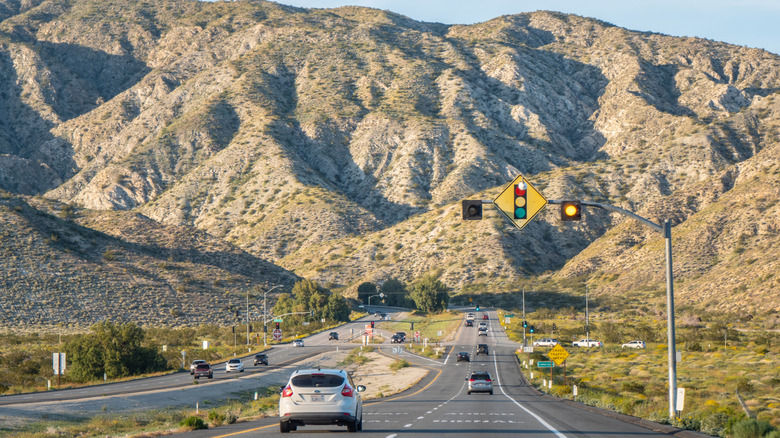
Whether undertaking one of the West Coast's breathtaking road trips or navigating America's most beautiful Great Lakes trail, Americans are used to driving longer distances than nationals of most other countries. According to a study by Frontier Group, Americans drive between 1.98 and 2.23 times more than the French, British, and Germans. We also out-drive Italians, Spaniards, and others. One reason for this is the fact that America was designed to be more car-dependent, with zoning laws intentionally engineered to cut off residential areas from services and amenities. Today, the result is the need to drive further to access these necessities — and comments like this on Reddit: "European here, and the distances are still the craziest part. Americans will casually say something is only three hours away like that's a normal little trip."
Size is another important factor. European nations are smaller when compared to the U.S., and this means everything is much closer. To put that into perspective, the continent's largest country, Russia, is around 1.1 million square miles, while the second largest, Ukraine, is about 233,000 square miles. In comparison, the U.S. is 3.8 million square miles! With this disparity, it isn't strange that Europeans are stupefied at the sheer amount of traveling it takes to get to some places. This story from Reddit may be hilarious, but it's how many travelers from smaller nations think: "I had met a German girl my age on Omegle or similar website ... Essentially they were coming for one week, and wanted to see like DC, NYC, Florida, Chicago, Texas, Grand Canyon, and LA. I felt so bad having to ruin it for her."
Food portions in restaurants
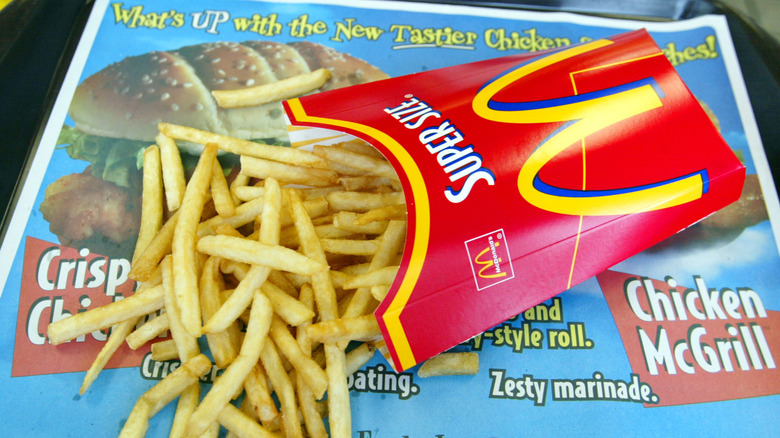
Many foreigners are astonished at food portions in American eateries. And we aren't talking about the supersized fast-food options. Some visitors find the size of regular restaurant meals downright surprising. As one Redditor explained, "You get a TON of food at a restaurant." Another Redditor gave more details: "I had a fried chicken sandwich at an airport fast food spot ... one regular sized sandwich had 3 massive pieces of fried chicken on it. Clearly intended to be eaten by one person in one sitting but waaaaaaaaaay more than I've ever seen on a chicken sandwich in Canada."
Our portion sizes can be double those of other countries. For example, in the U.K., a McDonald's medium drink is 13.5 ounces, while a comparable drink in the U.S. is 21 ounces. And large fries are 5.29 ounces, but in the U.S., they're 10.5 ounces. It turns out that there's a reasonable explanation. Different cultures attach different meanings to meals, and this influences size. For example, Italians stress the quality of ingredients over quantity, so meals are smaller. And in Japan, a concept of eating until 80% percent full is taken so seriously that it has an official name, Hara Hachi.
Contrary to these nations, American meals are larger because of our approximation of bigger with better and economic incentives for eateries to continually offer upgrades, among other factors. There's also the 'leftover' culture to consider. One American defending our portion sizes on Reddit said this: "In the southern USA where I am, it's considered good hospitality to be generous enough to send your guest(or customer) home with food to have later ... if you go over to your parents for dinner your mom sends you home with a plate."
Red Solo cups
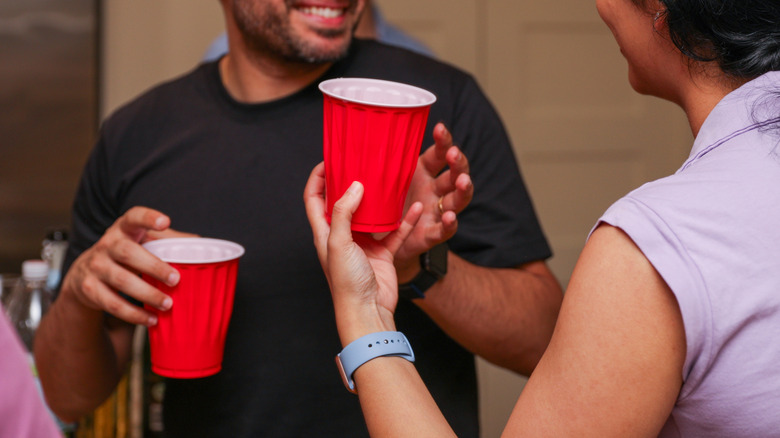
You may be surprised to learn that the basic, red Solo cup you stock for pizza night and casual parties is an icon in other countries. Like yellow school buses, the everyday cups have been elevated into celebrity status because of what they represent to the foreigners who've often seen them on TV shows or the big screen. The plastic drinkware, constantly present in movies about American teenagers and wild parties, has become a symbol of the freedom and wild abandon many associate with U.S. party culture. It made repeat appearances in the cult-classic, coming-of-age movie, "American Pie," and was also featured in films like "Fanboys" and "Neighbors."
While they are sold in some countries as "American party cups," apparently, many don't stock them. In fact, the superstar utensils are so rare that some visitors have been known to take them home as souvenirs! Those who see them in real life for the first time may first have to get over their shock before they even consider buying them. At least, that's the impression Reddit comments like this give: "For me it's the red Solo cups... when I moved to the US and attended my first party I remember being like "wow!! These actually exist?!?" It was magical :)."
Lest you think this is an exaggeration, another Redditor gives this clarification: "Whenever there's a party or BBQ or something in American films, people are drinking out of those cups. Those cups are not seen in other countries. We have disposable cups but they are usually either white or translucent and smaller."
Lack of walkable streets
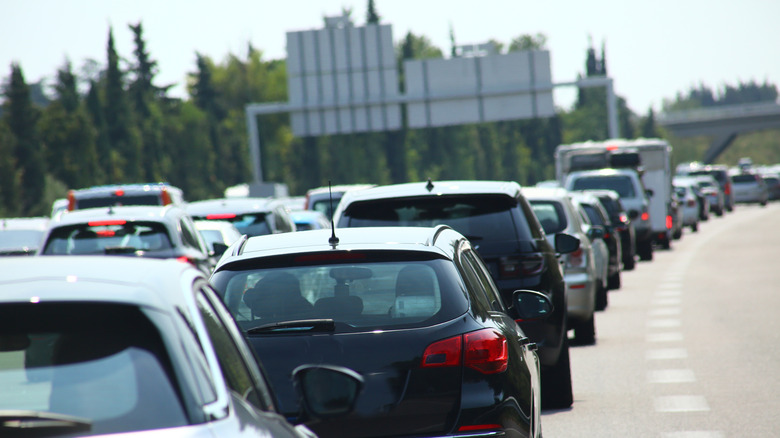
European visitors tend to be particularly shocked at the "pedestrian-unfriendly" design of many U.S. places. And you only have to look at their cities to see why. Whether it's one of Italy's walkable beach towns or Athens, called the most walkable destination on earth in 2026, destinations in many parts of the continent can be reached easily on foot, as they're designed to be highly walkable. Imagine, then, how surprising it is to get to the U.S. and find quite the opposite.
This Redditor used rather strong language to express their shock: "They hate pedestrians with a passion. It's impossible to walk in some places, even when there was a pavement it would just end out of nowhere. When the fella at the crossing is green, cars can still try to run you over." What may be even more surprising is that there is some truth to the statement. In the 1920s, car manufacturers lobbied to get the pedestrian-centric laws of the time changed so people would depend on their products.
Prior to that, laws actually favored pedestrians, with streets designed for walking. Once the rules changed, policies and attitudes towards pedestrians and walkable streets also adapted and came to prefer driving over walking. So when a Redditor says they were surprised by, "The unwalkability of everything," explaining that, "To get to shops from my hotel I had to cross over a major highway if I wanted to walk, so I had to drive everywhere," we can do nothing but sympathize.
Food quality (both good and bad)
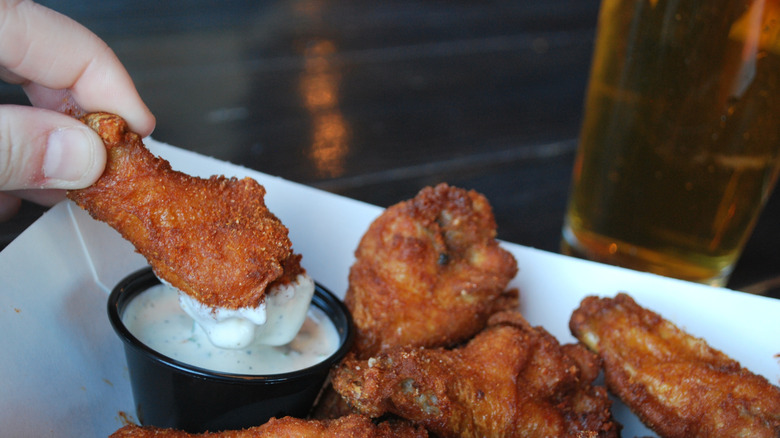
American food often gets a bad rap. When it isn't being slammed for lacking in the fresh fruits and vegetables department, it's being criticized for tasting too salty — or too sugary, take your pick. Our fast- food culture also gets knocked for limited nutritional content and severe impacts on health. Foreigners on Reddit, joined the long list of critics, agreeing that our food is shockingly bad.
"The high price and low quality of fresh products was shocking. And that every 30 mins ... suddenly the fruit and veg isles received a mist of water from hidden sprayers, supposedly to make everything look fresh. Was a real surprise," said one Reddit user. Another Redditor apparently found nothing to their liking, saying: "A lot of fried food. Salt actually isn't too bad, but everything lacks flavour. Cheese, butter, and burnt tasting BBQ sauce. Desserts are way too sweet."
However, not all visitors were disapproving of our food. Overseas visitors, here for the 2026 FIFA World Cup, discovered a few American foods and were shocked at how delicious they were. "Why did no one tell me ranch sauce is like crack? EUROPE, WE NEED RANCH ASAP," said a Swedish soccer fan, and a Scottish visitor expressing his surprise at Buc-ee's Beaver Nuggets proclaimed, "the European mind cannot comprehend how intoxicatingly good these things are," (via QZ). And say what you will about our oversized portions, some things — like free refills on drinks — though astounding, were highly appreciated on Reddit.
Everything being bigger
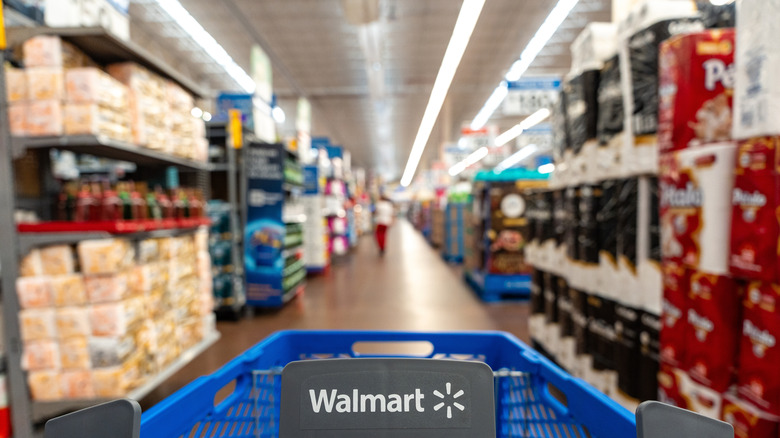
Food servings and driving distances aside, foreigners tend to be shocked at the abundance of personal possessions and everyday places in the U.S. Reactions to some things, like cars, aren't surprising, given that we've always known that many Americans love their cars big due to perceptions of increased safety and larger vehicles being more comfortable to drive on long trips. But some comments show how some things we take for granted can be considered bountiful blessings in other cultures.
"The size of a Farmers Mart in Atlanta – we shopped for the camp weekend with a trolley you'd normally see being used to restock the shelves in a U.K. supermarket. The beer section alone was the size of my local supermarket, said a Reddit user. Another Redditor echoed these sentiments for Walmart! "The size of some of the Walmart's is wild. Could spend hours on end just walking up and down all the aisles looking at all the stuff they sell." Walmart is one of those everyday places that visitors in the U.S. for the World Cup made viral, so Redditors are simply echoing a genuine trend!