
8 Once-Abandoned Train Stations That Have Transformed Into Something Else
There's something about abandoned buildings that brings out the adventurer in some travelers. From discovering previously unknown artifacts in the vacant recesses of older buildings to the unique aesthetic decay they often hold, many love nothing more than exploring a structure left in ruins. These train stations no longer offer the adventure of walking through decomposition or vast empty spaces — for that, you can consider visiting one of the once-thriving Olympic Stadiums that now lie abandoned or one of the U.S.'s abandoned airports. But they hold another kind of charm. Where there used to be decay and emptiness, they've been restored, offering insight into the past. Their previously vacant spaces now fill with activity and human interaction.
Many offer different types of accommodations: Charming bed and breakfasts and elegant hotels that welcome guests into lobbies resembling the old train stations' waiting rooms from the distant past. Others hold museums, many exhibiting railroad history, but some with unique subject matter. One European train station has been refitted into an unusual tropical destination that you wouldn't expect to find on the continent. If you ever find yourself in one of these destinations, consider adding their repurposed train stations to your itinerary.
Taisha Station, Japan (Now Former Taisha Station Preserved Historical Railway Station)
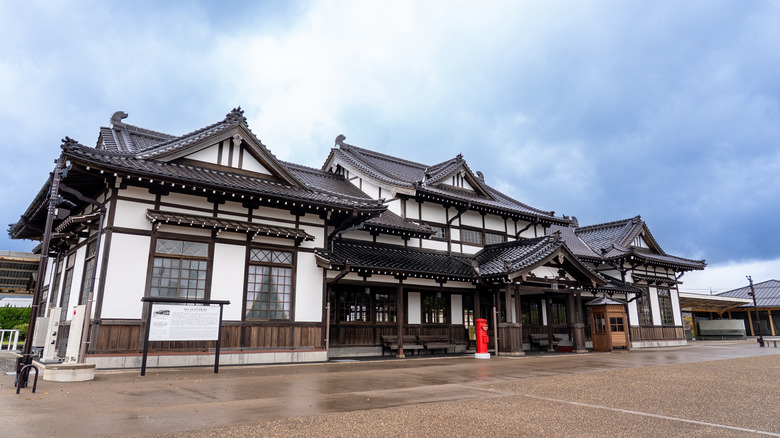
Legend has it that 8 million gods from all over Japan gather at the Izumo Taisha shrine in the city of Izumo in Shimane Prefecture every year. These gods attract masses of visitors seeking spiritual guidance. Historically, Taisha Station, which opened in 1912, was the main way to access the shrine. The station was rebuilt in 1924, and hundreds of thousands of pilgrims continued to use it until 1990, when it was abandoned due to the privatization of the national railways in Japan.
It wasn't until 2004, when the historic building was designated a National Important Cultural Property that its reopening became a possibility. By 2020, the station was being restored to its former elegance and reopened in 2026. Today, gable decorations, rich wood details, and the elegant sloping sides and raised center characteristic of Japan's traditional Kirizuma roofing style have been kept intact — retaining the palatial appearance of the 1924 design. Inside, coffered ceilings, chandeliers, authentic 20th-century furniture, and veneer panel wainscoting preserve the authentic 20th-century Japanese architecture.
Today, visitors still flock to Izumo Taisha in search of supernatural blessings. When that has been accomplished, those who head to the picturesque building find a museum-like attraction with exhibits from Taisha Station's heyday. Mannequins in railway uniform pose next to old ticket machines and other equipment to illustrate what a day traveling through the station may have looked like back then. And the old waiting rooms are open to visitors every day and have been fully preserved. Those interested in period furniture may want to time their visit for days when the VIP room opens, as it retains the formal furnishings the Imperial family used when traveling through the station.
Union Pacific Railroad Depot, U.S.A (Now Asher Adams Hotel)
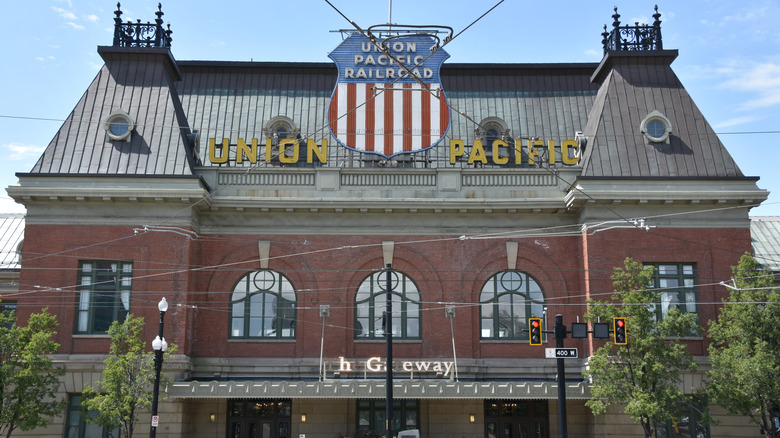
Imagine the western U.S. as a vast, unreachable empty land, without Hollywood, San Francisco, or any of California's many European-looking small towns. That was the state of affairs before Union Pacific began building America's first transcontinental railroad in the 1860s. After they built the railroad system that would birth industries and towns across California and the rest of the West, the railroad company turned to stations. Completed in 1909, the Union Pacific Railroad Depot in Salt Lake City, Utah, was one of its most exceptional buildings.
Decorated with French Renaissance-style embellishments, the roof was its most outstanding feature. Other architectural touches, like windows crafted from stained glass, grand murals, terrazzo floors, arched windows, and skylights, added to its allure. Inside, a central waiting room was topped by a domed ceiling and flanked by the ticket office, baggage rooms, and more. The station was Salt Lake City's railway hub until around 1986, when the popularity of air travel and other factors shuttered many train services. By 1989, all operations ceased, and it became a storage space. Since then, it's been reincarnated in many ways.
Its latest reinvention is Asher Adams Hotel, a spectacular destination that opened in 2024 with many of the original details. Upon entering the lobby, guests are greeted by murals from the 20th-century station on opposite ends of the walls. Stretching between them, the stained glass windows have been meticulously restored, and the flooring and walls also look like they did back then. But modern amenities like a bar and coffee bar have been added. Honoring the building's past, two event venues, Desert Wind and Pioneer, are named for trains and routes, respectively, while many suites are named for figures instrumental to the old station.
Michigan Central Station, U.S.A. (Now Michigan Central Hub)
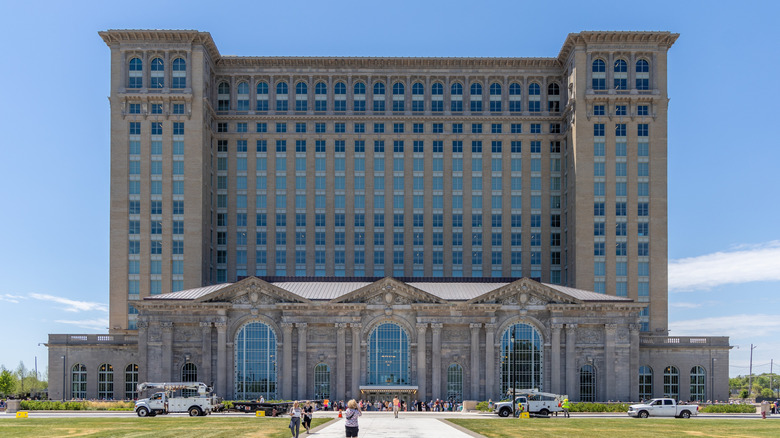
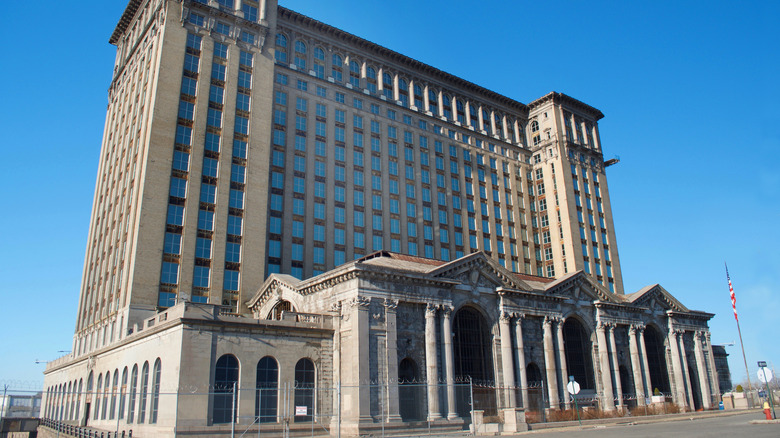
When Michigan Central Station opened in Detroit in 1913, it was the tallest station in the world and hailed as one of the U.S.'s most outstanding depots. Built in the Beaux-Arts style, the masses who used its services were treated to extravagance in every detail. The waiting room, built to resemble a Roman bathhouse, featured marble columns supporting a vaulted ceiling and its bronze chandeliers. A bright concourse was designed to flood with natural sunlight. While waiting for a train, a restaurant, barber shop, shoe-shining stand, and more added convenience. By the 1940s, the station served around 4,000 passengers daily, along with the employees who worked in its office complex.
In the 1950s, cars and public bus services became popular, and former passengers turned to them instead of trains. The streetcar service that had connected passengers to Michigan Central Station also closed, leaving it isolated. Detroit itself underwent massive population change, with many residents moving out, further lessening ridership. By 1988, the station closed and slowly fell into disrepair. But a turnaround came in 2018 when Ford Motor Company bought the building.
Ford's main plan was to transform Michigan Central Station into a hub for technology and electric car manufacturing. Tiles were restored, replacement columns handcrafted, and a 30-acre campus constructed with space for leisure, retail, and offices. In 2024, Michigan Central opened as a center for employees, students, entrepreneurs, and other innovators to work on cutting-edge products. There are plans to add shops, restaurants, and art, so if you visit Detroit in the future, it may be the 'it' destination to see — and you may also want to know the unwritten rules to follow while in the city.
Gare d'Orsay, France (Now the Musee d'Orsay)
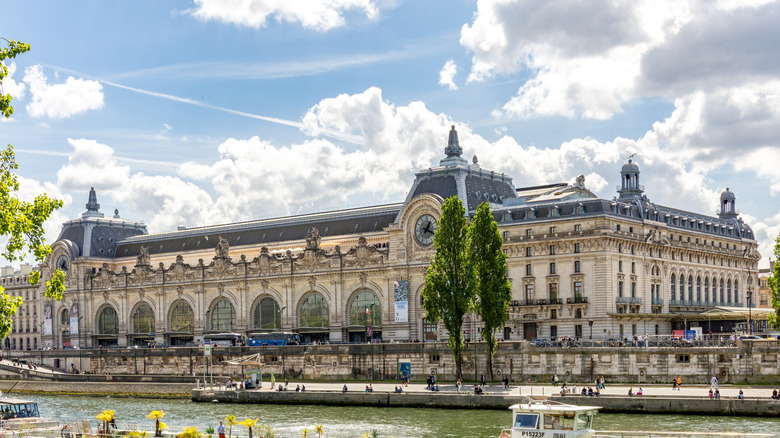
Gare d'Orsay hails back to a time when travel by train was an elegant affair, even by Parisienne standards. Nestled in France's capital city, the historic train station opened its doors in 1900 just in time to transport the many visitors swarming France for the World Fair. Afterward, it continued as the main terminus for the Paris-Orsay line, its Beaux-Arts style, grand staircase, and sparkly glass dome reflecting Paris' place as a global center of culture and art. But by 1929, more efficient stations and the rising popularity of cars decimated passenger numbers, leading the station to close its doors to the public and shift to carrying freight exclusively.
Gare d'Orsay ultimately closed and by 1970 stood totally abandoned and facing demolition. But the public was outraged at the idea of destroying such a beautiful building. Paris also needed a new museum for its large collection of Impressionist works, as they were held in a museum that was far too small for the growing number of visitors wanting to see them. Demolition was halted, and instead, a vast effort to repurpose the building into a museum was undertaken.
The final renovations incited divergent reactions when the station opened as Musée d'Orsay in 1986. Some found the new interior areas either too majestic or overwhelming, in a way that dwarfed the paintings. Others liked how the new layout led visitors through the paintings in an orderly fashion. Today, the museum houses over 18,000 works of art, including contemporary pieces and the world's largest collection of Impressionist and Post-Impressionist paintings, so if you're a fan of Monet and Degas, it's worth a visit. Three restaurants, a bookshop, numerous workshops, and a boutique add to the attractions.
Old Atocha Railway Station, Spain (Now Atocha Station Tropical Garden)
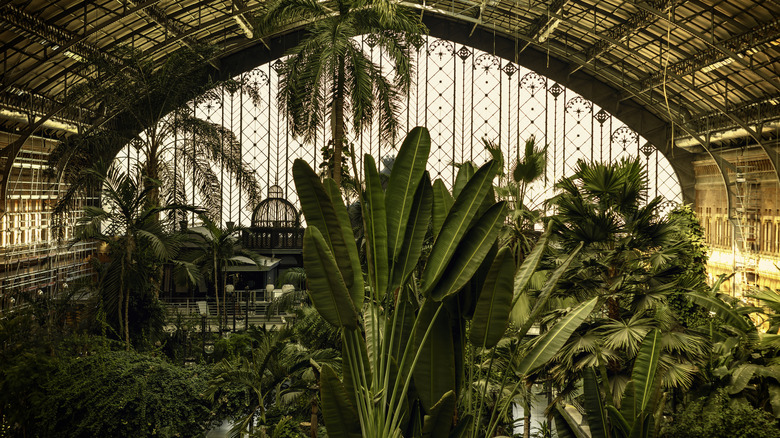
Some renovations make a place bigger, and some make it prettier. Atocha Railway Station has experienced both. It first opened in Madrid's Prado district in 1851, making it the city's oldest train station. Less than 50 years later, in 1892, a fire and the need for a bigger depot led to its rebuilding. The new station was constructed in the style of England's Crystal Palace, a famous structure built for the World Fair in 1851. Thin metal supports held the glass panels in place, creating a striking glass-and-metal aesthetic.
The 1980s saw increased traffic and high-speed rail that the 1892 building couldn't accommodate. And once again, Atocha Station needed to be redesigned. This time, Rafael Moneo, the architect contracted to build a new station, made an innovative suggestion. What if the old building could be repurposed and a new building made? This advice was accepted, and the old building was abandoned as a station, with all its train tracks moved to the new station built next to it.
The old Atocha Station was no longer fit for use as a station, but it was renovated into a pleasing destination. Around 7,000 plants from five continents were brought in to make the Atocha Station Tropical Garden, a destination where bench-dotted paths spiral past palm and mahogany trees from Cuba, bird of paradise flowers from Africa, heliconia flowers from South America, and more. To ensure a tropical feel, the garden maintains water lily ponds and jungle-like temperatures. Today, those who visit or stop at the garden while traveling on the train next door will also find eateries and a memorial to the victims of the 2004 bombings at the train station.
St. Louis Union Station, U.S.A. (Now St. Louis Union Station Hotel, Curio Collection By Hilton)
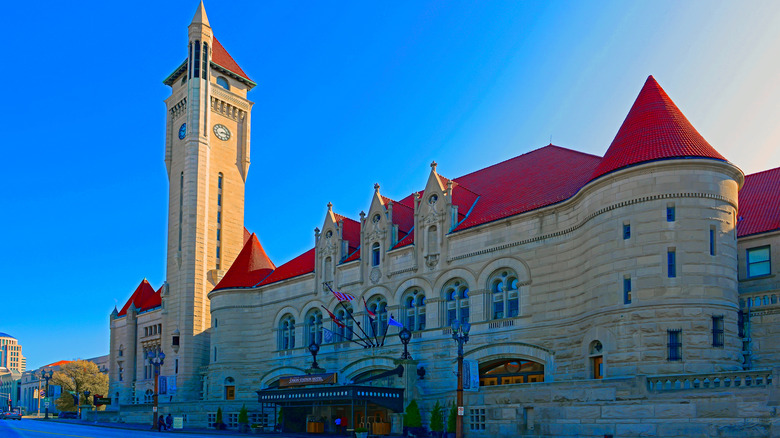
A bevy of beauties clad in black and white uniforms is intertwined with the history of the famous St. Louis Union Station in Missouri. Called the Harvey Girls, the women served in the station's 4,800-square-foot dining room and other restaurants, helping build its reputation for hospitality. With such a large dining room, it's not surprising that the terminal was quite sizable. In fact, it was the world's largest when it opened in 1894.
The station was also distinguished by its architecture. Marble stairs led to Grand Hall, an elaborate second-floor waiting room with two-tiered balconies, stained glass windows, chandeliers, and opulent shades of gold and green on the walls. Passengers who walked east found a ladies' lounge; to the west, dining areas and the 86-room Terminal Hotel. Although 100,000 daily passengers used the station by the 1940s, that number declined as airplanes and cars became more popular, leading to its closure in 1978. After that, apocalyptic scenes for the movie Escape from New York were filmed in its vacant space, but it stood largely abandoned until 1985, when it reopened as a leisure space.
In 2012, Hilton brought a DoubleTree hotel to the station but rebranded it as the St. Louis Union Station Hotel, Curio Collection, in 2016. The lobby greets guests with the grandeur of the old Grand Hall. The gold-leaf flourishes on the walls, stained glass windows, original flooring, and more have been preserved. Keeping with the train station aesthetic, other floors feature railroad themes. In 2020, an aquarium and other attractions were added to the building, making it one of the train stations considered destinations in its own right.
Petworth Railway Station, The U.K. (Now The Old Railway Station)
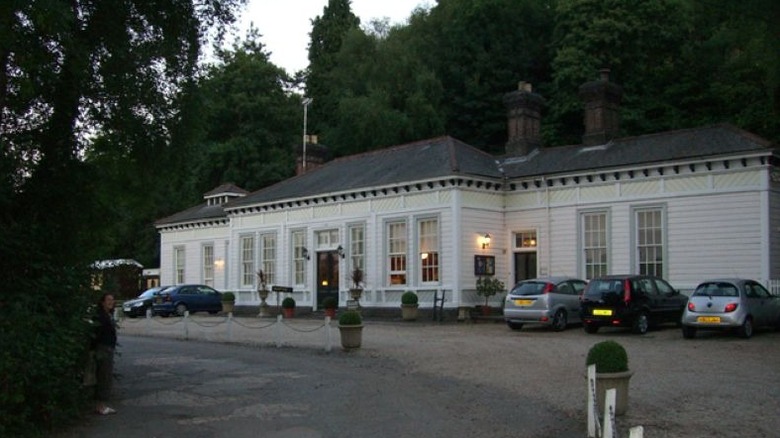
England's West Sussex region is known for its beautiful architecture. It's where drizzly weather hides cities like Chichester, an artsy urban center with a stunning medieval cathedral, historic mansions, and some of the world's best wineries. After Petworth Railway Station's original building was demolished in the 1880s, its replacement opened in 1894, earning it a place among the region's gorgeous structures. Widely regarded as one of Britain's most beautiful train stations, its single-story wooden building was accentuated with canopies, wrought-iron detailing on the roof of the booking hall, and stained-glass windows.
In 1948, Britain nationalized its railways, which led to the demise of less-profitable stations in smaller towns. Petworth Railway Station unfortunately fell into this category and stopped carrying passengers and freight by 1966. It soon deteriorated and was in a state of abandonment until the 1980s, when it was renovated as a bed and breakfast.
The Old Railway Station was the simple name given to the bed and breakfast, in homage to the fact that new owners had kept as many original details as possible. Today's guest lounge is the old waiting room, and just outside it, the old platform is where guests find breakfast being served in the warmer summer months. The station building hosts two guest rooms, and the old ticket office with its original windows is the kitchen. To augment accommodations, Pullman railway carriages have been added, providing two king-sized rooms and six rooms with double beds. One carriage houses a restaurant where afternoon teas and dinners are served. Lunch service is also offered on some days.
Santa Fe Union Station, U.S.A. (Now Galveston Railroad Museum)
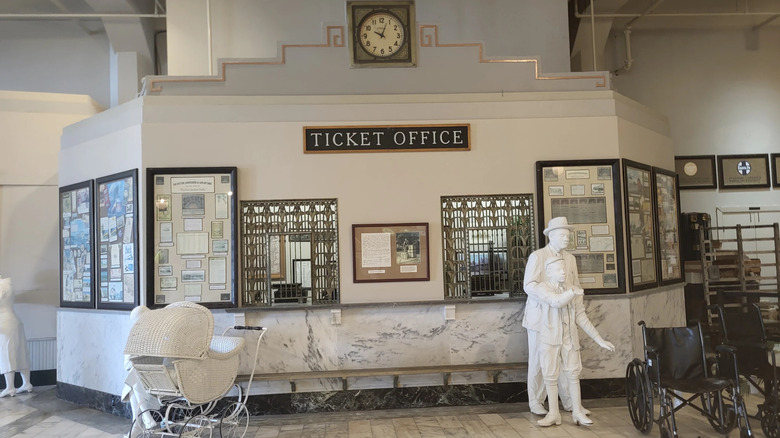
When the Galveston Daily News called Santa Fe Union Station's four-story, red-brick building "one of the most complete and imposing of its kind in the Southwest," in 1897 (via Rosenberg Library Museum), it was probably an accurate description. Built in 1896, the depot replaced a line of smaller stations constructed during the 1870s and was designed to make the best impression on visitors to Galveston, Texas. Around 1914, an office building was erected and connected to the 1896 station by an annex. But in 1931, the part constructed in 1896 was razed, and a new one was built in 1932, with elements of the Art Deco style.
By 1967, the last set of passengers had gone through the station, and it closed its doors. The building then stood in a neglected state and was even set to be demolished. But in 1978, a philanthropic organization, the Moody Foundation, decided to save the historic building from destruction. The station was renovated and renamed the Shearn Moody Plaza. Importantly, it was also decided that railway and station artifacts should be preserved in a museum on the ground floors.
The Galveston Railroad Museum has fulfilled its mandate to preserve railroad history. The 1932 station has been fully restored and is one of the exhibits on show. Displays tracing the history of the railroad in Texas, along with examples of passenger cars, freight cars, and more, are also on exhibit. Train enthusiasts will find historic steam and diesel locomotives, the oldest remaining Ten Wheeler locomotive in Texas, and other old trains. The museum also houses the Southwest's oldest collection of dining china.